DVCA NEWSLETTER REBUTTAL
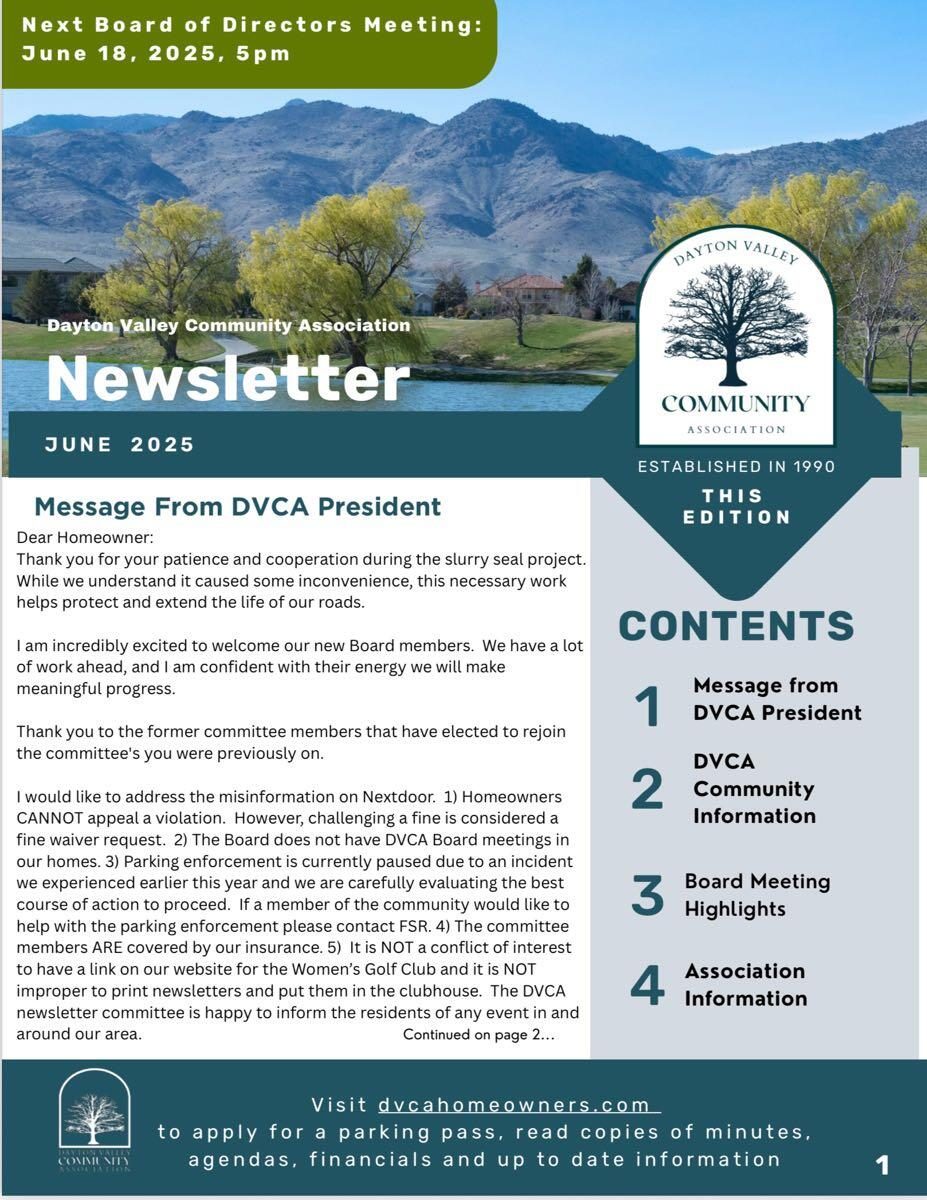
>> 1) Homeowners CANNOT appeal a violation. However, challenging a fine is considered a fine waiver request.
Under NRS 116.31031(2), homeowners are entitled to request a hearing to contest a fine or sanction—commonly referred to as an appeal.
The Board may call it a "fine waiver," but under the law, it's the same process. The applicable provisions are found in NRS 116.31031, specifically Section 2, which governs the notice and hearing procedures required before a fine can be imposed and allows for appeal by the unit owner.
>> 2) The Board does not have DVCA Board meetings in our homes.
The Board does conduct votes outside of the official HOA meetings. Prior to these votes, Board members communicate among themselves, often while at home. While the Board may claim they do not "meet" in private residences, they routinely hold informal gatherings—what they refer to as “get-togethers.”
It’s worth noting that all current Board members are close personal friends of the President and regularly attend social events, including BBQs, at her home.
Under NRS 116.31083(1)(b), if a quorum of the Board (four or more members) is present, any deliberation or decision on Association business must occur at an open meeting, with proper notice and minutes. Even if they label these gatherings as social, the law does not permit voting or decision-making outside a properly noticed, open session.
If a quorum is present, they must refrain from discussing or voting on Association business during these so-called "get-togethers." Anything less violates both the spirit and letter of Nevada law.
>> 3) Parking enforcement is currently paused due to an incident we experienced earlier this year and we are carefully evaluating the best course of action to proceed. If a member of the community would like to help with the parking enforcement please contact FSR.
I was responsible for parking enforcement from 2024-2025. The previous volunteer served in the same role during 2023–2024. Both of us resigned following separate incidents that occurred during our enforcement rounds—incidents that were not covered by the HOA’s legal counsel or its insurance policies.
Under NRS 116.31037, the association is required to indemnify its officers, directors, employees, and agents against liability incurred while acting in good faith and within the scope of their duties. However, that indemnification is not absolute—it depends on whether the action was authorized and whether coverage applies.
In this case, the association’s Directors & Officers (D&O) insurance did not extend coverage to the situation we faced. That left both of us exposed to personal liability, despite acting in service to the community.
Volunteers should be aware: if your enforcement duties aren’t clearly backed by written board authorization, legal counsel, and insurance confirmation, you may be operating outside the scope of coverage.
>> 4) The committee members ARE covered by our insurance.
Committee members may be covered by the Association’s Directors & Officers (D&O) insurance, but only when they are engaged in authorized decision-making activities that fall within the defined scope of their committee’s responsibilities.
However, D&O insurance does not extend to any form of hands-on or physical volunteering. This includes activities such as enforcement rounds, maintenance tasks, or interacting directly with residents in the field. If you are involved in a physical incident—whether it involves a person, an animal, or property—you are personally liable, and the Association’s insurance will not protect you.
If you are confronted or threatened by a homeowner during volunteer work, be advised: the Board will not support your complaint, and legal counsel will not defend you. This is because of a strict legal limitation known as “Board Scope.”
Under NRS 116.3102 and NRS 116.31036, the powers and duties of the Board are narrowly defined. Any action or volunteer activity that falls outside the enumerated responsibilities of the Board or its duly authorized committees is considered unauthorized and excluded from legal and insurance protections.
>> 5) It is NOT a conflict of interest to have a link on our website for the Women's Golf Club and it is NOT improper to print newsletters and put them in the clubhouse. The DVCA newsletter committee is happy to inform the residents of any event in and around our area.
The HOA cannot legally spend funds on anything that does not directly benefit the membership. This is not just a matter of policy—it’s a fiduciary obligation grounded in NRS 116.3102(1)(b), which requires that common expenses be for the maintenance, repair, improvement, or benefit of the common elements or the association’s members.
For example, posting promotional materials—like the Women’s Golf Club flyer—on the official HOA website constitutes the use of Association resources to promote a non-HOA-affiliated group, many of whom are not members. Legal counsel has confirmed that this kind of use is not permitted, as it benefits non-members using member-funded platforms.
This same principle explains why we no longer host Christmas parties. If even one attendee is not a homeowner, then a portion of HOA funds is being spent on non-member entertainment—and that’s a violation of the legal guidance the Association has received.
I didn’t make these rules. Legal did. Our duty is to follow them—even when the result seems inconvenient or unpopular.
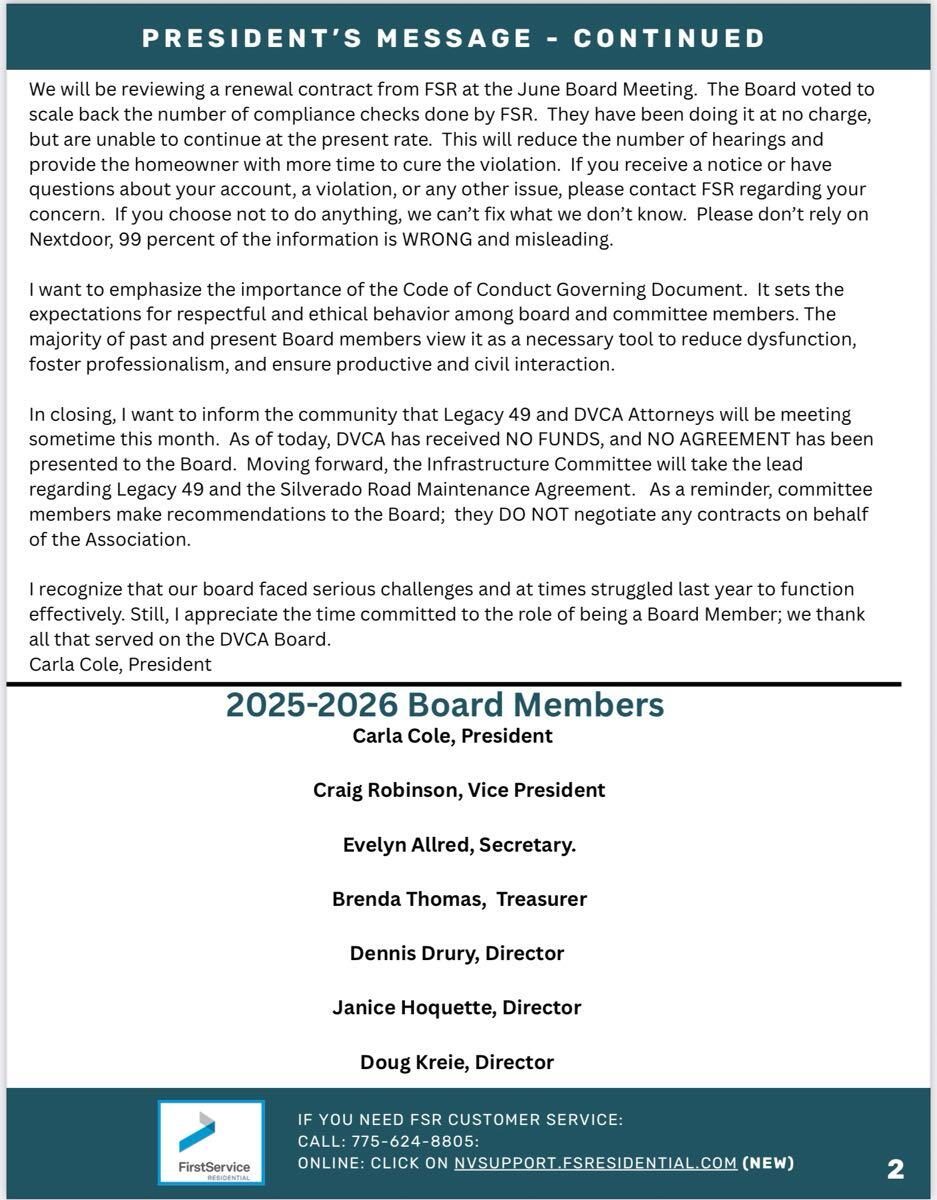
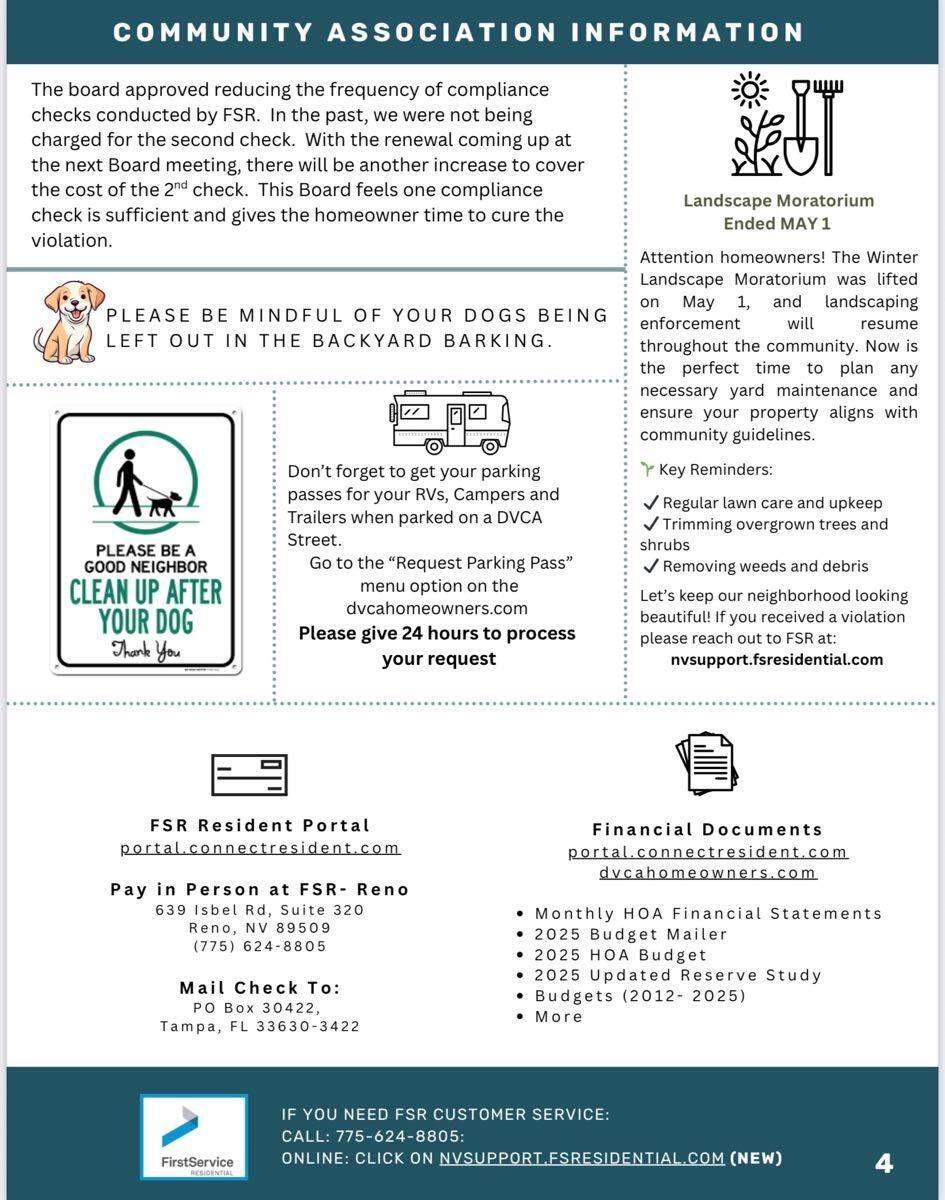
>> We will be reviewing a renewal contract from FSR at the June Board Meeting. The Board voted to scale back the number of compliance checks done by FSR. They have been doing it at no charge, but are unable to continue at the present rate. This will reduce the number of hearings and provide the homeowner with more time to cure the violation. If you receive a notice or have questions about your account, a violation, or any other issue, please contact FSR regarding your concern. If you choose not to do anything, we can't fix what we don't know. Please don't rely on Nextdoor, 99 percent of the information is WRONG and misleading.
Reducing the number of compliance checks does not give anyone more time to correct a violation.
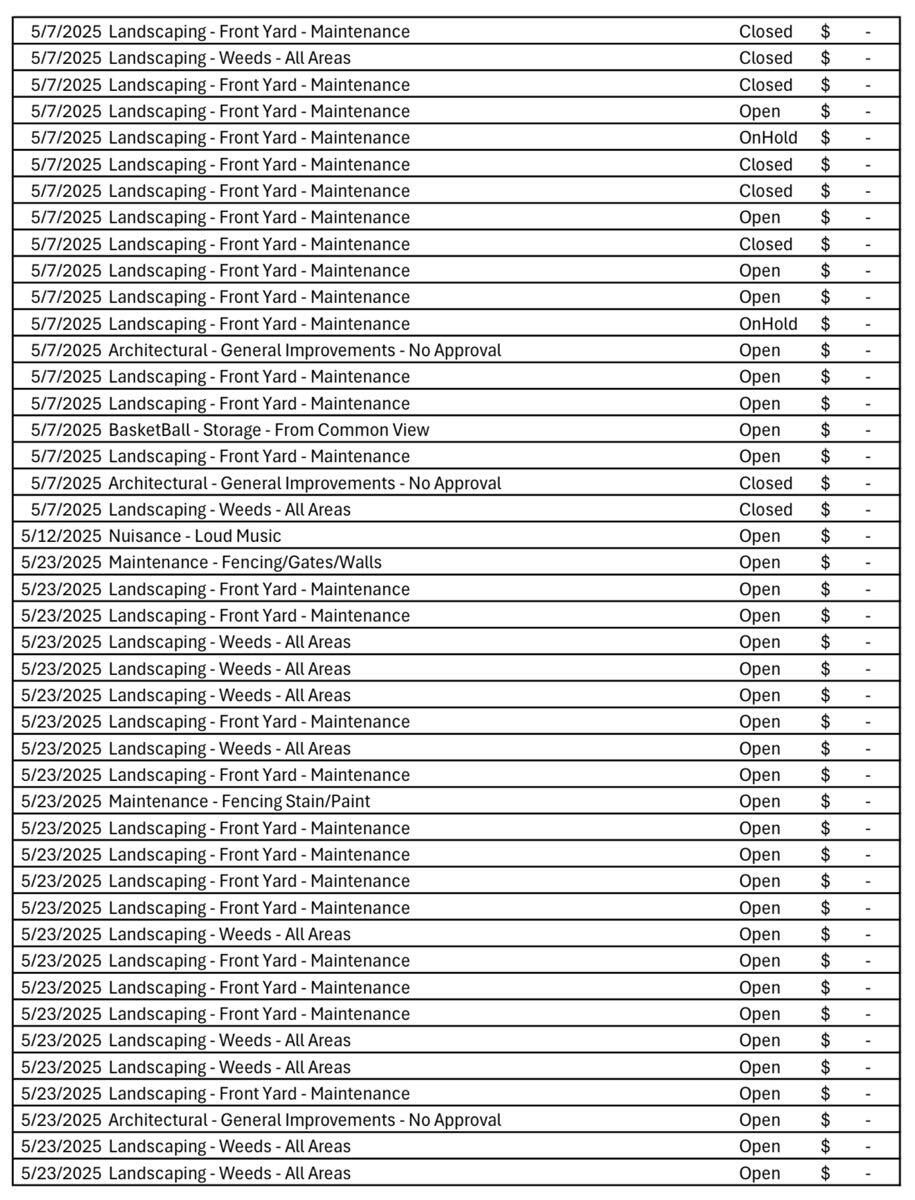
Per standard HOA enforcement procedure, each violation is subject to a two-week "cure" period, followed by a one-week "notification" period. After that, if the issue remains unresolved, the violation is classified as “recurring” and is resubmitted weekly—regardless of how often property management conducts on-site checks.
In other words, the frequency of compliance checks has no impact on your allotted cure time.
In fact, fewer compliance checks can actually work against you. Why? Because property management also documents when a violation has been resolved. If there are fewer checks, a corrected violation may not be recorded in time to prevent resubmission, and your violation may continue to show as active even after it’s been fixed.
Bottom line: less enforcement does not mean more leniency—it means more uncertainty.
>> I want to emphasize the importance of the Code of Conduct It sets the expectations for respectful and ethical behavior among board and committee members. The majority of past and present Board members view it as a necessary tool to reduce dysfunction, foster professionalism, and ensure productive and civil interaction.
This claim is inaccurate.
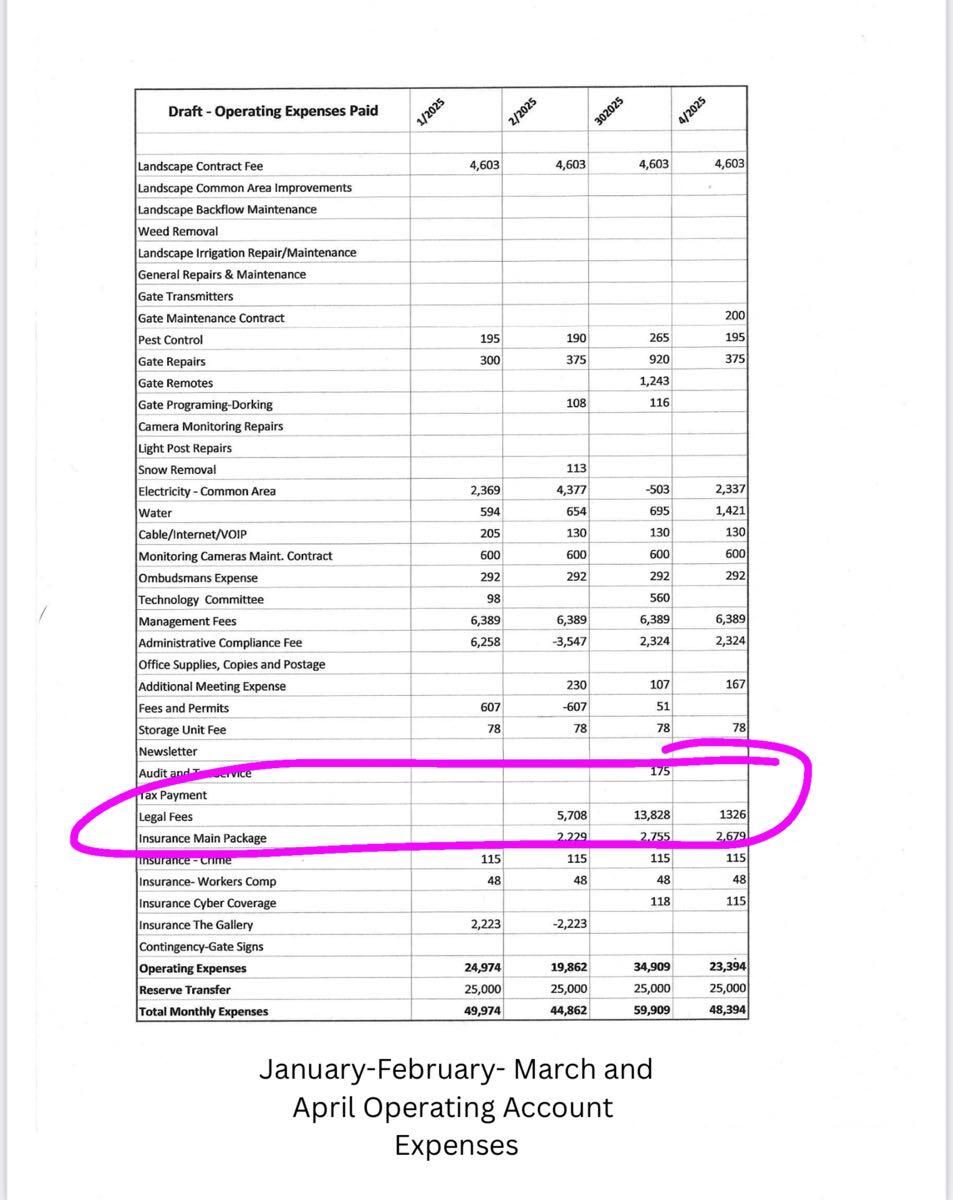
In fact, a majority of past Board members actively fought to have this document removed from use, recognizing the legal and financial risks it presents. Its continued use has already cost the Association—DVCA—tens of thousands of dollars in legal fees.
Moreover, the Nevada Real Estate Division (NRED) has been alerted, and a formal challenge to the legality of the document is likely forthcoming. The board should tread carefully: relying on a disputed policy document may expose the Association to regulatory scrutiny and additional liability.
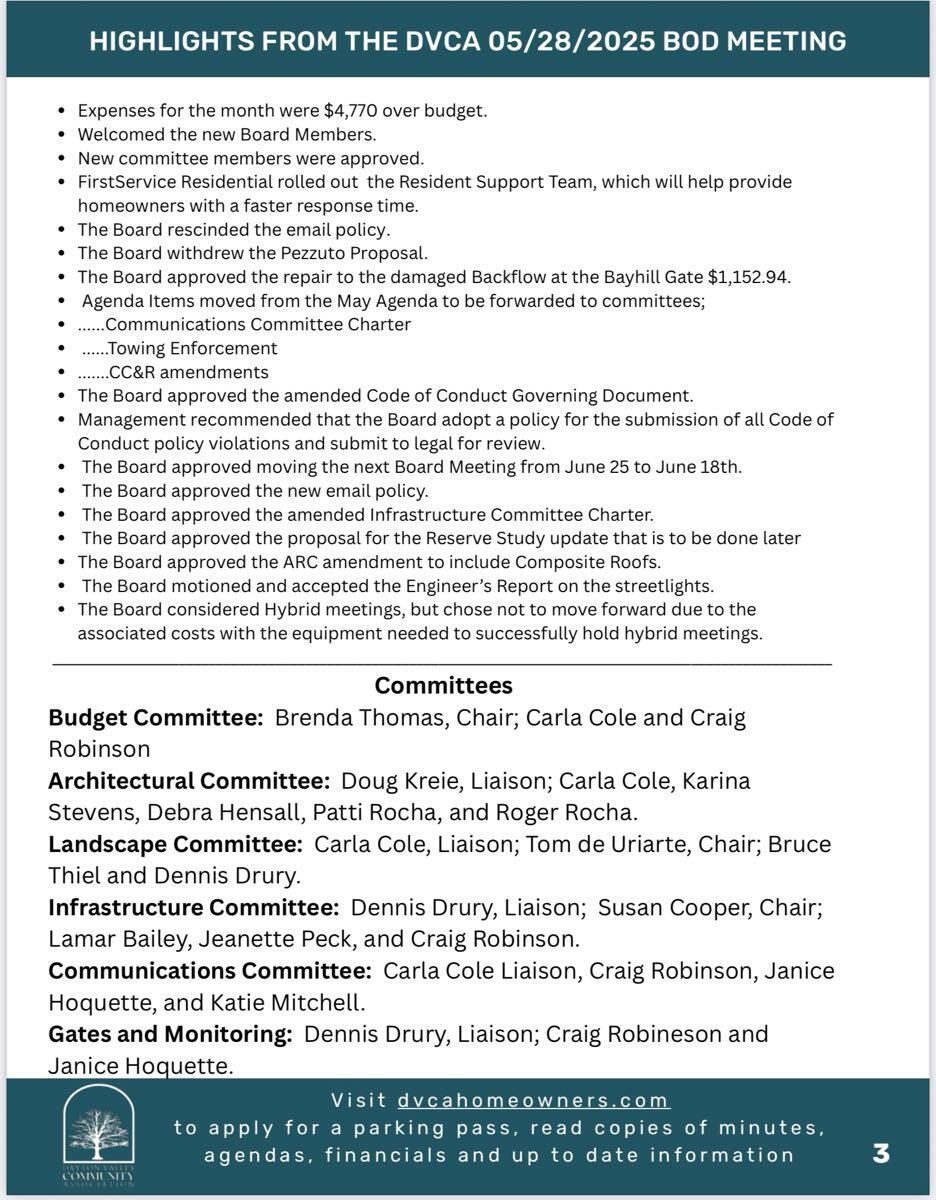
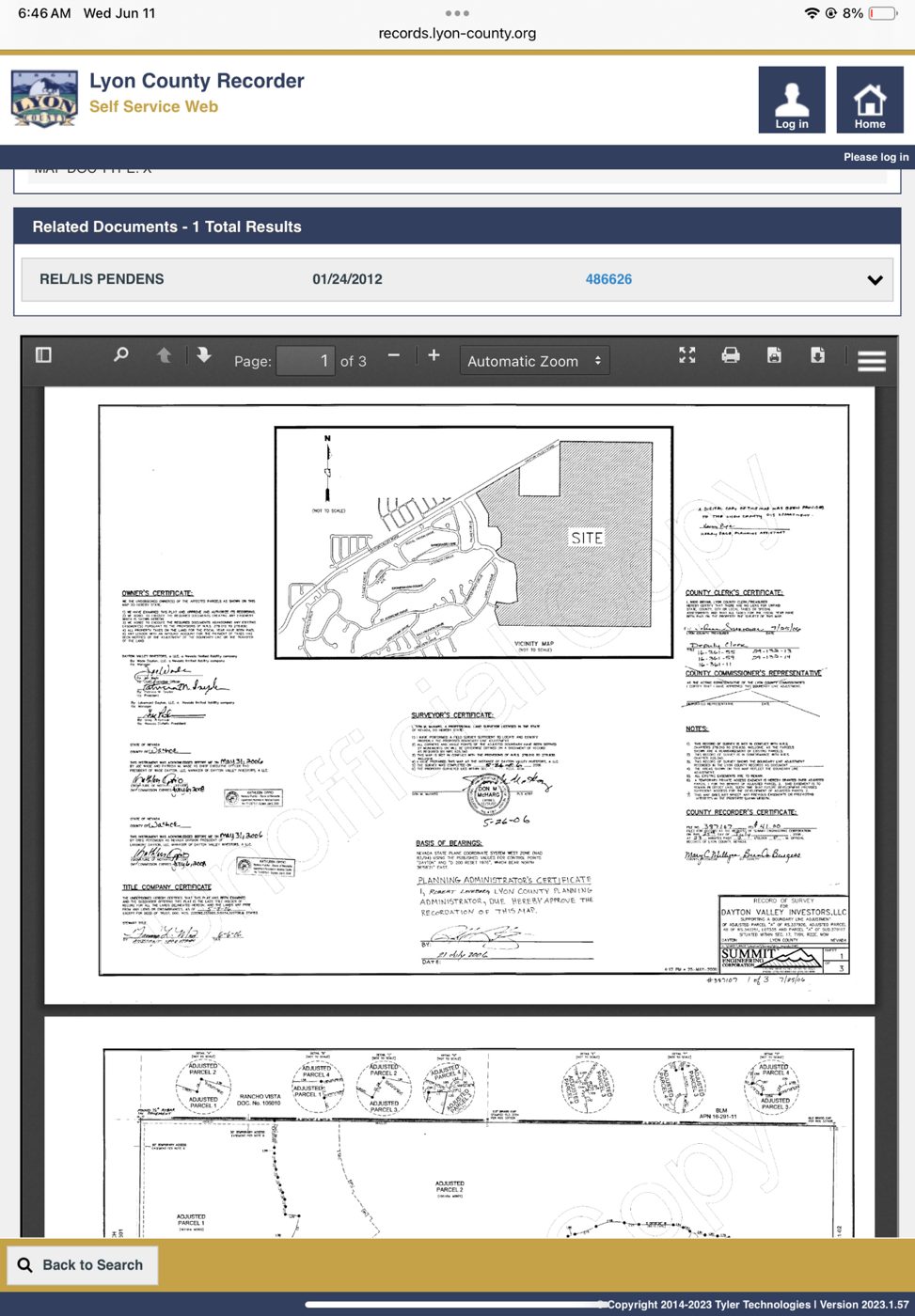
>> In closing, I want to inform the community that Legacy 49 and DVCA Attorneys will be meeting sometime this month. As of today, DVCA has received NO FUNDS, and NO AGREEMENT has been presented to the Board. Moving forward, the Infrastructure Committee will take the lead regarding Legacy 49 and the Silverado Road Maintenance Agreement. As a reminder, committee members make recommendations to the Board; they DO NOT negotiate any contracts on behalf of the Association.
This statement needs a decoder ring and maybe a flowchart.
The Community Outreach Committee was composed of four board members and four homeowners. Because four board members constituted a quorum, those board members could not vote at the committee meetings—at least not officially.
Instead, the four board members recommended to the two board members not on the committee that DVCA support the Legacy 49 project. So let’s do the math: four board members recommended, and two accepted—that’s a majority of the Board voting to support the project, just not all in the same room.
To make it even clearer: the entire Board eventually voted unanimously to support Legacy 49, and a formal letter of recommendation was drafted, edited by committee members, and signed by the entire Board including the President.
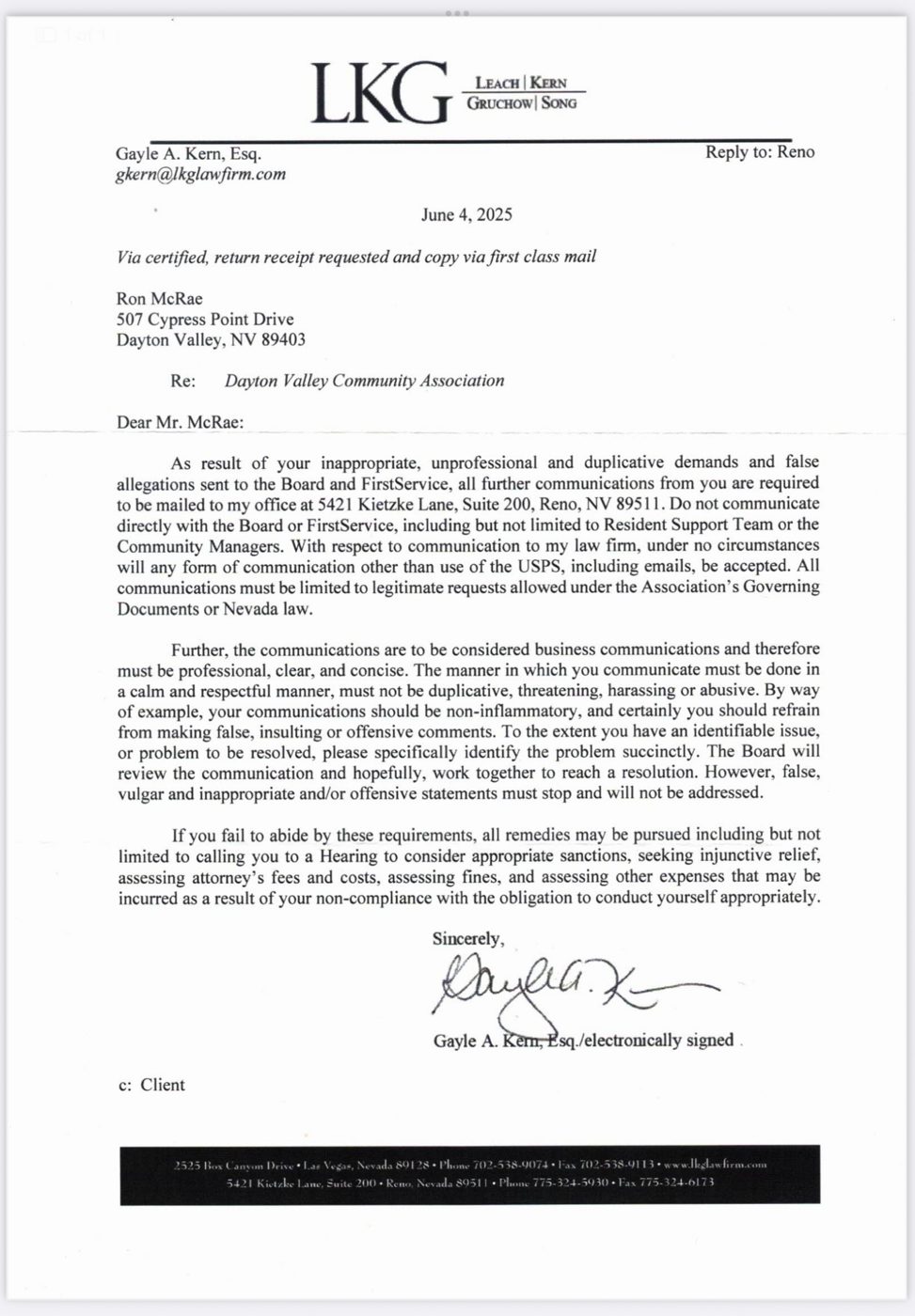
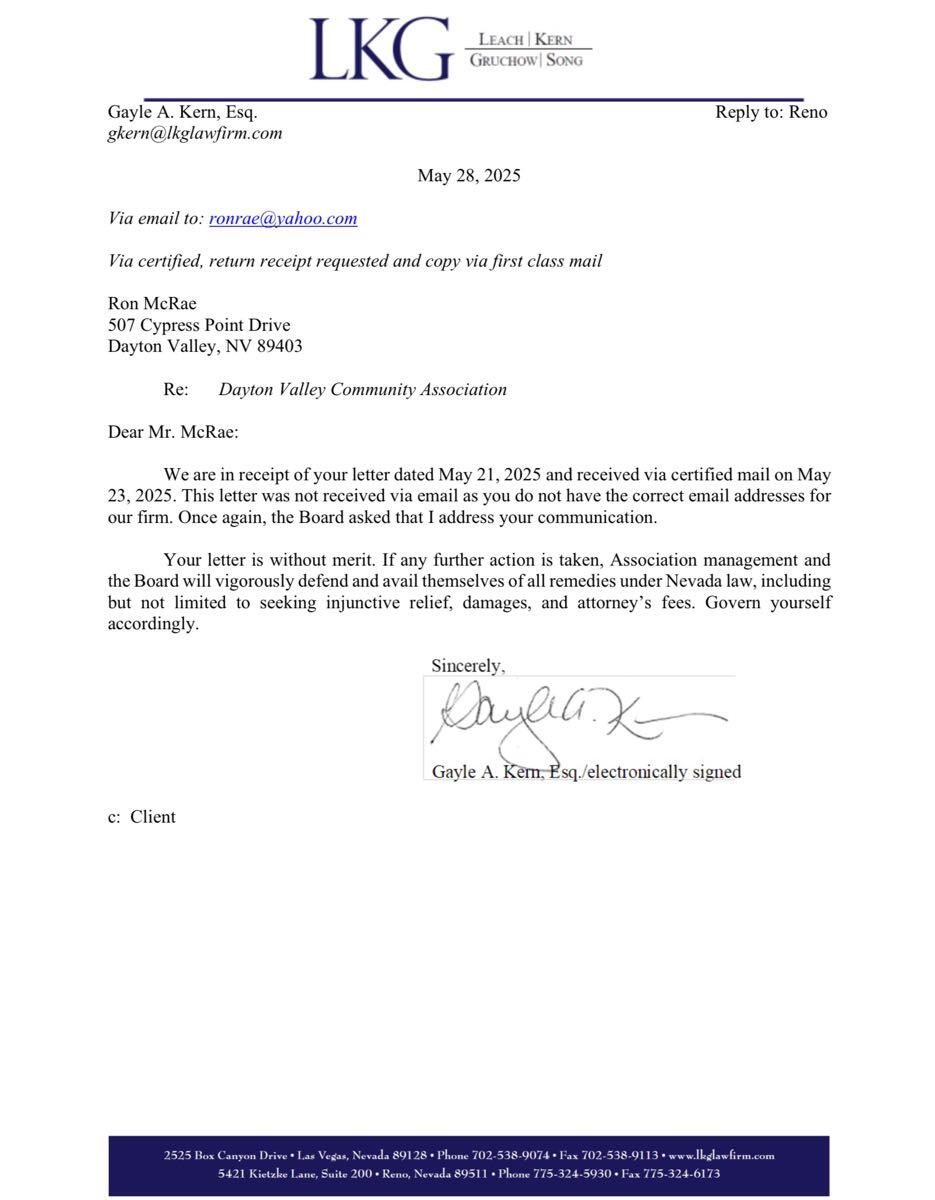
Now for the real kicker: the law firm LKG represents both DVCA and the Legado HOA—and Legacy 49 is part of Legado. So, the same attorney is representing two separate HOAs with potentially conflicting interests. When I brought this fact to the new board’s attention I received a letter from legal demanding all future requests be sent to legal including requests for association records. See last picture. LKG’s current rate is $390/hr in 6 min increments.