Why these posts are here

From 2019 to 2026 I posted on Nextdoor about Dayton Valley: board meetings, the gates, roads, parking, legal fees and the association’s records. Many of those posts no longer exist there. On Nextdoor, one neighbor’s report is enough to start a removal, and criticism of the board was often labeled “public shaming.” A warning that the DVCA roads were icy was taken down that way. About half of my posts were removed, and I never won an appeal. In September 2026 I stopped posting there.

This section keeps my own posts as I wrote them, with their photos, so the record of what was said, and when, survives. Replies, reactions and other people’s comments are not included.

332 posts · 174 no longer on Nextdoor

Tips: OR for either word (gate OR fence), "quotes" for words together ("palmer gate"), -word to leave out (gates -legacy). Search also reads the text in screenshots.

October 30, 2026 at 7:44 AM · Shared with: anyone and your neighborhood

Sorry to see you go….

If you didn’t attend the board meeting on Wednesday you may not have heard the biggest announcement.

Our long term board member, Dennis, announced he and his wife, Ramona, are moving away.

We wish them luck for the next chapter in their lives.

Dennis is part of a small team that has guided the HOA over the last 8 years. If you like the direction of our community…you have him to thank. 😀

October 28, 2026 at 7:42 AM · Shared with: anyone and your neighborhood

Does anybody have the newest signed contract between First Service Residential?

I have been stonewalled trying to get the contract. I’ve contacted the board, property management, LKG law (DVCA’s council) and KSKD law (FSR’s council).

I’ve only been trying for two months. Perhaps I should just wait longer? What are they hiding?

Photo from the post

October 19, 2026 at 8:14 AM · Shared with: anyone and your neighborhood

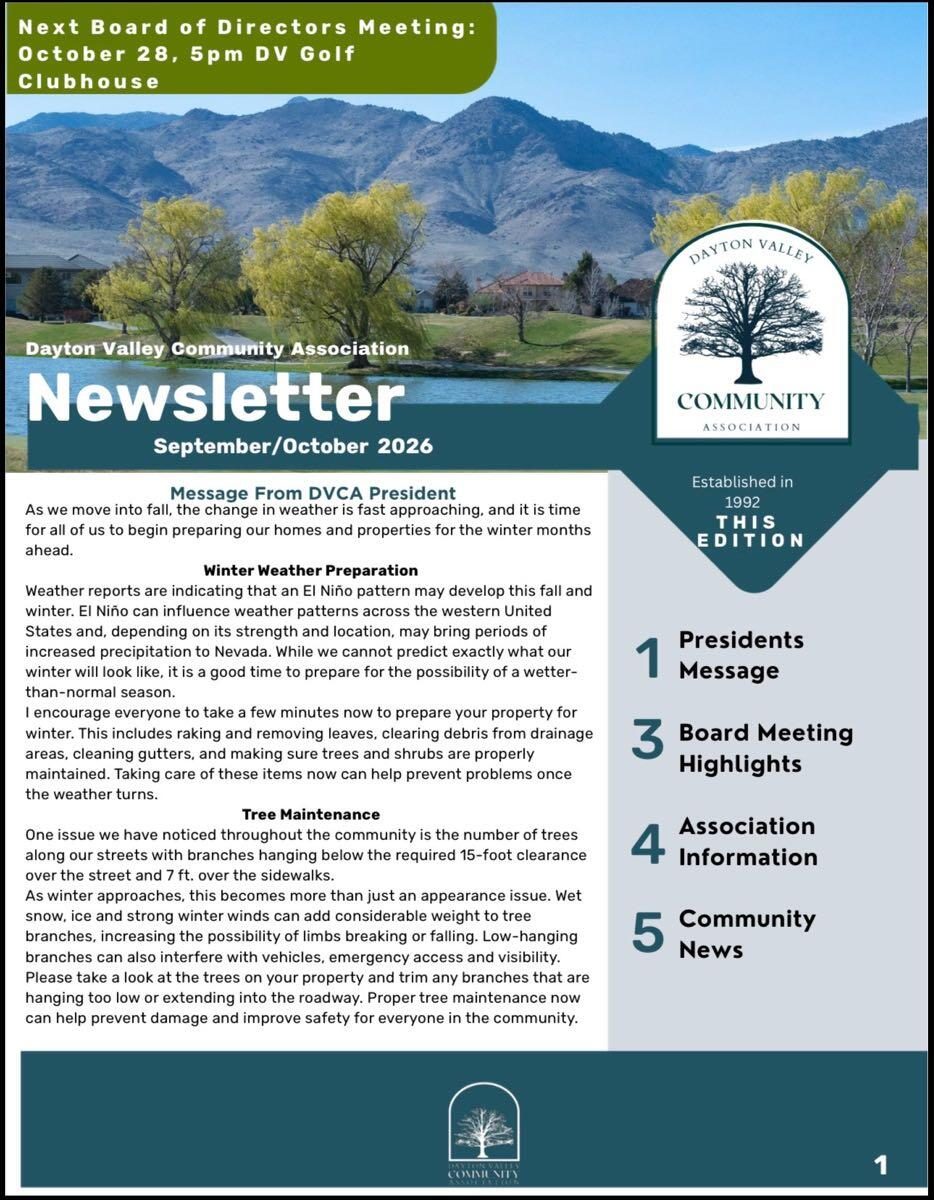
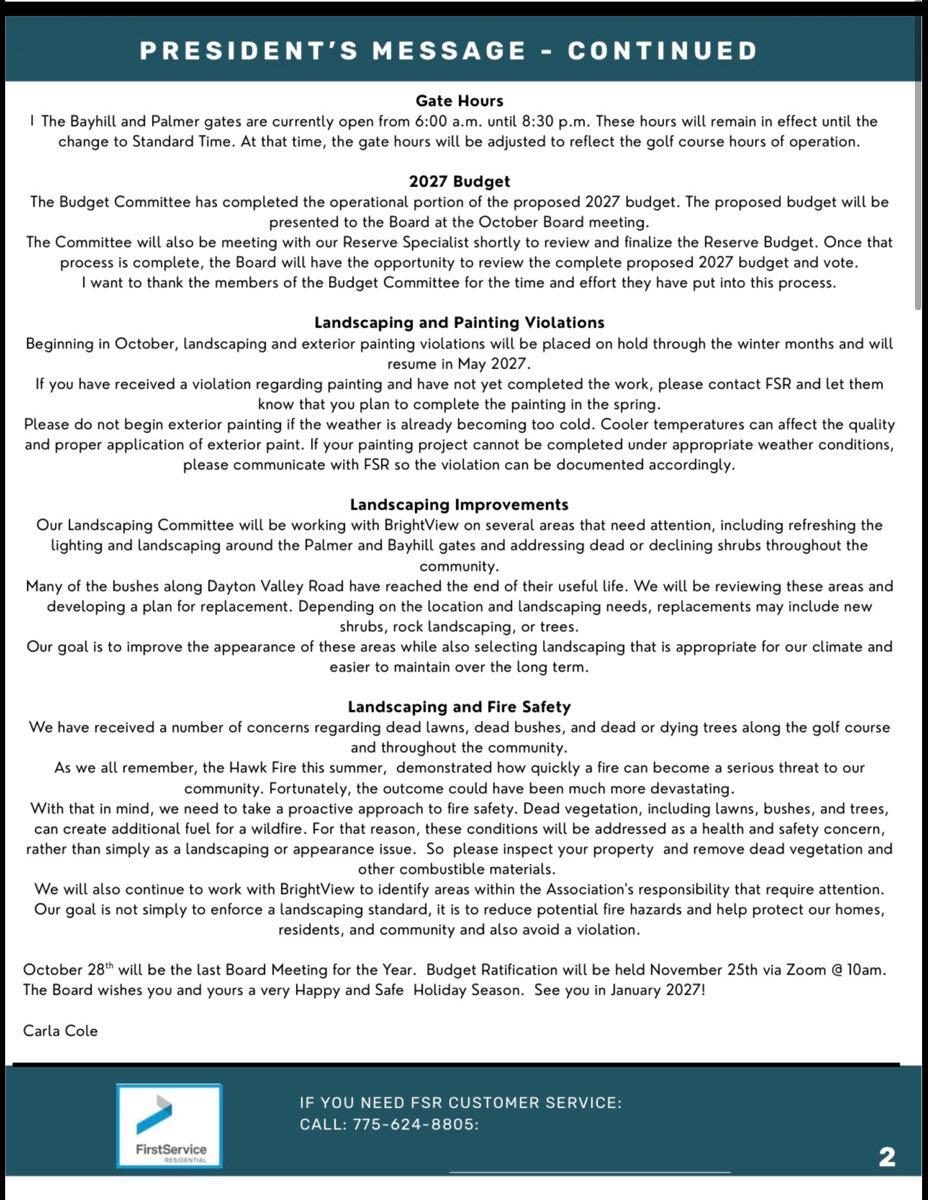
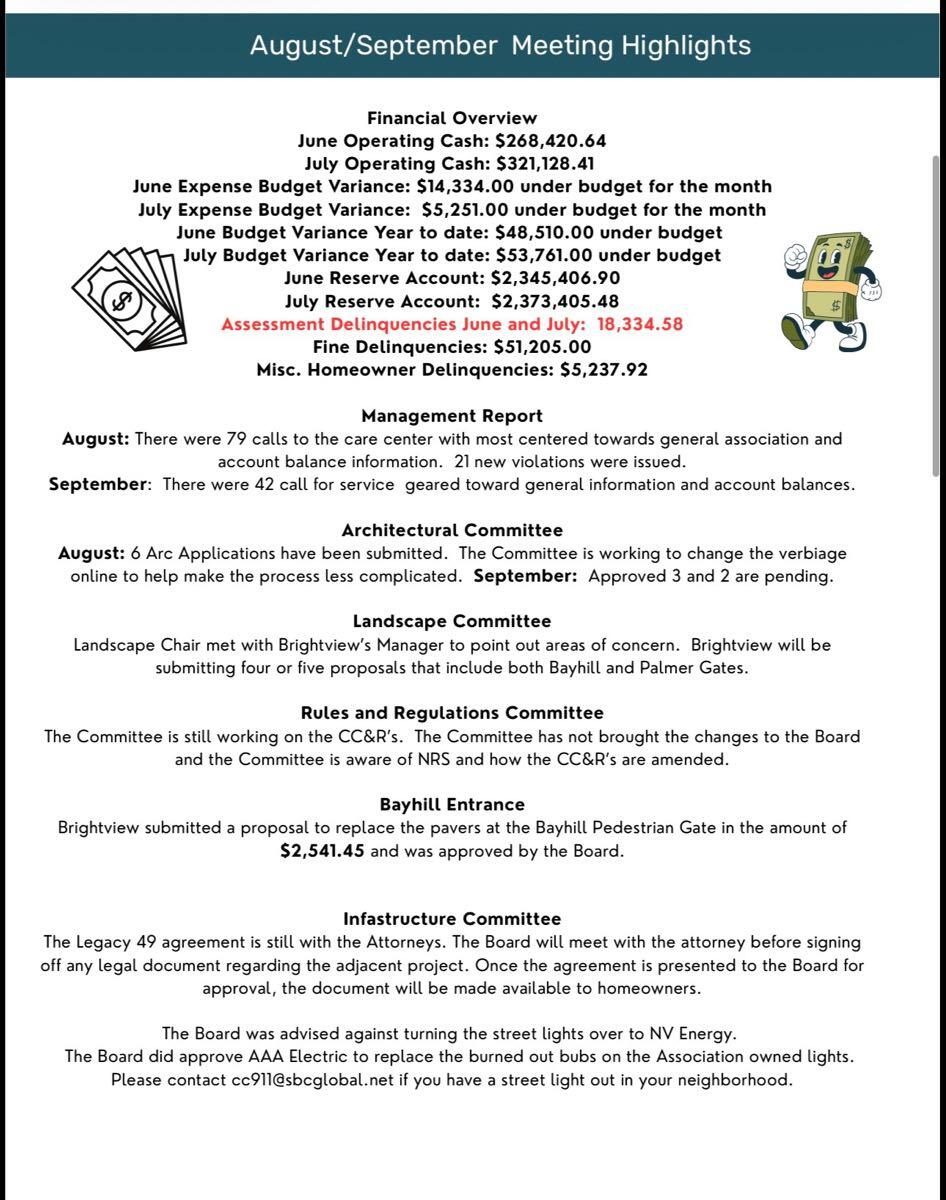
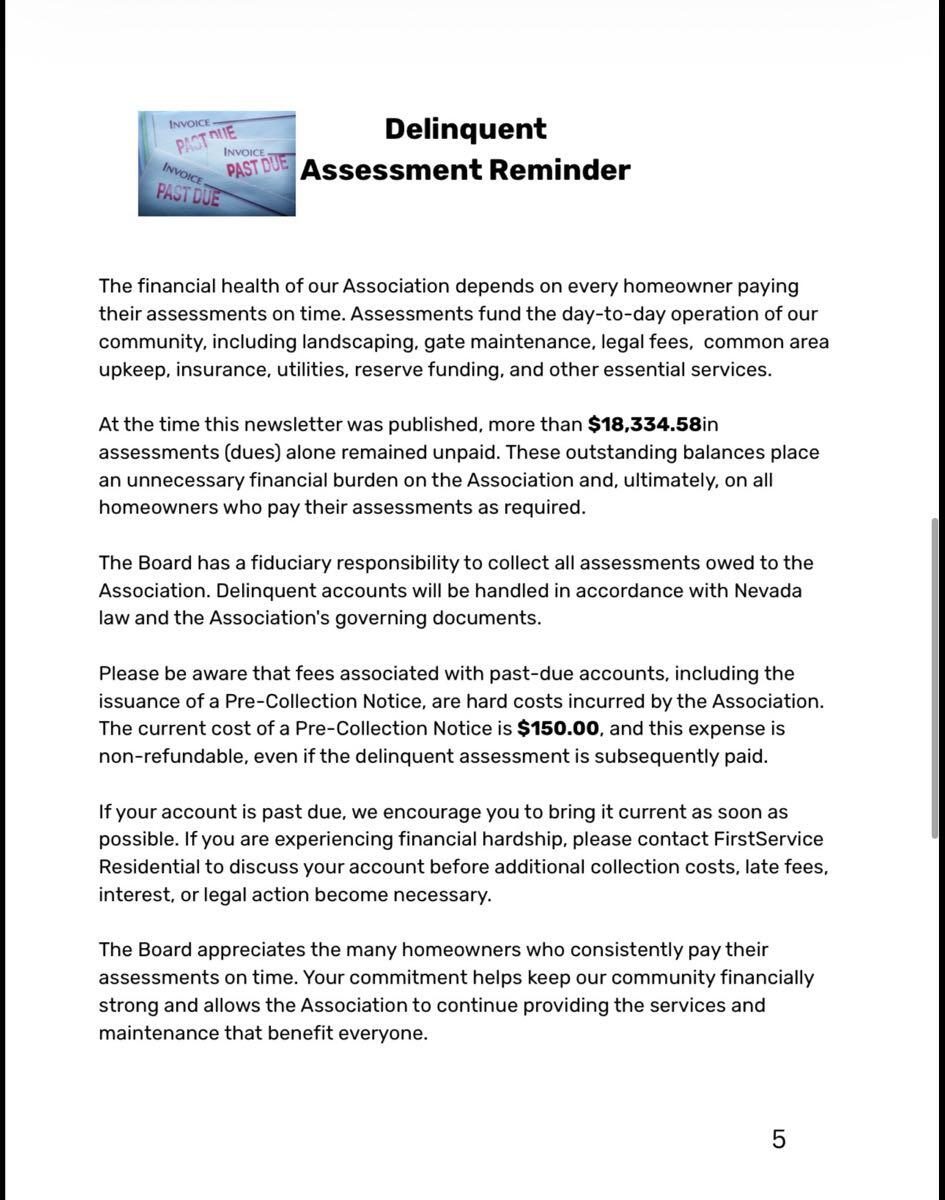
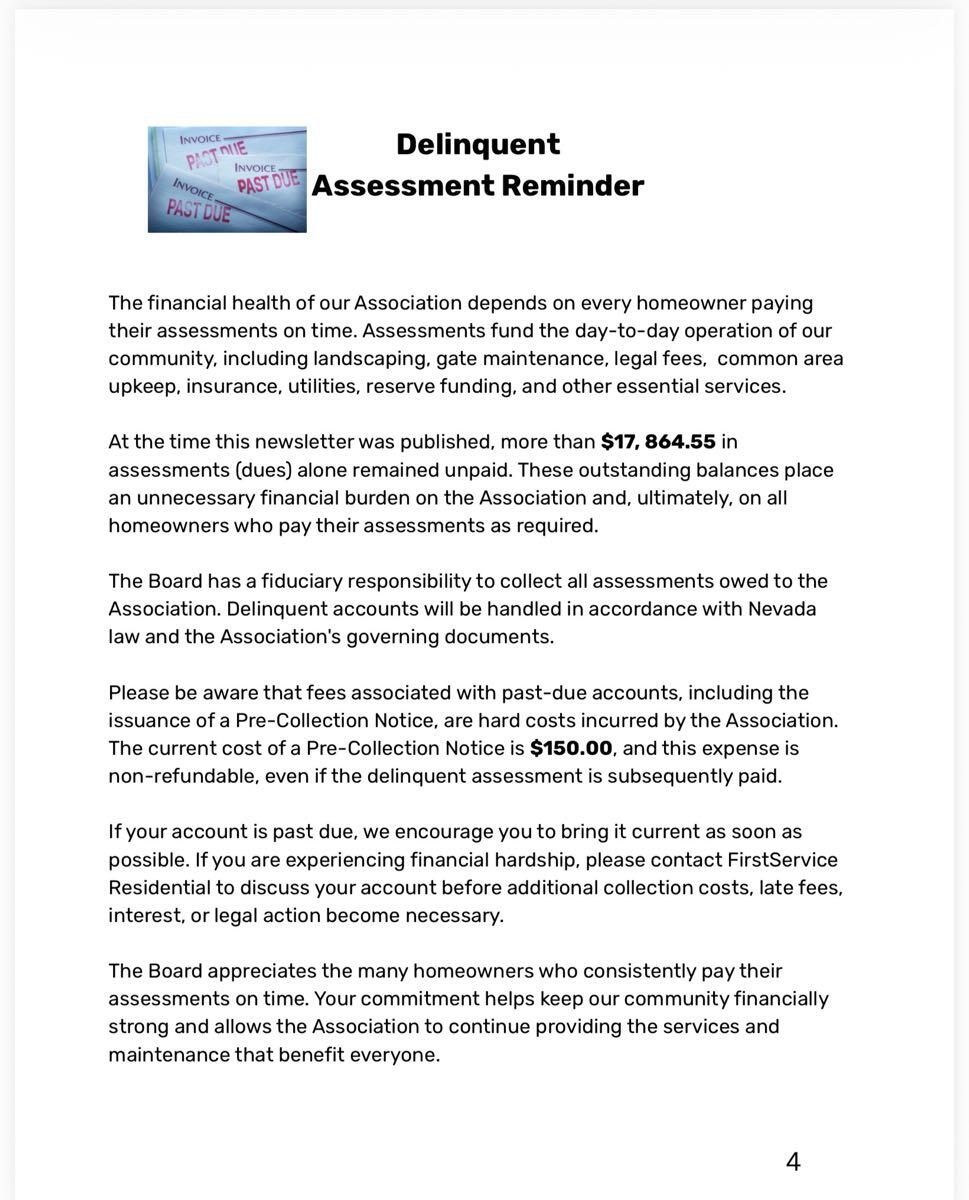
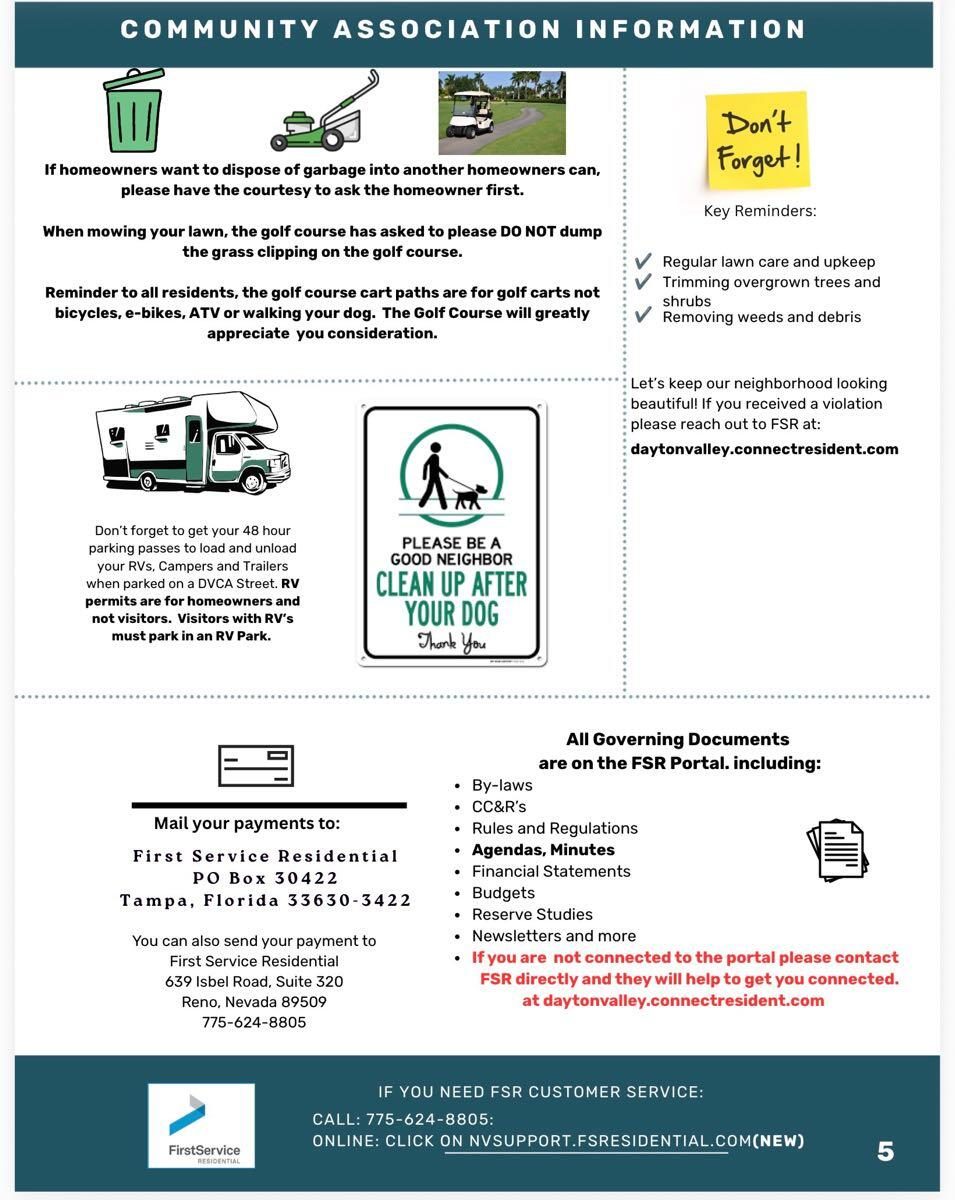
Here is the latest newsletter from our DVCA board.

There is no mention of Legacy 49’s progress although construction starts in the next few months. Also…no mention of DR Horton’s expansion of “Point Legado” across Dayton Valley Rd.

Hmmm….

Photo from the postPhoto from the postPhoto from the postPhoto from the postPhoto from the postPhoto from the postPhoto from the postPhoto from the post

September 16, 2026 at 6:16 AM · Shared with: your neighborhood

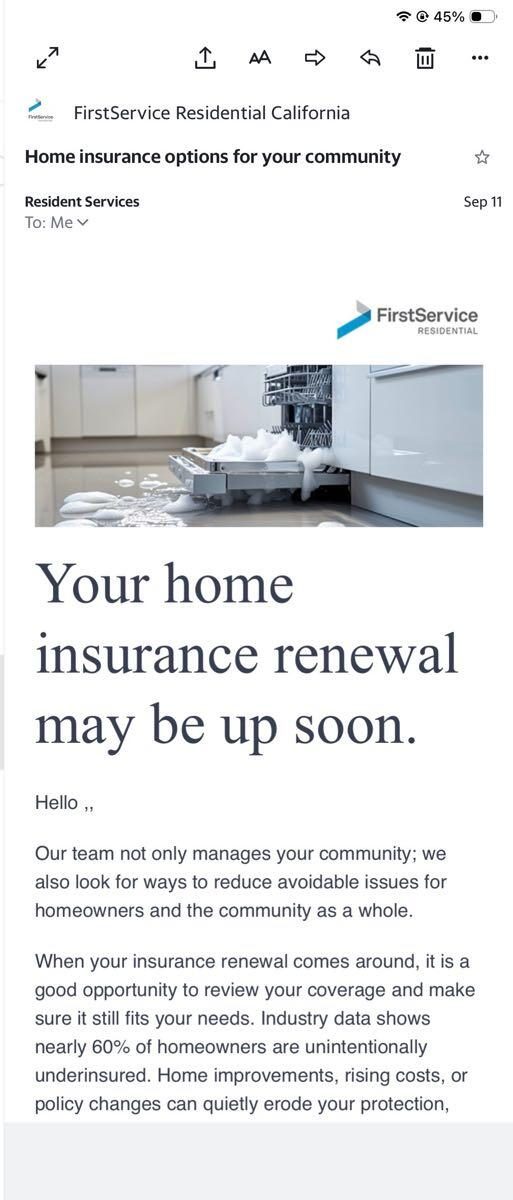
DVCA Homeowners: Has Anyone Else Received This Marketing Email From FSR?

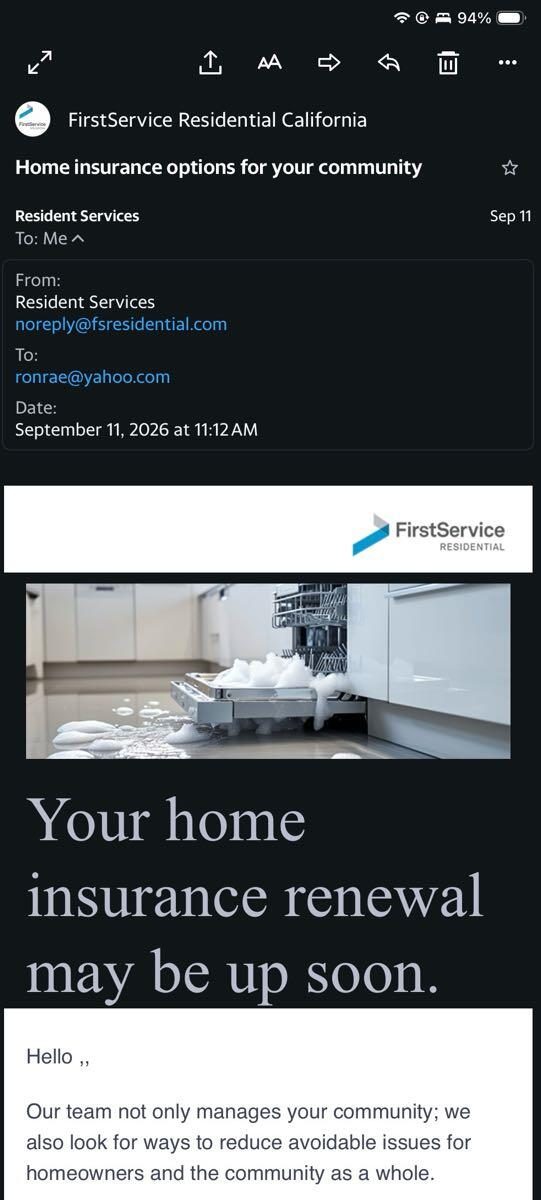
I recently received a marketing email from FirstService Residential promoting homeowners insurance. I’d like to know how many other DVCA homeowners received it.

This raises some thorny legal and governance questions.

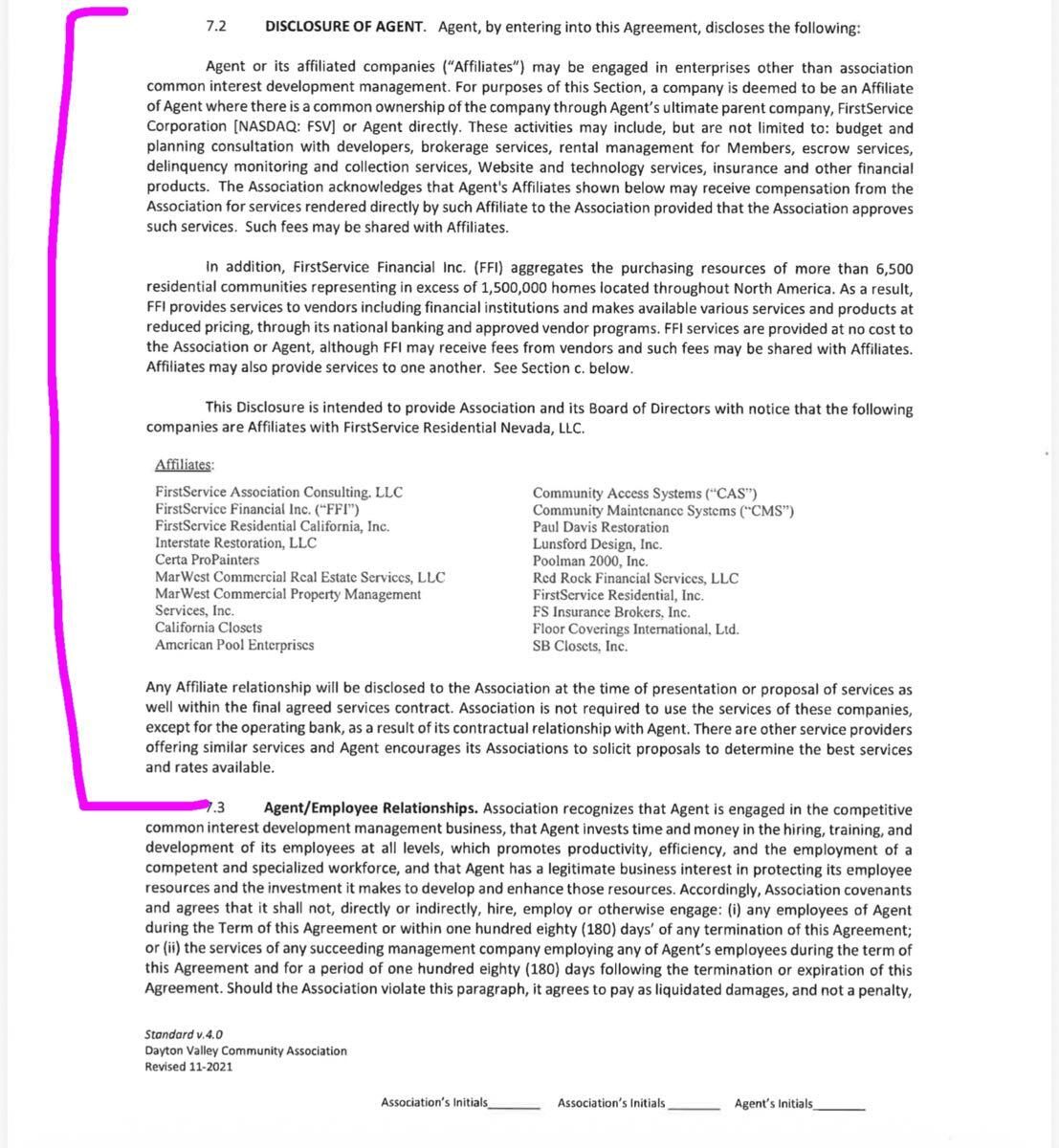
FSR possesses homeowner email addresses because it manages our Association. If information collected for HOA business is being used for commercial marketing, homeowners are entitled to ask: Who authorized that use? Was our information provided to an affiliate, insurance company, or marketing partner? What consent was obtained? And did the DVCA Board approve or have knowledge of this program?

There is also a potential issue for the HOA Board itself. If Association membership information was provided or made available for commercial solicitation, the question isn’t limited to what FSR did. The Board may need to explain what it authorized, what the management contract permits, and what safeguards exist for homeowner information.

I’m trying to determine how widespread these solicitations are.

If you received this email, please do not delete it. Send me a private message through Nextdoor. I can provide the contact information for the management and legal teams representing DVCA HOA and First Service Residential so you can contact them directly and ask how your information was obtained, how it is being used, whether it was shared, and who authorized that use.

The more homeowners who independently ask these questions, the harder it becomes to dismiss this as an isolated concern.

Our email addresses were provided so our HOA could communicate with us. Were they also provided so someone could sell us something?

That deserves an answer.

Photo from the postPhoto from the postPhoto from the postPhoto from the post

September 12, 2026 at 7:01 AM · Shared with: your neighborhood · No longer on Nextdoor

I SENT THE FOLLOWING COMPLAINT TO LKG LAW (DVCA COUNSEL), KSKD LAW (FSR COUNSEL) , FIRST SERVICE RESIDENTIAL (FSR) AND EXECUTIVE MEMBERS OF THE DVCA HOA BOARD.

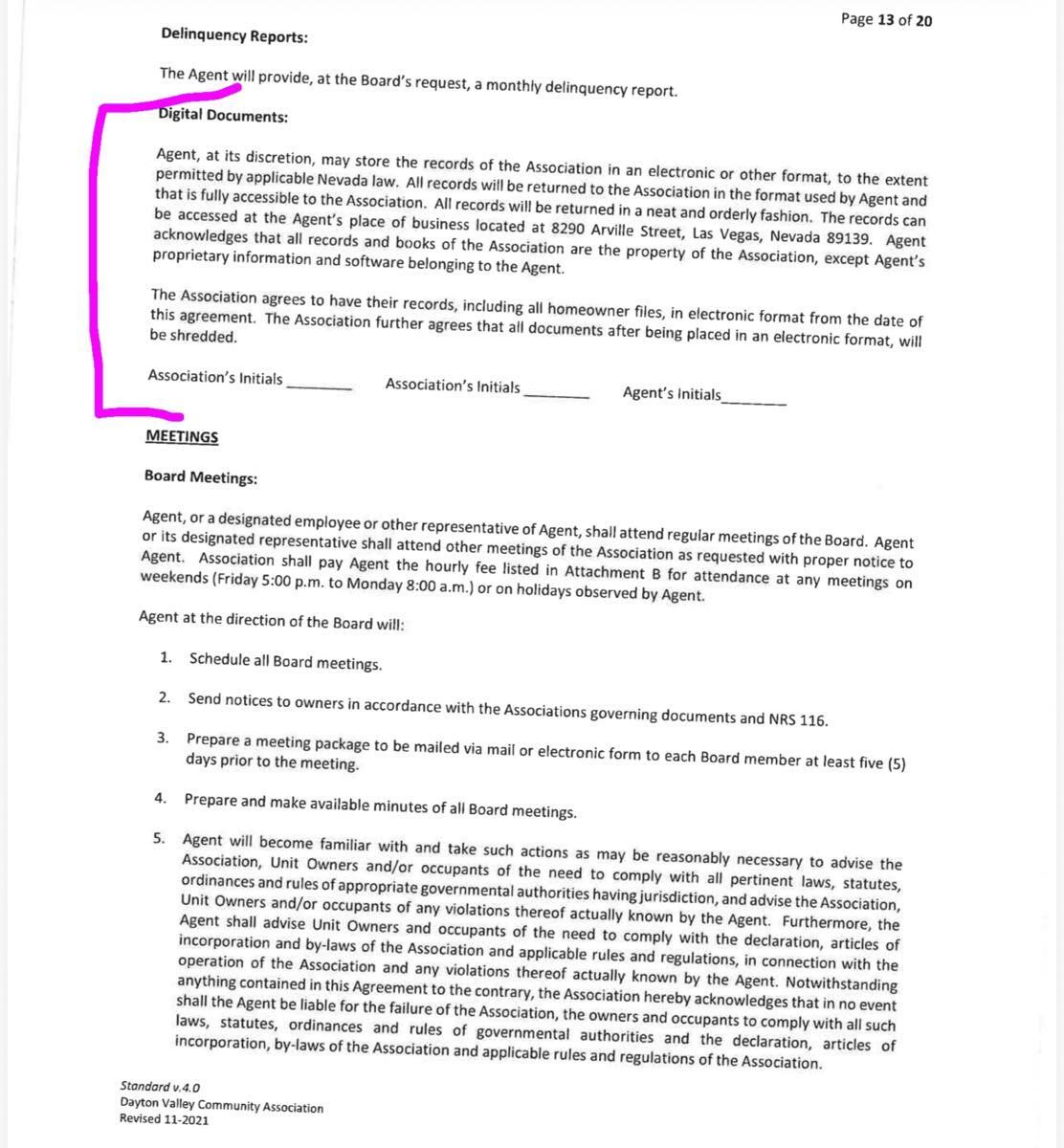
QUOTE: “We partner with your board to deliver strategies that simplify operations, enhance service, and elevate your resident experience. Get a proposal tailored to your property, goals, and priorities.” (See picture #1 & #2)

QUOTE: “Our team not only manages your community; we also look for ways to reduce avoidable issues for homeowners and the community as a whole. When your insurance renewal comes around, it is a good opportunity to review your coverage and make sure it still fits your needs.” (See picture #3).

When Did My HOA Dues Include Marketing?

Apparently, FirstService Residential has decided that managing our HOA also makes my inbox a convenient place to advertise insurance.

That raises a few questions I think every DVCA homeowner should be asking:

Who authorized FirstService Residential to use homeowner contact information for marketing purposes?

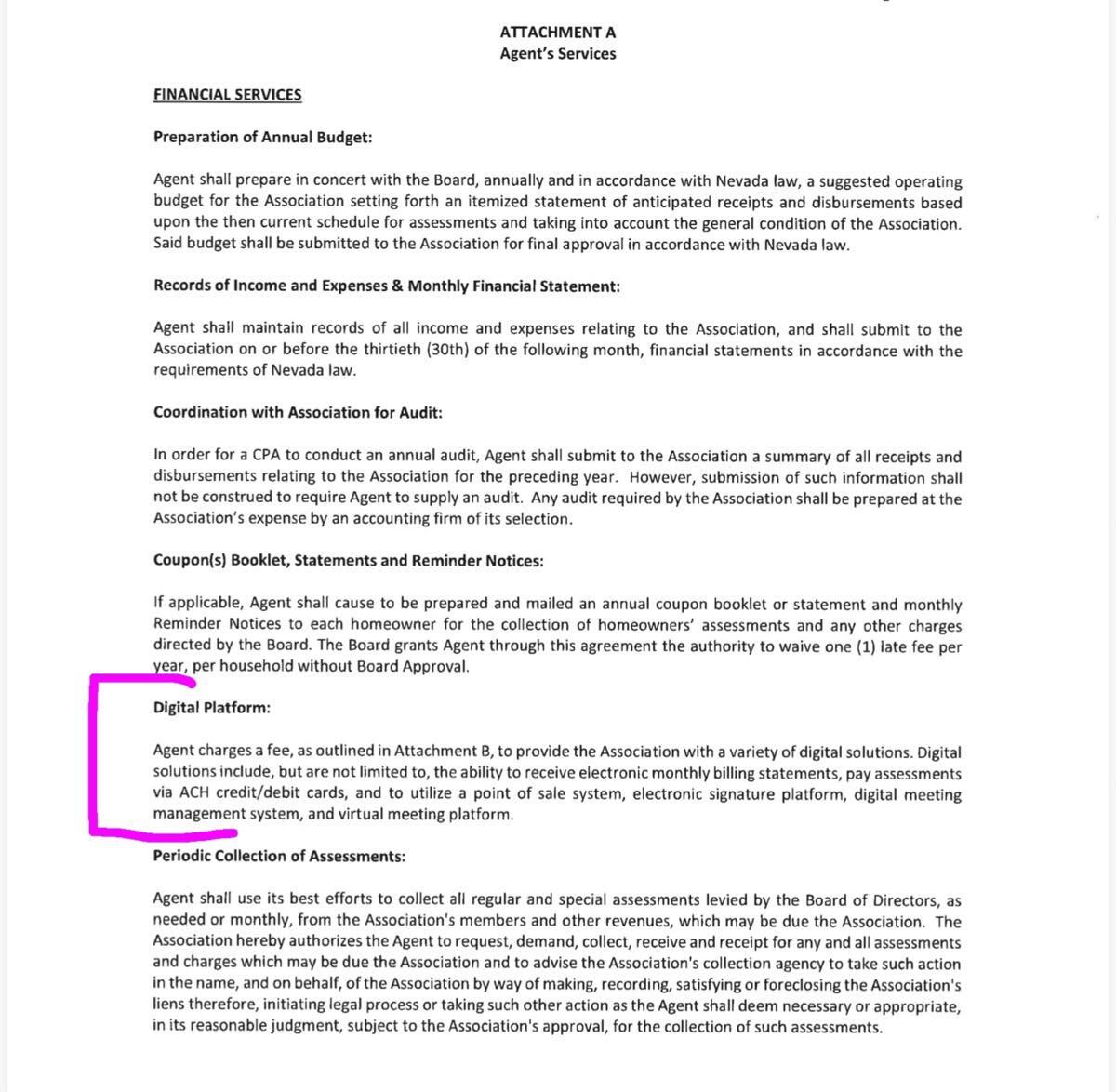
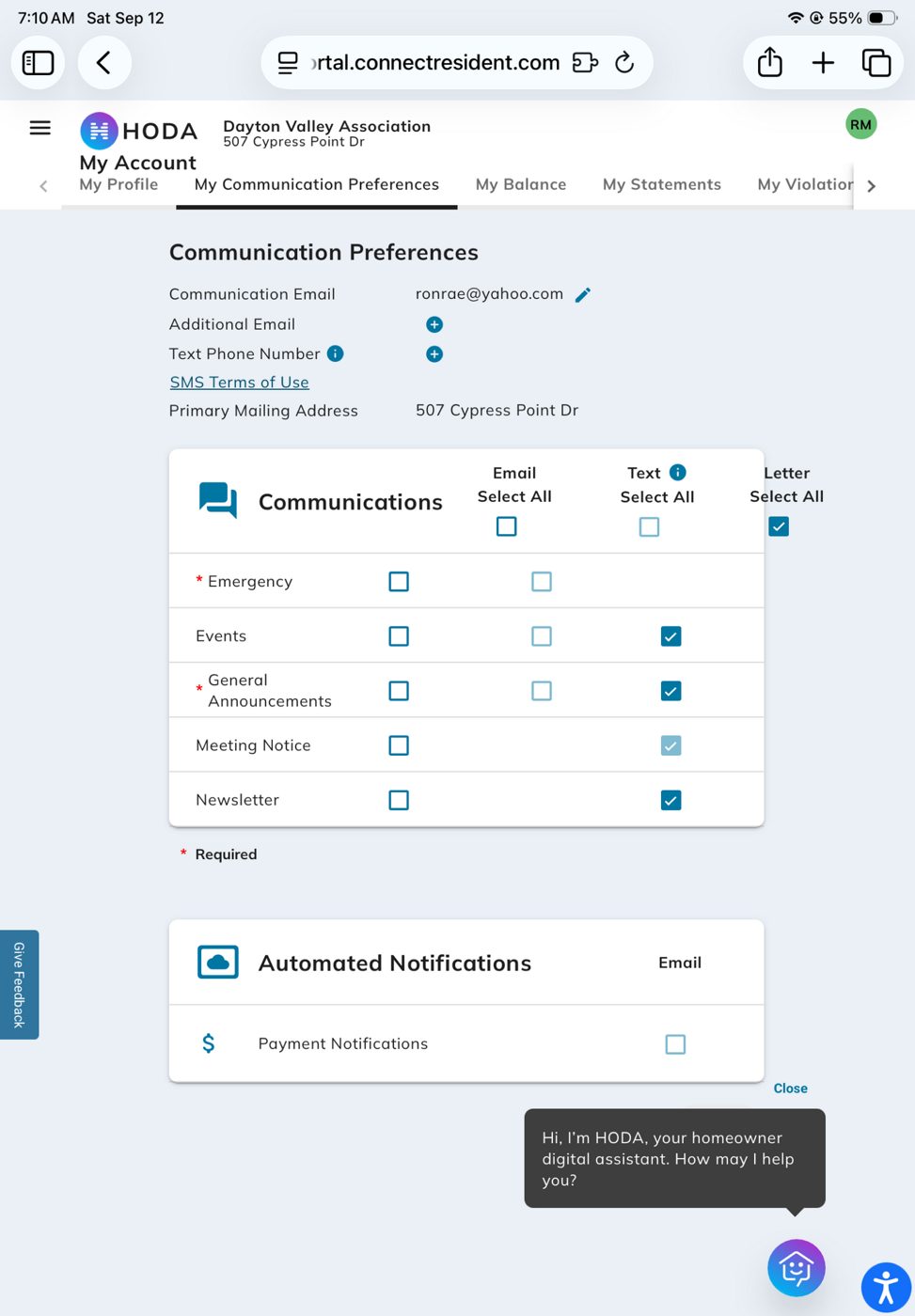
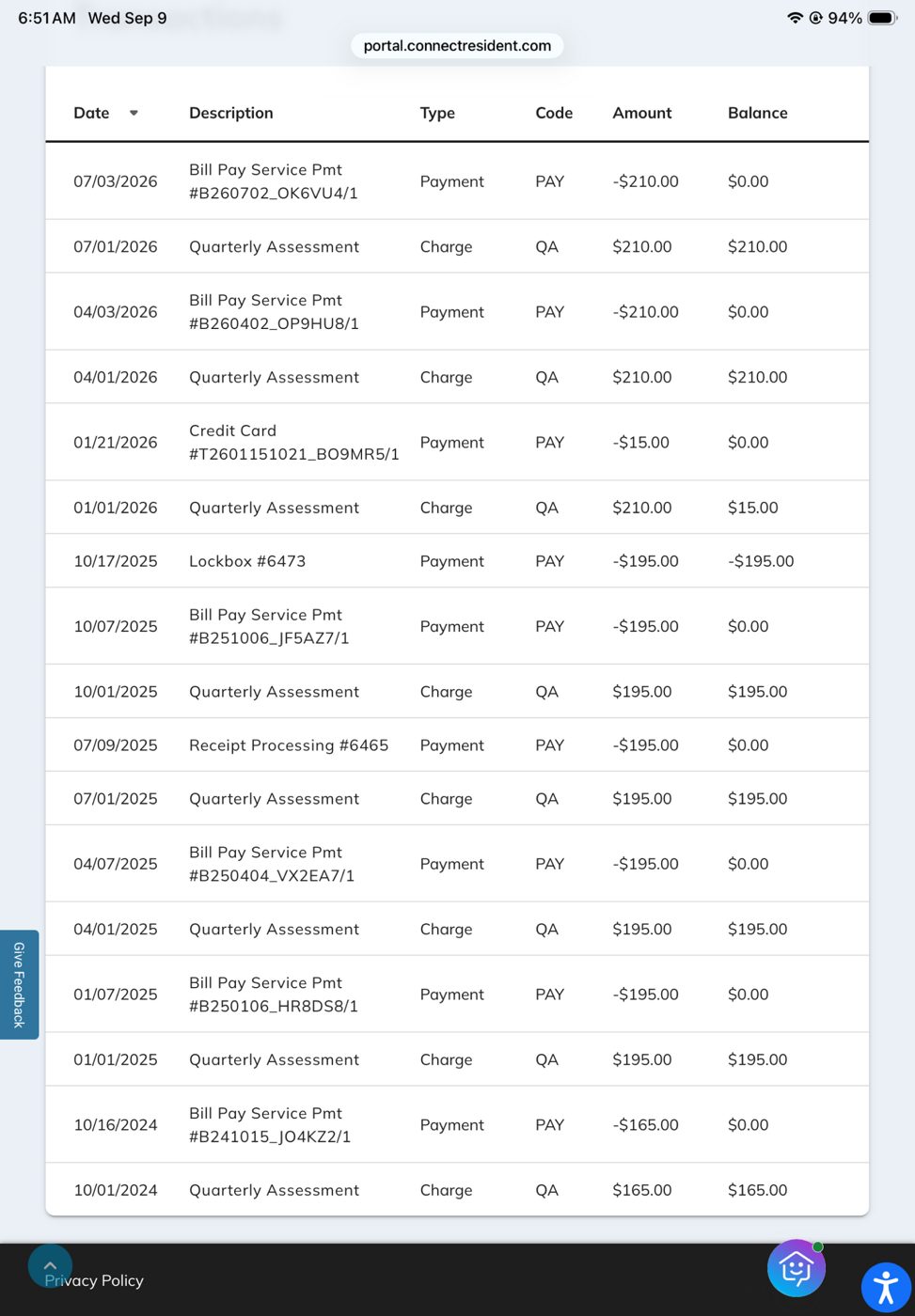
I provided my email address for Association business. Notices. Assessments. Violations. Elections. Community information. (See picture #4).

I do not recall giving permission for my contact information to become a marketing list for insurance products or other commercial services.

So I would like to know:

* Did DVCA authorize FirstService Residential to use our homeowner information for commercial marketing?
* Did the Board approve this?
* Is homeowner information being provided to an insurance company, broker, affiliate, or other third party?
* Is FirstService Residential being compensated for referrals or marketing?
* What other products or services are being marketed using information collected through its role as our community manager?
* Where, exactly, did homeowners consent to this?

There is an important distinction between an HOA management company possessing my email address because it needs to administer the Association and using that same information to try to sell me something.

If the answer is that somewhere in a 47-page privacy policy we supposedly “agreed” to this simply by using FirstService Residential’s portal, I’d still like to know when the DVCA Board authorized our Association’s management relationship to become a marketing opportunity.

FirstService Residential was hired to manage the Association.

I don’t remember us hiring them to monetize access to the homeowners.

Perhaps this is another good question for the three-minute Homeowner Forum.

Just make sure you can ask it quickly.

Photo from the postPhoto from the postPhoto from the postPhoto from the post

September 11, 2026 at 6:43 AM · Shared with: your neighborhood · No longer on Nextdoor

Apparently Asking Questions Is Now “Public Shaming”

I’ve noticed an interesting trend lately.

When I post something questioning the actions of the DVCA Board, the post frequently disappears because it has supposedly been reported as “public shaming.”

Apparently, discussing the actions of elected HOA directors in their official capacities is now considered shaming.

So let’s review some of the terrible things I have had the audacity to discuss publicly.

I questioned why the Association was contemplating spending six figures on streetlights on Bayhill and Augusta while two streetlights on Sawgrass have been broken, rotting at the base, and ignored for more than five years.

Public shaming.

I questioned why parking enforcement appears concentrated on certain streets while other streets seemingly receive little or no enforcement.

Public shaming.

I questioned why parking areas originally constructed by the developer are being painted red and removed from use, and I asked Lyon County whether those spaces were required as part of the original development approvals.

Public shaming.

I questioned why the Association spent significant money with legal counsel attempting to rewrite the CC&Rs when everyone knew an amendment required approval from 51% of the entire membership. The effort ultimately produced nowhere near that participation.

Public shaming.

I questioned why we are paying a professional management company while our community has been assigned what FSR calls a “provisional manager,” resulting in basic governance questions repeatedly being sent to attorneys billing hundreds of dollars per hour.

Public shaming.

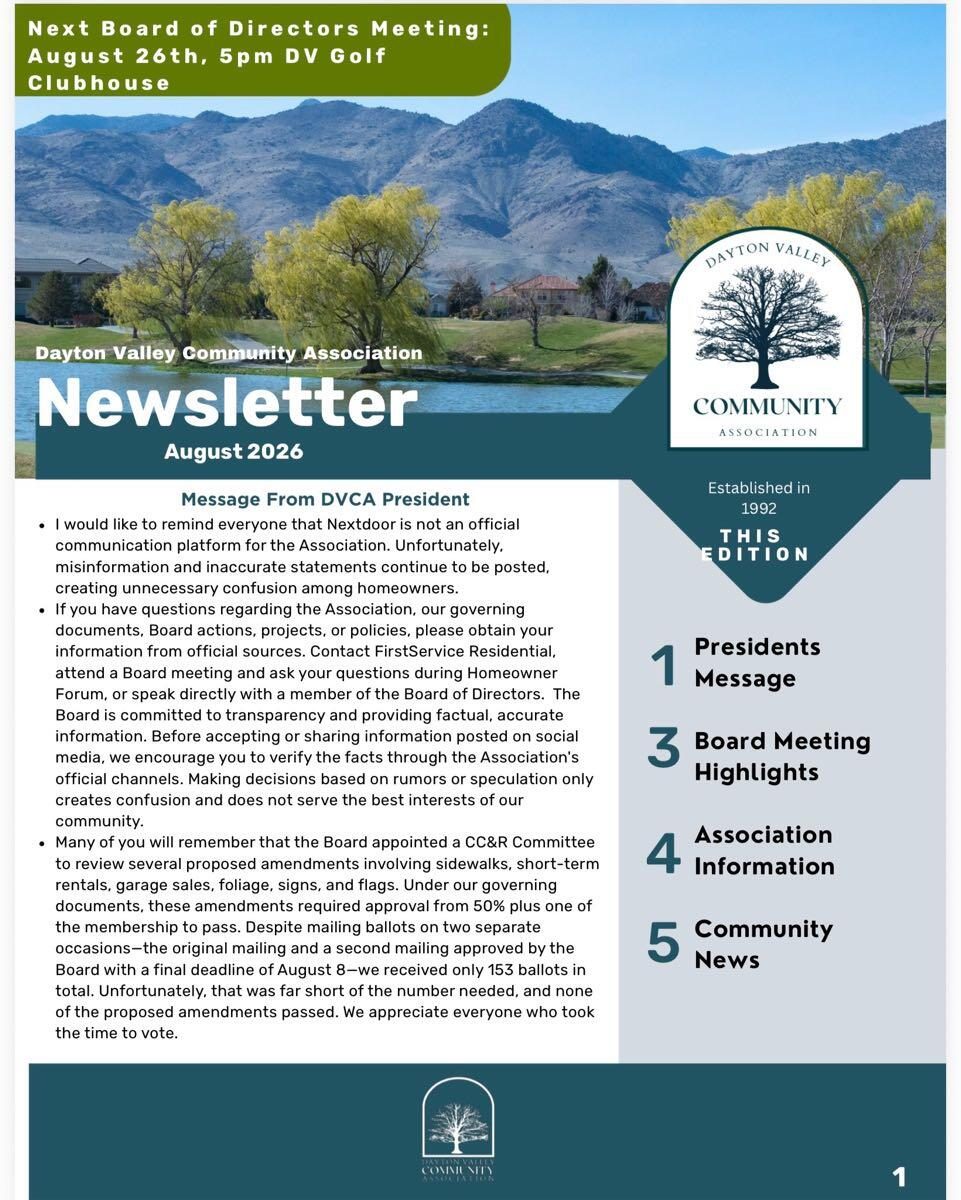
I questioned why Board member names and contact information disappeared from the newsletter while homeowners were simultaneously being told to get their information from “official sources.”

Public shaming.

I pointed out that homeowners are encouraged to attend Board meetings and ask questions, while Homeowner Forum gives them roughly three minutes and does not require the Board to actually answer those questions.

Public Shaming

I questioned why FSR is sending marketing emails to homeowners for insurance. Who authorized this? Who is getting paid for this? NRS states FSR is the custodian of records. It doesn’t give them access to homeowner emails for marketing services or products.

Public shaming.

And, of course, I have questioned legal spending, enforcement practices, violation procedures, selective enforcement, CC&R interpretations, parking rules, Board conduct, and whether decisions being made actually comply with our governing documents and Nevada law.

Apparently all of that is “public shaming.”

Here is the problem.

Criticism of an elected HOA Board is not inherently public shaming.

Questioning how homeowners’ money is spent is not public shaming.

Naming the directors who vote for, advocate for, or implement a policy is not automatically public shaming.

Asking why one street gets attention while another is ignored is not public shaming.

And pointing to the Association’s own records, meeting statements, newsletters, budgets, governing documents, and correspondence is certainly not public shaming simply because someone finds the resulting discussion uncomfortable.

There is a very simple way for a Board to avoid embarrassing public discussions:

Make defensible decisions.

Explain them.

Apply the rules consistently.

Answer reasonable questions.

Publish the information homeowners need to evaluate what their elected directors are doing.

Transparency is easy when everyone agrees with you. The real test of transparency is how an organization responds when somebody starts asking uncomfortable questions.

Deleting the uncomfortable questions doesn’t answer them.

It just makes the questions more interesting.

And perhaps we should reconsider the phrase “public shaming.”

Public officials should not be personally humiliated or harassed. I agree completely.

But when people voluntarily serve on a Board, exercise authority over 824 homes, spend homeowners’ money, hire attorneys, adopt rules, levy fines, restrict parking, and make decisions affecting everyone in the community, their official actions are legitimate subjects of public discussion.

Accountability occasionally causes embarrassment.

That doesn’t necessarily mean the person asking the question did something wrong.

Sometimes embarrassment is simply what happens when a decision becomes difficult to explain in daylight.

So perhaps the question isn’t:

“Why does Ron keep publicly shaming the Board?”

Perhaps the better question is:

“Why are ordinary questions about Board actions considered so shameful?”

Photo from the post

September 10, 2026 at 10:21 AM · Shared with: your neighborhood · No longer on Nextdoor

Apparently Legal Fees Only Matter When a Homeowner Causes Them

There’s been quite a bit of discussion lately about one homeowner allegedly “costing” DVCA approximately $50,000 in legal fees since 2022.

So, in the interest of transparency, let’s open the history book to another chapter in DVCA’s legal spending.

Nevada Real Estate Division cases 2021-761 and 2021-696.

These weren’t lawsuits filed by me.

They weren’t lawsuits filed by another homeowner.

They weren’t records requests, social-media posts, angry emails, or homeowners asking inconvenient questions.

These were disciplinary proceedings brought by the Nevada Real Estate Division against the Dayton Valley Community Association and multiple members of its Board of Directors.

And who did DVCA hire to defend the Association and its directors?

LKG Law - our corporate HOA counsel. The same counsel that encouraged the board to move forward with litigation.

The reported legal bill?

Approximately $175,000.

Let that number marinate for a moment.

$175,000.

Now, accuracy matters. The cases were ultimately dismissed. Nobody should pretend otherwise.

But dismissal doesn’t magically refund the legal fees.

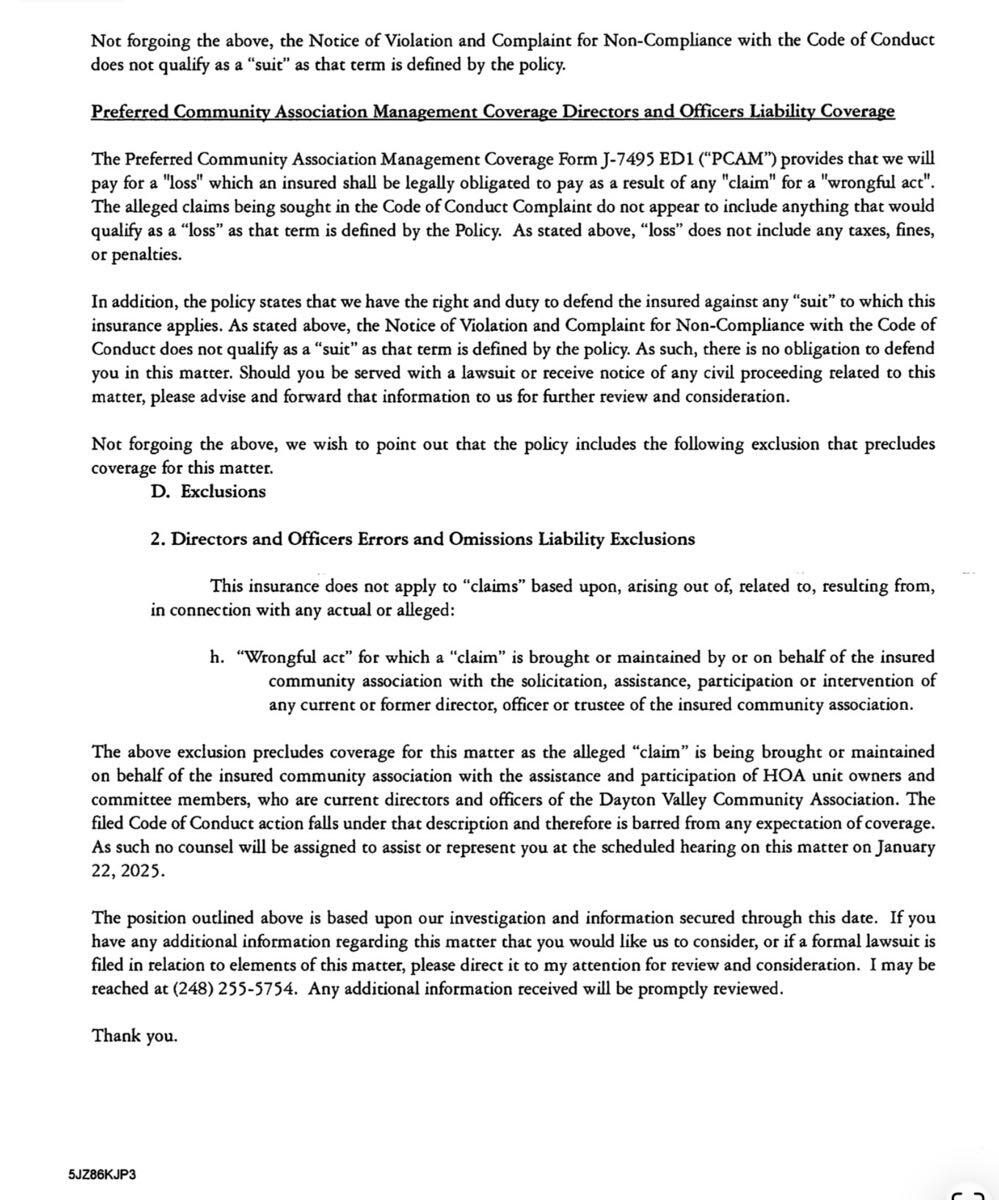
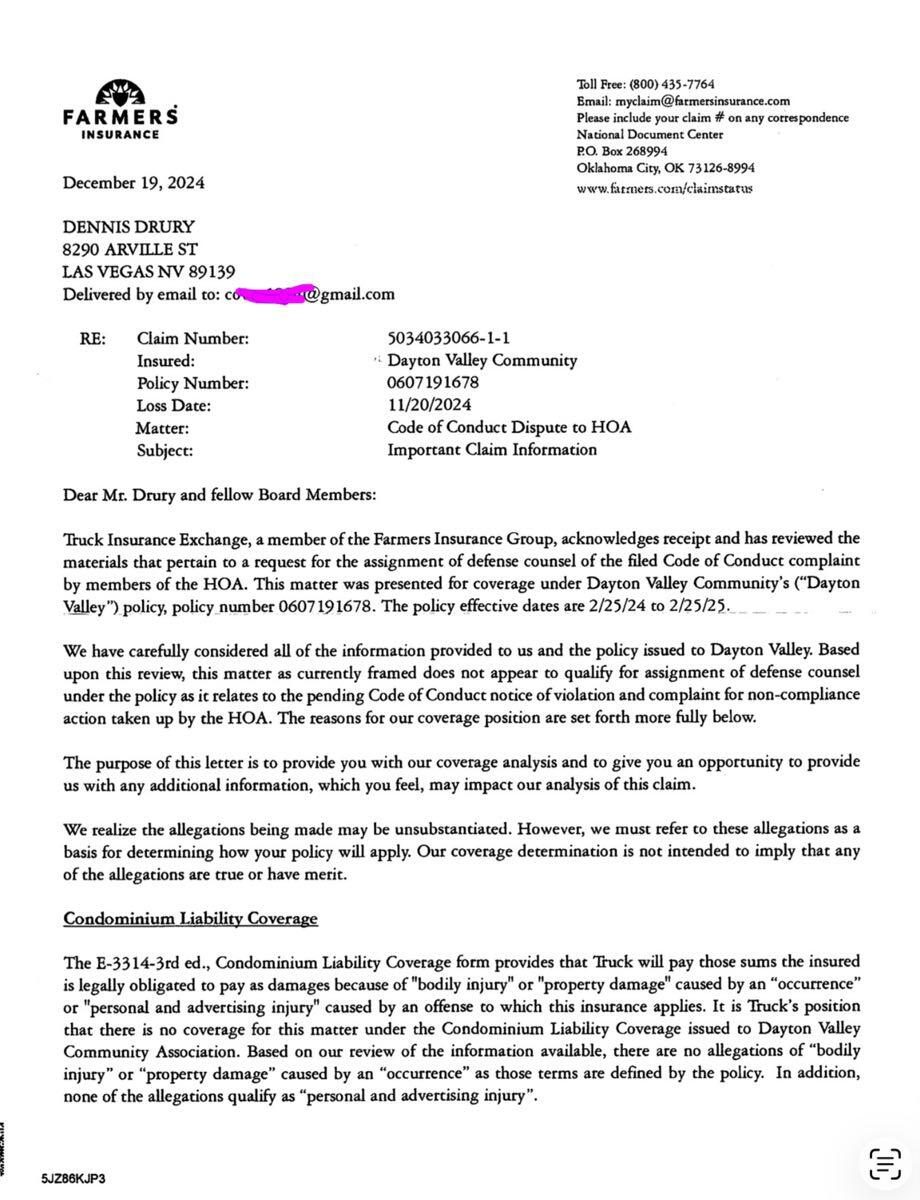
Farmer’s Insurance still paid approximately $175,000 for the defense. This increases our premiums and ultimately led to our HOA liability insurance being dropped.

Which makes the current pearl-clutching over the supposed $50,000 legal tab rather entertaining.

Apparently, when a homeowner challenges the Board and the Board chooses to send matters to legal counsel, the resulting legal fees become the homeowner’s fault.

But when the Nevada Real Estate Division itself brings disciplinary action against the Association and its directors, and the defense costs approximately $175,000, somehow that chapter doesn’t make it into the community’s bedtime story about legal expenses.

Funny how accounting works around here.

For perspective:

One homeowner allegedly “costing” the HOA: $50,000.

Defending DVCA and its directors from NRED disciplinary proceedings: approximately $175,000.

Here’s an idea.

Instead of assigning legal bills to whichever homeowner asked the question that caused the Board to call the attorney, perhaps we should start assigning legal expenses to the people who actually authorize the attorney to perform the work.

Homeowners cannot authorize LKG to spend DVCA’s money.

Homeowners cannot approve legal invoices.

Homeowners don’t control how frequently the Board calls counsel.

The Board does.

So the next time someone tells you that a homeowner “cost the Association” thousands of dollars in legal fees, ask a better question:

Who authorized the legal work?

Then ask another:

Why?

Cases 2021-761 and 2021-696 are public records. Homeowners can read the allegations, DVCA’s response, and the ultimate disposition for themselves.

And perhaps after reading them, someone can explain why $50,000 allegedly associated with one homeowner deserves a public lecture, while approximately $175,000 spent defending the Association and its directors from state disciplinary proceedings apparently deserves amnesia.

If we’re going to have a community-wide conversation about legal spending, great.

Let’s just make sure we bring all the receipts.

September 10, 2026 at 9:16 AM · Shared with: your neighborhood · No longer on Nextdoor

Apparently Legal Fees Only Matter When a Homeowner Causes Them

There’s been quite a bit of discussion lately about one homeowner allegedly “costing” DVCA approximately $50,000 in legal fees since 2022.

So, in the interest of transparency, let’s open the history book to another chapter in DVCA’s legal spending.

Nevada Real Estate Division cases 2021-761 and 2021-696.

These weren’t lawsuits filed by me.

They weren’t lawsuits filed by another homeowner.

They weren’t records requests, social-media posts, angry emails, or homeowners asking inconvenient questions.

These were disciplinary proceedings brought by the Nevada Real Estate Division against the Dayton Valley Community Association and multiple members of its Board of Directors.

And who did DVCA hire to defend the Association and its directors?

Gayle Kern and LKG Law.

The reported legal bill?

Approximately $175,000.

Let that number marinate for a moment.

$175,000.

Now, accuracy matters. The cases were ultimately dismissed. Nobody should pretend otherwise.

But dismissal doesn’t magically refund the legal fees.

Insurance still paid approximately $175,000 for the defense. This is one of the reasons we were dropped by Farmer’s insurance.

Which makes the current pearl-clutching over a supposed $50,000 legal tab rather entertaining.

Apparently, when a homeowner challenges the Board and the Board chooses to send matters to legal counsel, the resulting legal fees become the homeowner’s fault.

But when the Nevada Real Estate Division itself brings disciplinary action against the Association and its directors, and the defense costs approximately $175,000, somehow that chapter doesn’t make it into the community’s bedtime story about legal expenses.

Funny how accounting works around here.

For perspective:

One homeowner allegedly “costing” the HOA: $50,000.

Defending DVCA and its directors from NRED disciplinary proceedings: approximately $175,000.

Yet somehow I’m the cautionary tale.

Here’s an idea.

Instead of assigning legal bills to whichever homeowner asked the question that caused the Board to call the attorney, perhaps we should start assigning legal expenses to the people who actually authorize the attorney to perform the work.

Homeowners cannot authorize LKG to spend DVCA’s money.

Homeowners cannot approve legal invoices.

Homeowners don’t control how frequently the Board calls counsel.

The Board does.

So the next time someone tells you that a homeowner “cost the Association” thousands of dollars in legal fees, ask a better question:

Who authorized the legal work?

Then ask another:

Why?

Cases 2021-761 and 2021-696 are public records. Homeowners can read the allegations, DVCA’s response, and the ultimate disposition for themselves.

And perhaps after reading them, someone can explain why $50,000 allegedly associated with one homeowner deserves a public lecture, while approximately $175,000 spent defending the Association and its directors from state disciplinary proceedings apparently deserves amnesia.

If we’re going to have a community-wide conversation about legal spending, great.

Let’s just make sure we bring all the receipts.

September 9, 2026 at 8:06 AM · Shared with: your neighborhood · No longer on Nextdoor

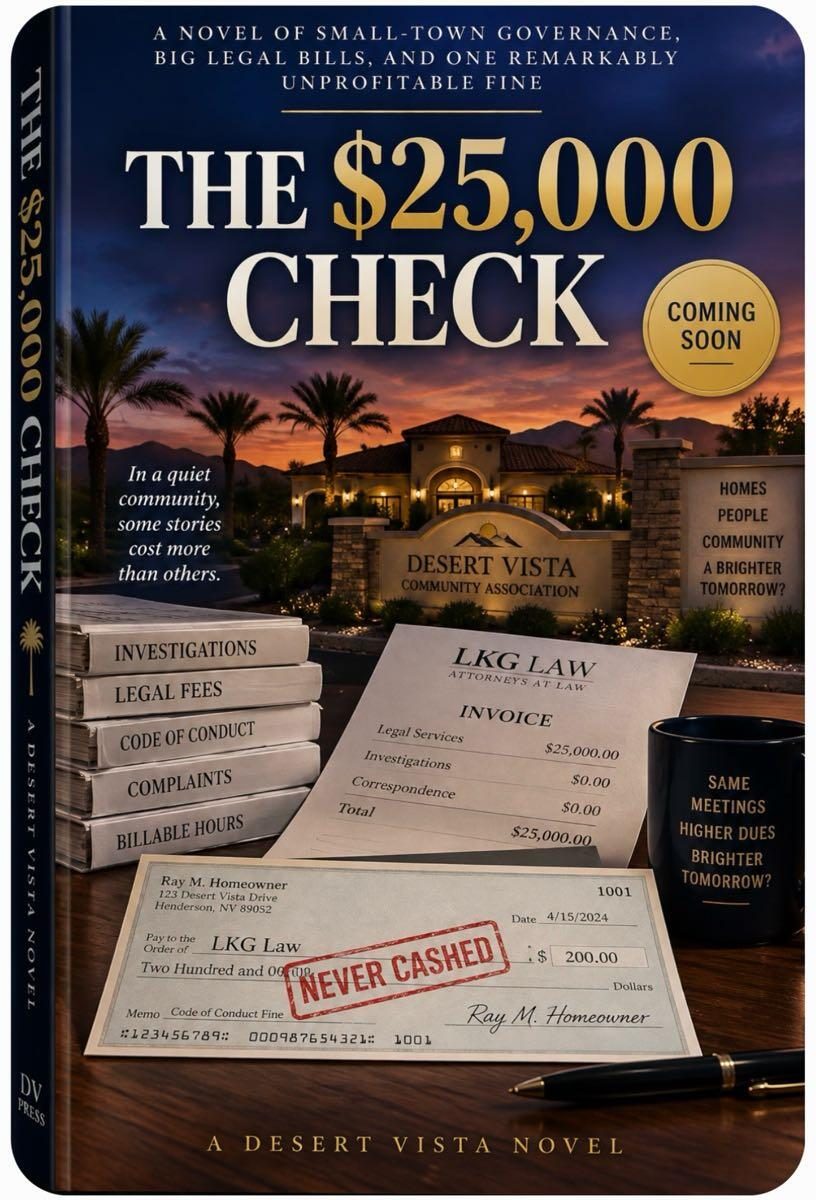
# **THE $25,000 CHECK**

### *A Novel of Small-Town Governance, Big Legal Bills, and One Remarkably Unprofitable Fine*

**Coming Soon**

Welcome back to **Desert Vista**, the quiet Nevada community where the golf course is green, the meetings are long, and somehow every disagreement ends with an attorney billing by the hour.

In this latest installment, residents awaken to a startling revelation on the neighborhood social-media page:

**ONE HOMEOWNER HAS COST THE COMMUNITY $50,000 IN LEGAL FEES.**

The accusation comes from **Margaret**, wife of a longtime former association president and current board member.

The homeowner?

We'll call him **Ray**.

But Margaret's story has one small problem.

It leaves out approximately **$25,000 worth of plot.**

### CHAPTER ONE

## **Code of Conduct**

Three little words.

Years earlier, during Margaret's husband's tenure on the board, Margaret somehow came into possession of emails containing protected homeowner information.

At first, she denied receiving the information from her husband.

Then the lawyers became involved.

And, as tends to happen in Desert Vista whenever lawyers become involved, the story became both more expensive and more interesting.

Eventually, the source of the information was acknowledged.

Which makes a sentence in Margaret's latest neighborhood post particularly entertaining:

**"To begin, my husband cannot share privileged information."**

Technically, neither can the fictional husband in this novel.

Readers will simply have to wait for Chapter Two to discover why that sentence requires considerably more explanation.

### CHAPTER THREE

## **The Complaints**

Margaret eventually files **two Code of Conduct complaints** against Ray.

Now the board faces a choice.

Handle the dispute sensibly?

Or...

**CALL THE LAWYERS.**

This is Desert Vista.

Of course they call the lawyers.

Letters are written.

Emails fly.

Investigations occur.

Billable hours accumulate.

Legal invoices eventually approach:

# **$25,000**

And after this magnificent display of jurisprudence, governance, investigation, correspondence, and professional legal expertise, the association achieves its breathtaking conclusion.

Ray is fined:

# **$200**

Twenty-five thousand dollars spent.

Two hundred dollars assessed.

A return on investment so impressive it could only have been achieved by an HOA.

### CHAPTER FOUR

## **Who Spent the Money?**

Years later, Margaret publicly suggests that Ray has "cost" the community approximately $50,000 in legal fees.

There is only one problem.

Ray cannot hire association counsel.

Ray cannot authorize an investigation.

Ray cannot instruct association attorneys to research anything.

Ray cannot approve a $5,000 legal bill.

Ray cannot approve a $10,000 legal bill.

Ray certainly cannot approve a $25,000 legal bill.

**The Board can.**

This presents an uncomfortable question for our fictional community:

If the board authorized the legal work, why is the homeowner being blamed for what the board chose to spend?

It's a little like blaming the defendant for the prosecutor's salary.

### CHAPTER FIVE

## **The $150,000 Question**

Then comes the larger revelation.

Since 2022, Desert Vista has reportedly spent more than:

# **$150,000 ON LEGAL FEES**

Suddenly, the mystery isn't:

**"Which homeowner should we blame?"**

The mystery is:

**Who authorized $150,000 in legal spending?**

**What did the homeowners receive for it?**

And perhaps most interestingly:

**Why did approximately $25,000 get spent pursuing Code of Conduct complaints that ultimately produced a $200 fine?**

Our hero would love to ask Margaret directly.

Unfortunately...

**she blocked him.**

### EPILOGUE

## **The Check**

But every great novel deserves a twist.

Ray paid the $200 fine.

He wrote the check.

He mailed it directly to the association's law firm.

After all, following $25,000 in legal work, surely someone would deposit the final, hard-earned fruits of the investigation.

They didn't.

**The check was never cashed.**

So after approximately **$25,000 in legal expenses**, the association's actual recovery was:

# **$0**

Some stories end with justice.

Some end with redemption.

**This one ends with an uncashed check.**

### **THE $25,000 CHECK**

*A fictional tale inspired by the timeless question every homeowner eventually learns to ask:*

**"Wait... who authorized the lawyers?"**

**Coming soon to a neighborhood social-media feed near you.**

*Any resemblance to actual homeowners, board members, attorneys, legal invoices, Code of Conduct complaints, blocked social-media accounts, or spectacularly uncashed checks is, naturally,
entirely coincidental.*

Dennis Carla Craig
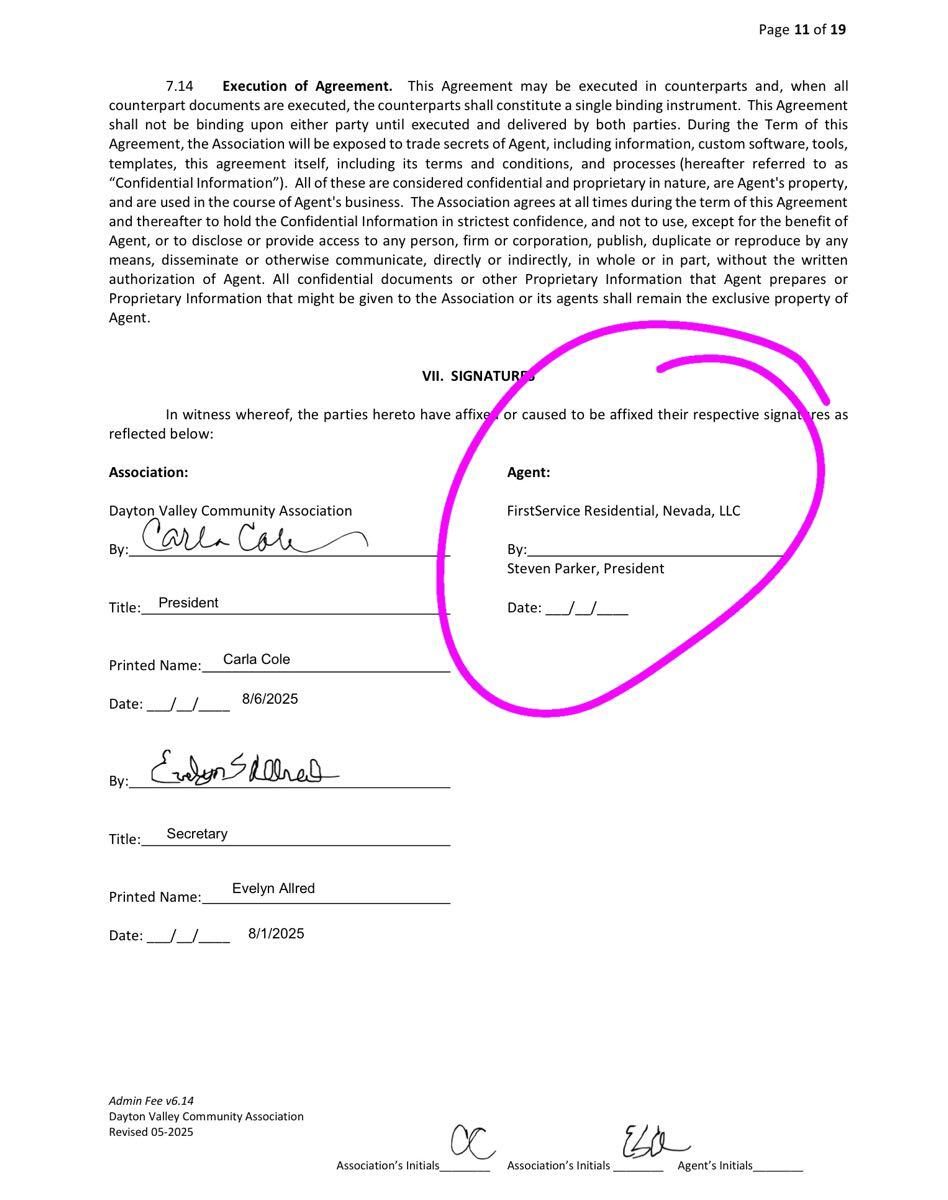
Photo from the post

September 9, 2026 at 6:16 AM · Shared with: your neighborhood · No longer on Nextdoor

Hello DVCA,

There is currently a post on Nextdoor discussing DVCA's legal fees and claiming that ONE homeowner has been responsible for approximately $50,000 in legal expenses since 2022.

The author states she is married to a current Board member who served as DVCA President for many years.

The unnamed homeowner she is referring to is me.

But there is a rather important part of the story missing from her post. It can be summed up in three words:

**Code of Conduct.**

During her husband's tenure on the Board, she received emails containing protected homeowner information. She initially denied that the information came from her husband. When the matter was addressed by legal counsel, the source of the information was ultimately acknowledged.

That makes this line from her current post particularly remarkable:

"To begin, my husband cannot share privileged information."

The Association's own records regarding the prior Code of Conduct matter tell a considerably more complicated story.

She subsequently filed two Code of Conduct complaints against me.

The Board chose to send those matters through legal counsel. The resulting legal expense to the Association was approximately **$25,000**.

The fine I was ultimately assessed?

**$200.**

Think about that for a moment.

Approximately $25,000 in Association legal expenses to produce a $200 fine, and now the homeowner on the receiving end of that process is publicly portrayed as having "cost" the community the legal fees.

That is your Board's legal-spending problem in a nutshell.

There is another fact conspicuously absent from this narrative: **I cannot authorize LKG Law to do anything.**

A homeowner cannot authorize an investigation. A homeowner cannot retain Association counsel. A homeowner cannot approve a legal invoice. A homeowner cannot instruct Association counsel to spend $5,000, $10,000 or $25,000 investigating a Code of Conduct complaint.

**The Board authorizes the legal work.**

And under DVCA's established procedure, communications with Association counsel are controlled through the Board, including the President. So if the Association spent approximately $50,000 involving matters related to me, ask the people who had the authority to spend it why they chose to do so.

Blaming a homeowner for legal bills authorized by the Board is like blaming the defendant for the prosecutor's salary.

The original post is an extraordinary exercise in gaslighting: disclose just enough supposedly confidential information to identify and blame a homeowner, omit the circumstances that generated a substantial portion of the expense, and then suggest that homeowner may somehow be responsible if everyone's dues increase.

If DVCA has spent more than $150,000 on legal fees since 2022, homeowners absolutely should be asking questions.

But the question shouldn't be, "Which homeowner can we blame?"

It should be:

**Who authorized $150,000 in legal spending, what did we receive for it, and why did approximately $25,000 get spent pursuing Code of Conduct complaints that resulted in a $200 fine?**

I'd be happy to respond directly to the original post.

Unfortunately, its author has me blocked.

Want to hear the funniest part of the story? I sent the $200 violation check to LKG law and it was never deposited. $25k spent and I paid $0. True story.

Dennis Carla Craig
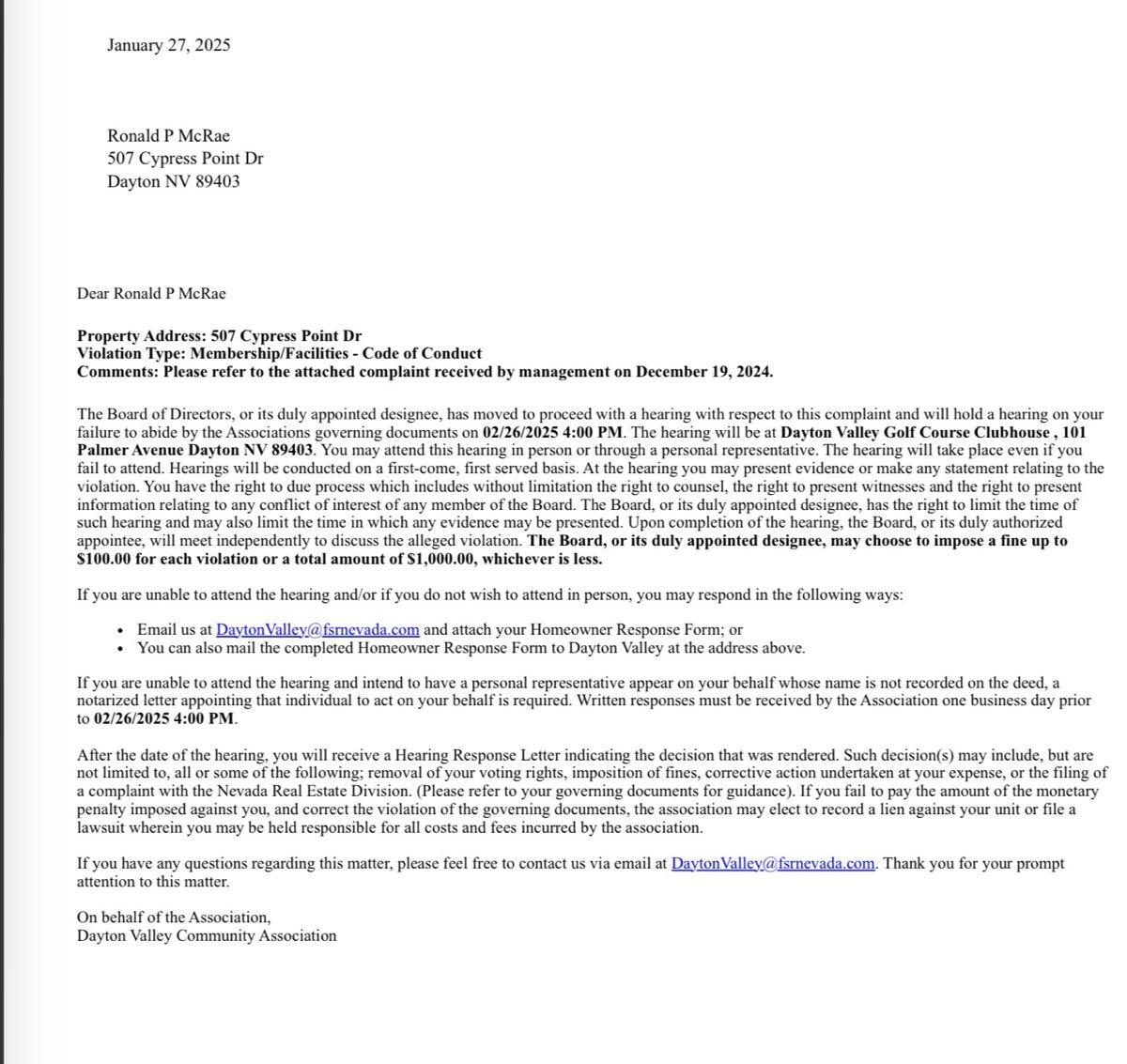
Photo from the postPhoto from the postPhoto from the postPhoto from the postPhoto from the postPhoto from the postPhoto from the post

September 7, 2026 at 8:24 AM · Shared with: your neighborhood · No longer on Nextdoor

📚 COMING SOON

THE LIGHTS OF FAIRWAY HILLS

A Novel of Power, Privilege & Municipal Illumination

From the author who asked the dangerous question, “Where exactly did all the money go?” comes a gripping new work of suburban political fiction.
Welcome to Fairway Hills, an exclusive planned community where the golf course is beautiful, the newsletters celebrate transparency, and apparently not all streetlights are created equal.

For more than five years, two streetlights on quiet Cypress Hollow have stood dark.

Not burned out.

Not awaiting new bulbs.

Rotted at the base. Dead. For five years.

Nobody seems particularly concerned.

Then something remarkable happens.

The Fairway Hills Community Association begins contemplating a six-figure streetlight replacement project on prestigious Oakmont Lane and Magnolia Way.

Why there?

Why now?

And why does one of those troublesome poles just happen to sit outside the home of a prominent member of the Fairway Hills Women’s Golf Society, who also happens to chair the Association’s Infrastructure Committee?

Surely it’s a coincidence.

It has to be.

Because otherwise our fictional protagonist might start asking uncomfortable fictional questions about whether a committee chair should participate in decisions involving a capital improvement immediately adjacent to her own fictional property.

And nobody in Fairway Hills likes uncomfortable questions.

Especially during the homeowner forum.

⸻

EARLY PRAISE FOR THE LIGHTS OF FAIRWAY HILLS

⭐️⭐️⭐️⭐️⭐️
“A breathtaking exploration of what becomes possible when you’re spending other people’s money.”
— The Journal of Fictional HOA Governance

⭐️⭐️⭐️⭐️⭐️
“I couldn’t put it down. Mostly because I was waiting to find out whether anyone would ever fix the two broken streetlights.”
— Suburban Infrastructure Quarterly

⭐️⭐️⭐️⭐️⭐️
“The conflict-of-interest subplot is deliciously uncomfortable.”
— Golf & Governance Magazine

⭐️⭐️⭐️⭐️⭐️
“Six figures for streetlights? Now THAT is fiction.”
— The Homeowner Review

⸻

CHAPTER 12

Some Streetlights Matter More Than Others

The residents begin asking a deceptively simple question:

Before Fairway Hills spends $100,000+ replacing streetlights somewhere else, why not repair the two known failed streetlights that have been deteriorating for five years?

The suggestion is considered dangerously innovative.

One resident proposes an even more radical infrastructure strategy:

FIX THE BROKEN STUFF FIRST.

Unfortunately, the proposal suffers from one significant weakness:

It doesn’t photograph nearly as well for the newsletter.

⸻

CHAPTER 13

Three Minutes of Democracy

Fairway Hills leadership repeatedly reminds residents that anyone with questions should attend a Board meeting.

And they absolutely can.

Toward the end.

For three minutes.

According to the fictional community’s meeting notice:

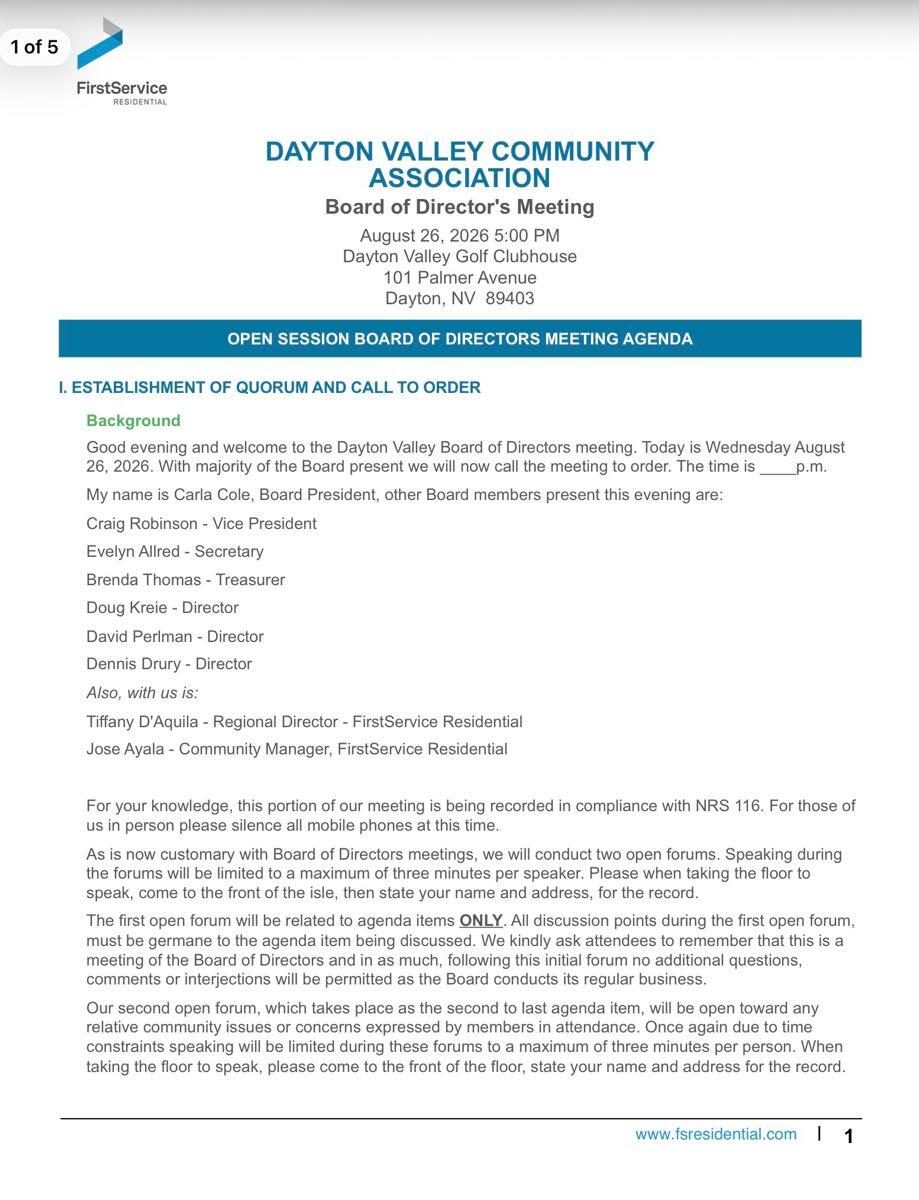
“Our second open forum, which takes place as the second to last agenda item, will be open toward any relative community issues or concerns expressed by members in attendance… speaking will be limited during these forums to a maximum of three minutes per person.”

Three glorious minutes of transparency.

Residents eventually begin asking another troublesome question:

Whatever happened to the town halls?

Fairway Hills used to have them.

Then homeowners kept showing up.

Worse, they asked questions.

Some even criticized the Board.

Naturally, this made town halls considerably less enjoyable.

⸻

THE LIGHTS OF FAIRWAY HILLS

Power has a price.

Apparently streetlights do too.

And in Fairway Hills, the most important question isn’t whether the light works.

It’s whose house it’s shining on.

This is a work of fiction. Names, locations and identifying details have been changed. Any resemblance to actual persons, golf clubs, homeowners associations, committees, newsletters, budgets, mysteriously abandoned town halls, or strategically illuminated front yards is entirely coincidental.

Right?

Image withheld in the public version. Sign in to see it.
Photo from the post

September 4, 2026 at 10:45 AM · Shared with: anyone · No longer on Nextdoor

This is why I don’t post on Nextdoor anymore.

Censorship is rampant. Any complaint about the board is labeled “public shaming”.

Your board doesn’t want transparency. It wants censorship. What a bunch of snowflakes.

Image withheld in the public version. Sign in to see it.
Photo from the post
Image withheld in the public version. Sign in to see it.
Photo from the post

September 4, 2026 at 5:43 AM · Shared with: your neighborhood · No longer on Nextdoor

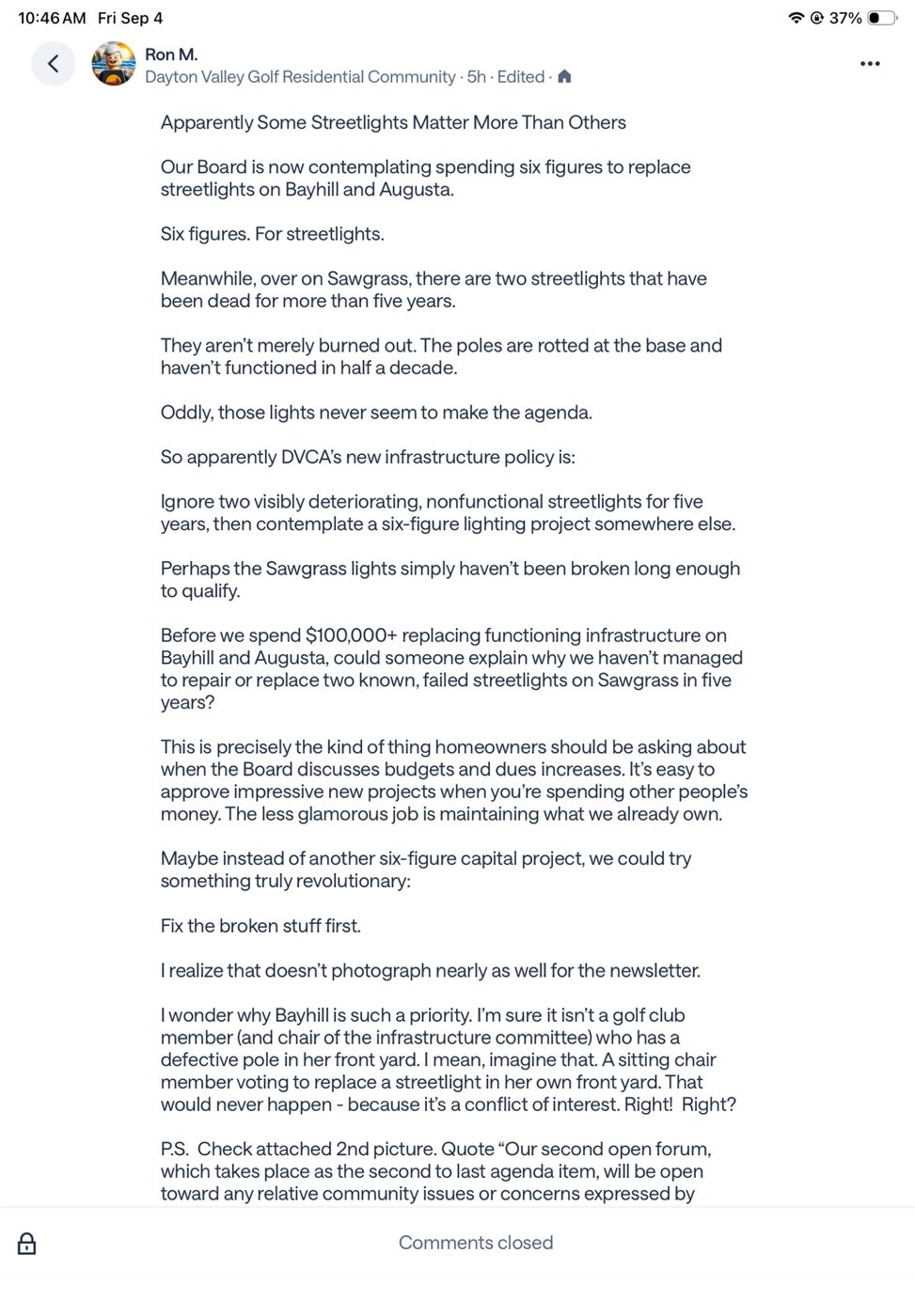
Apparently Some Streetlights Matter More Than Others

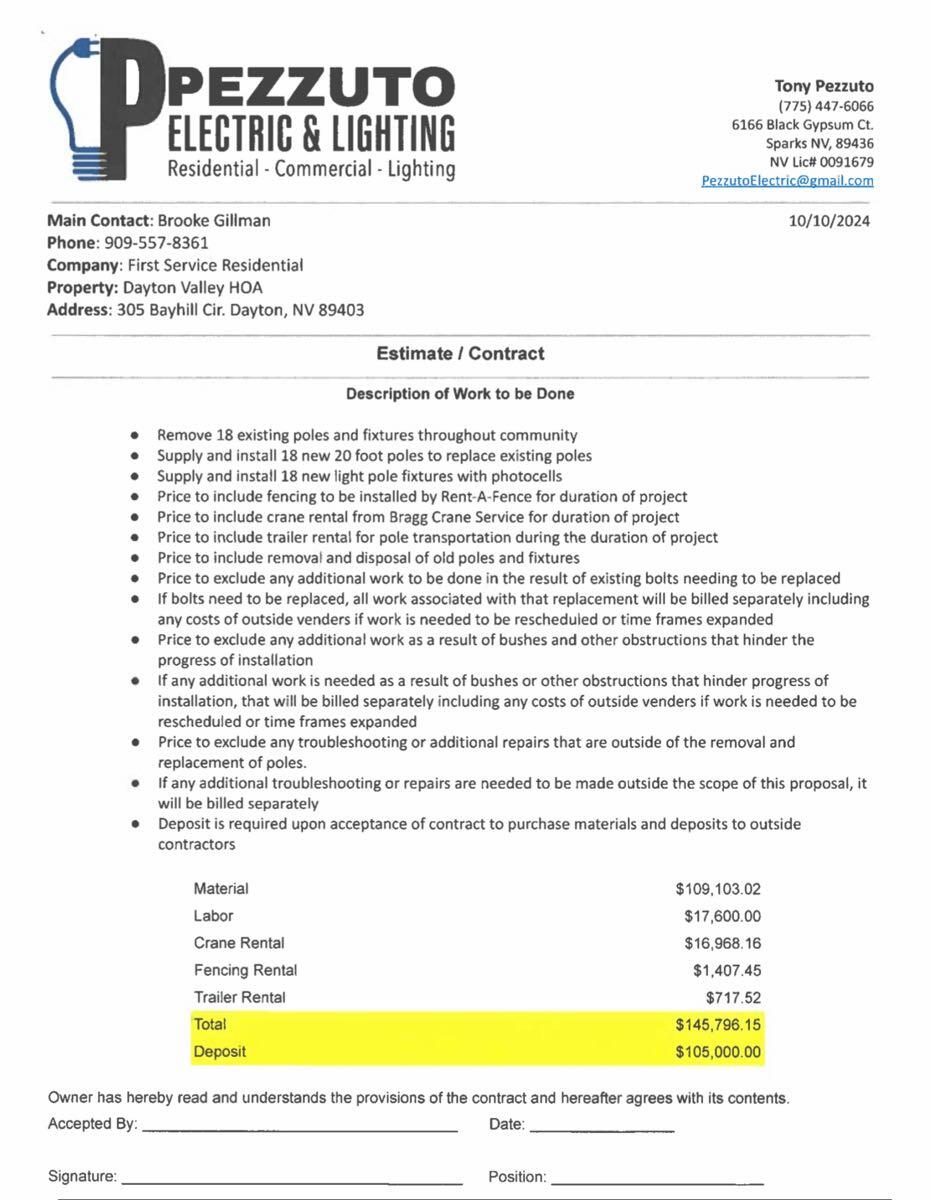
Our Board is now contemplating spending six figures to replace streetlights on Bayhill and Augusta.

Six figures. For streetlights.

Meanwhile, over on Sawgrass, there are two streetlights that have been dead for more than five years.

They aren’t merely burned out. The poles are rotted at the base and haven’t functioned in half a decade.

Oddly, those lights never seem to make the agenda.

So apparently DVCA’s new infrastructure policy is:

Ignore two visibly deteriorating, nonfunctional streetlights for five years, then contemplate a six-figure lighting project somewhere else.

Perhaps the Sawgrass lights simply haven’t been broken long enough to qualify.

Before we spend $100,000+ replacing functioning infrastructure on Bayhill and Augusta, could someone explain why we haven’t managed to repair or replace two known, failed streetlights on Sawgrass in five years?

This is precisely the kind of thing homeowners should be asking about when the Board discusses budgets and dues increases. It’s easy to approve impressive new projects when you’re spending other people’s money. The less glamorous job is maintaining what we already own.

Maybe instead of another six-figure capital project, we could try something truly revolutionary:

Fix the broken stuff first.

I realize that doesn’t photograph nearly as well for the newsletter.

I wonder why Bayhill is such a priority. I’m sure it isn’t a golf club member (and chair of the infrastructure committee) who has a defective pole in her front yard. I mean, imagine that. A sitting chair member voting to replace a streetlight in her own front yard. That would never happen - because it’s a conflict of interest. Right! Right?

P.S. Check attached 2nd picture. Quote “Our second open forum, which takes place as the second to last agenda item, will be open toward any relative community issues or concerns expressed by members in attendance. Once again due to time constraints speaking will be limited during these forums to a maximum of three minutes per person”.

So much for communicating with the board at a scheduled meeting. Why don’t we have town halls anymore? Oh yeah, homeowners consistently attend just to berate the board. Who wants that?

Image withheld in the public version. Sign in to see it.
Photo from the postPhoto from the post

August 31, 2026 at 6:54 AM · Shared with: your neighborhood · No longer on Nextdoor

█████: Why Is Our HOA Investigating Ownership of This Property?

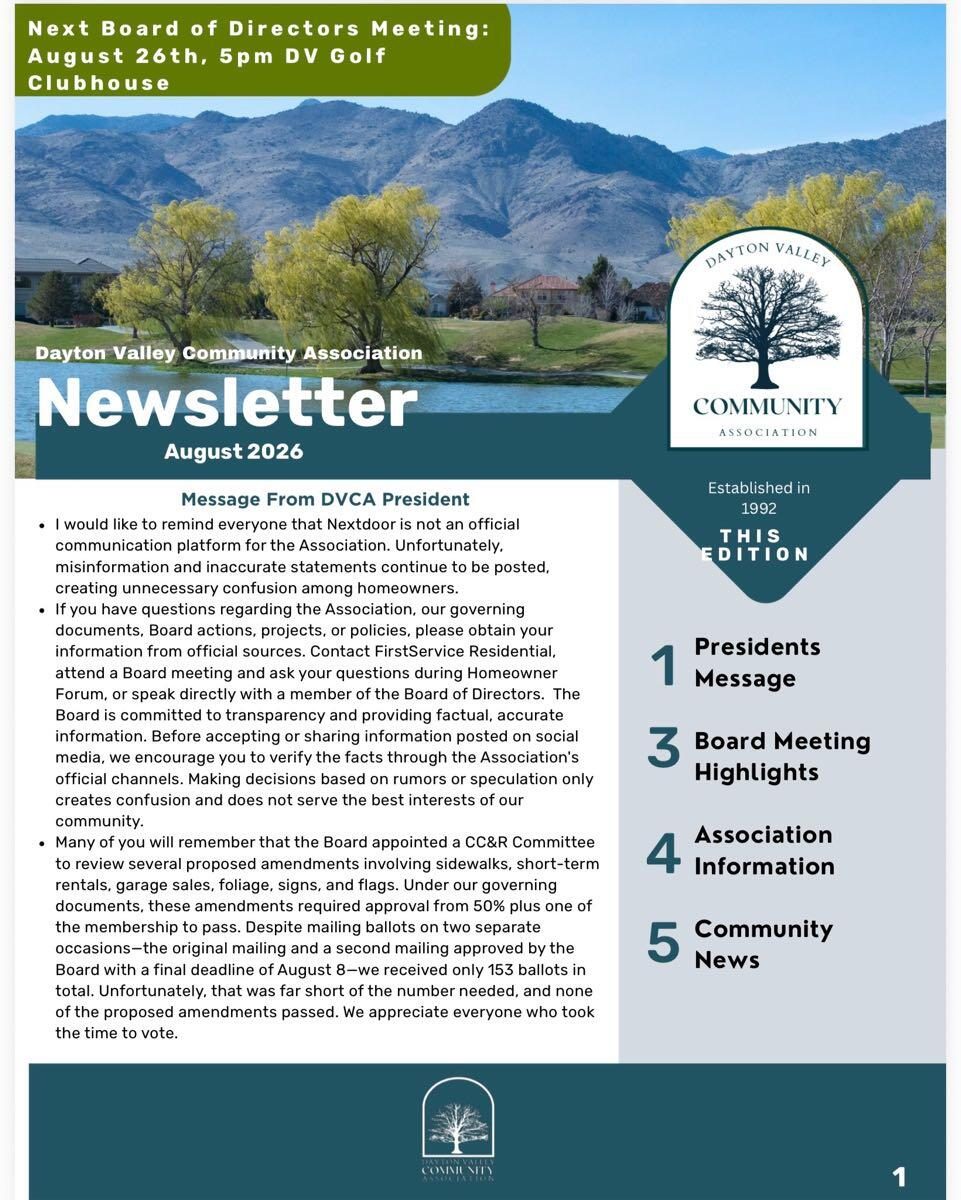
The latest DVCA newsletter contains an interesting announcement:

“Property Ownership Investigation - █████. The Board is currently working to determine the legal ownership of the property…”

Before the Association goes much further down this road, homeowners might want to understand exactly what 957 is and, more importantly, what liabilities could come with it.

This is not an ordinary residential lot.

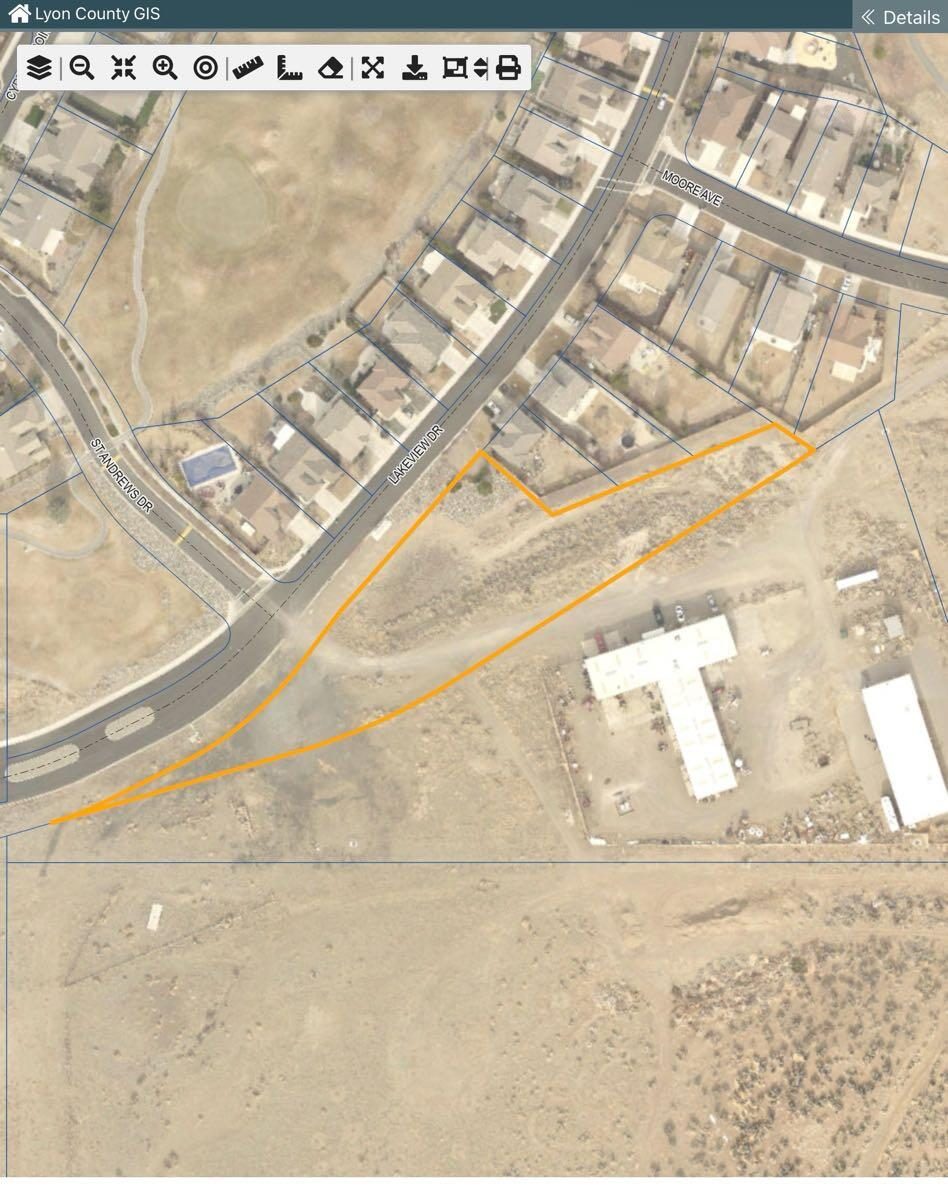
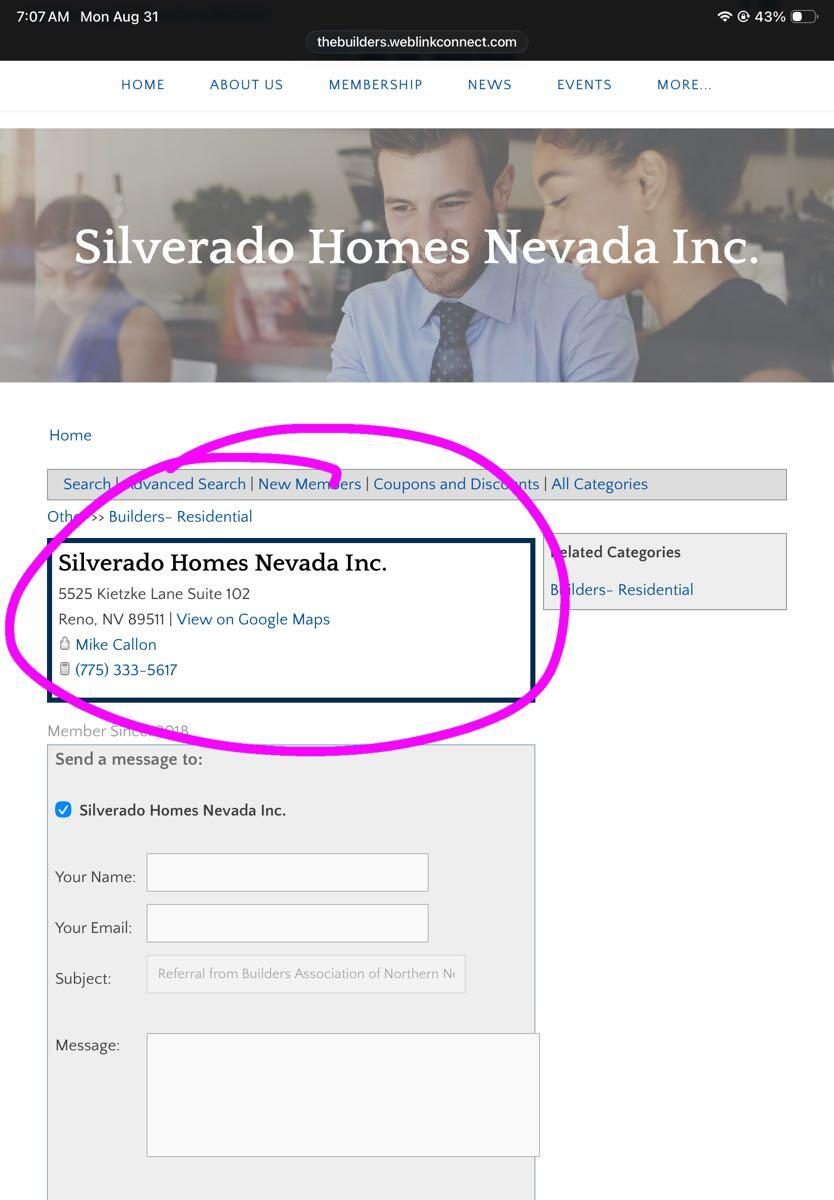
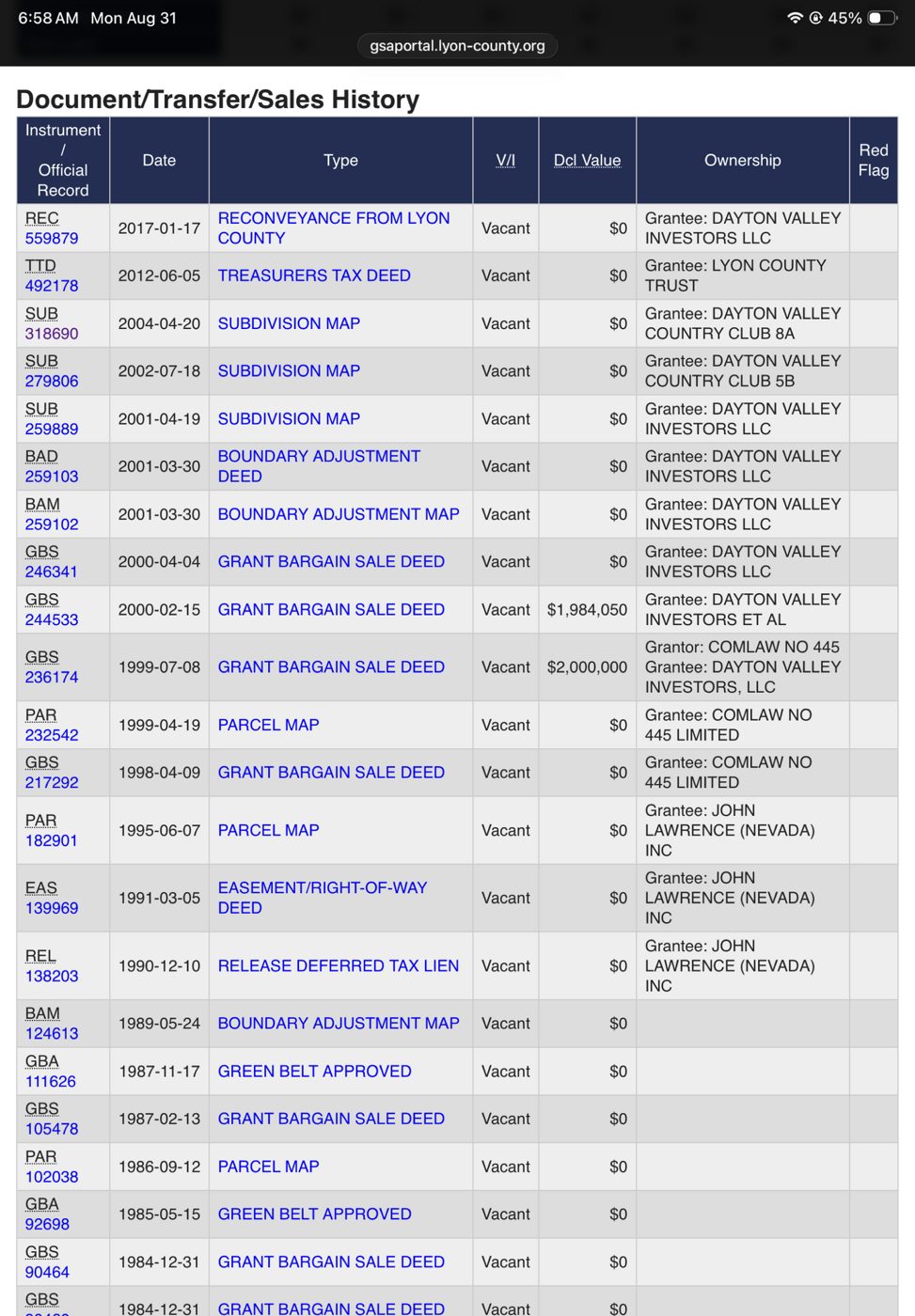
█████ is a remainder parcel owned by Dayton Valley Investors (aka Lakemont Homes, aka Silverado Homes - see pictures for identical corporate address) and should ultimately belong to, or otherwise be the responsibility of, the golf course (owned by Tour Specs, LLC).

Why?

Because the golf course maintenance facility is accessed by a driveway that runs through this parcel. See picture.

More importantly, the property contains a holding/drainage pond that collects runoff from Lakeview Drive and St. Andrews. That pond isn’t decorative landscaping. It serves a drainage function for the surrounding area.

And that raises a much bigger question than whose name appears in the Lyon County records:

Why would DVCA want to assume responsibility for this property?

If the Association acquires or accepts responsibility for the parcel, several issues immediately need to be addressed.

The golf course would presumably need a legally enforceable easement for continued access across HOA property to its maintenance facility.

Then there is the pond.

Who becomes responsible for inspecting it? Maintaining it? Removing sediment and vegetation? Repairing drainage structures? Ensuring it has adequate capacity? What happens if a major storm causes the pond to overflow and surrounding homes are flooded?

If DVCA owns the property, those questions potentially become our questions, our insurance issues, our legal expenses, and ultimately our homeowners’ money.

This isn’t a cute little piece of common area that needs some weeds pulled twice a year. It’s a parcel containing drainage infrastructure with a golf course access road running through it.

Before the Board even considers putting DVCA anywhere in the chain of ownership, I would hope it obtains a title report, identifies every existing easement and drainage obligation, determines who historically maintained the pond, establishes why DVI ended up with the remainder parcel, determines the golf course’s legal rights to the driveway, and obtains a written assessment of the Association’s potential liability if the drainage system fails.

And homeowners should be told something else:

Is the Board merely trying to identify the rightful owner so that DVCA knows whom to contact, or is the Board considering having the Association take ownership or responsibility for this parcel?

Those are two very different things.

The newsletter says the Board is committed to providing homeowners with “factual, accurate information” from “official sources.”

Great.

Then this seems like an excellent opportunity for some transparency before DVCA accidentally turns a property-record mystery into a permanent HOA liability.

Finding the owner is one thing.

Becoming the owner is something else entirely.

Image withheld in the public version. Sign in to see it.
Photo from the postPhoto from the post
Image withheld in the public version. Sign in to see it.
Photo from the post

August 29, 2026 at 6:44 AM · Shared with: your neighborhood

The Incredible Disappearing HOA Board

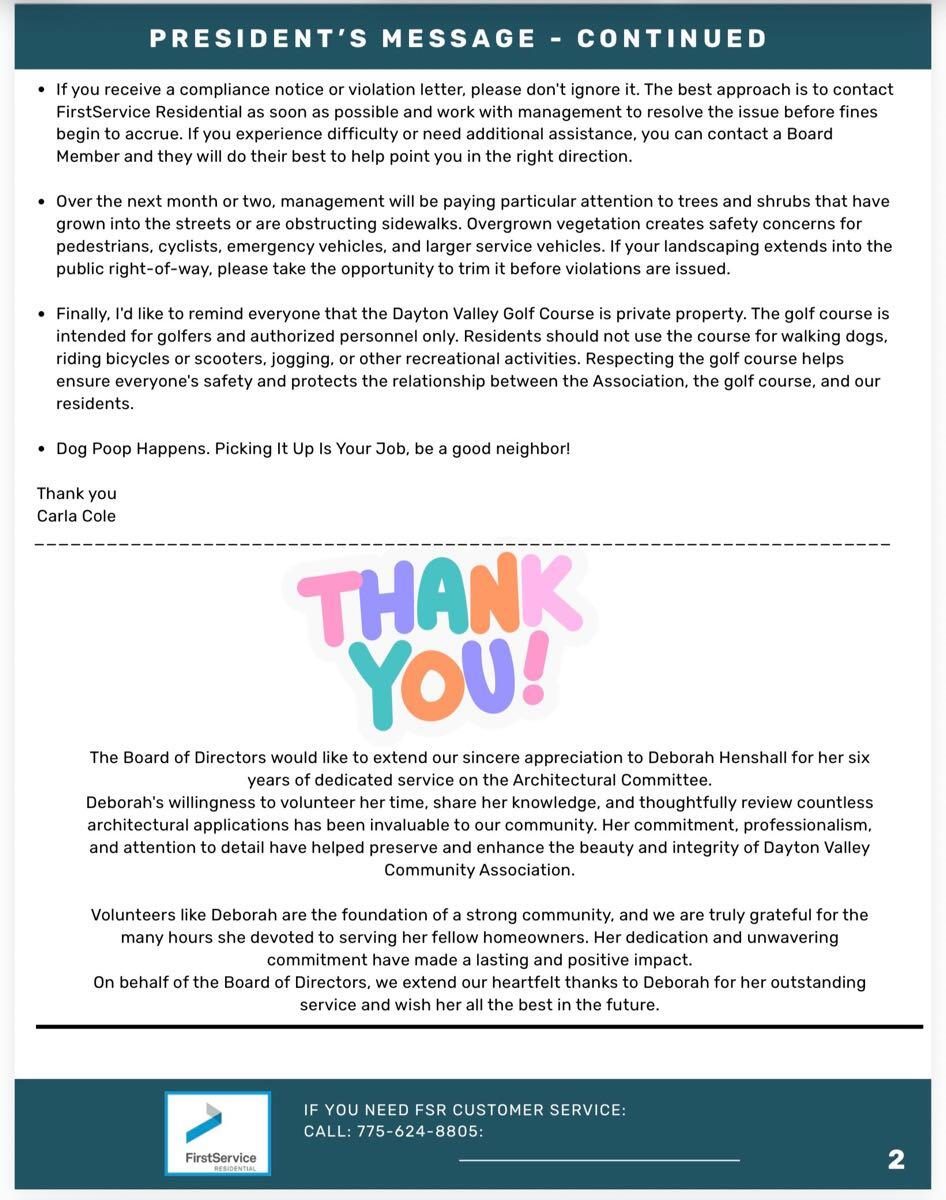
I have attached the latest newsletter. Notice anything missing? Look again. The individual board members are not listed nor is there contact info for ANY board member. You can’t even contact our community manager. The only phone number given is the call center for First Service Residential - our property management company.

==============

Has anyone else noticed that our elected DVCA Board has apparently entered the Witness Protection Program?

Want to contact a board member? Good luck.

Board contact information has disappeared. Now even the directors’ names have vanished from the newsletter.

Whatever happened to transparency and openness?

These are elected representatives of our community. Homeowners should not need a secret handshake, decoder ring, or membership in the women’s golf club to figure out how to communicate with the HOA president.

And there’s another issue that deserves an answer: Where are official Board communications being stored?

As far as I am aware, Board members are using individual Gmail accounts for HOA business. That raises a very basic records-management question.

What happens when a director resigns, loses an election, or simply walks away?

If Association business is being conducted through Gmail accounts controlled by individual directors, who controls those records after that director leaves? Are the accounts owned and administered by DVCA? Are messages automatically archived somewhere under Association control? Is there a retention policy? Can future directors and management retrieve those communications?

Or does part of the Association’s institutional record potentially walk out the door with the director?

This isn’t some obscure technical question. Board communications can involve contracts, enforcement decisions, legal matters, vendor discussions, homeowner complaints, financial decisions, and other Association business. Those records shouldn’t depend upon whether a former director remembers a Gmail password three years from now.

Nobody is asking directors to publish their personal cellphone numbers or home addresses. Give each director an Association-controlled email account, retain the records centrally, and provide homeowners with a straightforward way to contact their elected representatives.

Instead, we’ve somehow arrived at a system where the Board has become less accessible, its members’ names have disappeared from the newsletter, and homeowners are left wondering how official communications are being preserved.

And then there’s the rather awkward perception that access depends on whether you’re part of the right social circle.

If you’re in the women’s golf club or Monday morning bridge club, apparently finding the HOA president isn’t terribly difficult. If you’re an ordinary homeowner with a question, concern, or disagreement, you’re left trying to figure out how to communicate with your own elected representatives.

That’s backwards.

Transparency shouldn’t require a tee time.

And responsible record retention shouldn’t depend on somebody’s Gmail password.

Photo from the postPhoto from the post
Image withheld in the public version. Sign in to see it.
Photo from the postPhoto from the postPhoto from the postPhoto from the post

August 17, 2026 at 5:12 PM · Shared with: your neighborhood · No longer on Nextdoor

Want an example of how DVCA wastes homeowners’ money?

Here’s one that played out over several years, and much of the story is sitting right there in the Lyon County Recorder’s public records.

A few years ago, a homeowner in DVCA was incarcerated and his house essentially became abandoned.

The water was shut off. The lawn died. The front fence blew down, exposing an overgrown backyard. At some point the house was burglarized, the garage door was damaged, and it was left partially open.

It was an absolute nightmare for the surrounding neighbors. I completely understand why something needed to be done. A property in that condition is an eyesore, a security problem, and potentially affects the value of every house around it.

The question is how the Board chose to deal with it and how much homeowners paid for that strategy.

DVCA initially did what it normally does: issue violations.

Dead grass? Violation.

Fence? Violation.

Garage door? Violation.

Property maintenance? More violations.

At $100 per week for continuing violations, the numbers piled up. At one point, the amount being claimed against this property was more than $30,000.

There was just one enormous problem.

The property was already financially underwater.

The public records showed multiple loans secured by the property, including a relatively recent loan modification. Looking at the debt against the property and the condition of the house, there was an obvious question that should have been asked before spending thousands of dollars chasing HOA fines:

Even if DVCA wins, where exactly is the money going to come from?

And then it got even more expensive.

The homeowner attempted bankruptcy.

DVCA, through LKG Law, became involved in the bankruptcy proceedings because of the HOA’s claims and liens against the property. Legal work was performed to preserve DVCA’s position and distinguish the Association’s property-related lien rights from the homeowner’s personal bankruptcy obligations.

LKG ultimately succeeded in protecting DVCA’s position in that proceeding.

But winning a legal argument and collecting money are two very different things.

The Board continued down the same road.

Letters.

Demands.

Liens.

Default notices.

More legal involvement.

More time.

More money.

Meanwhile, the basic economics of the property hadn’t magically changed.

And now we can look at the public record and see how the story ended.

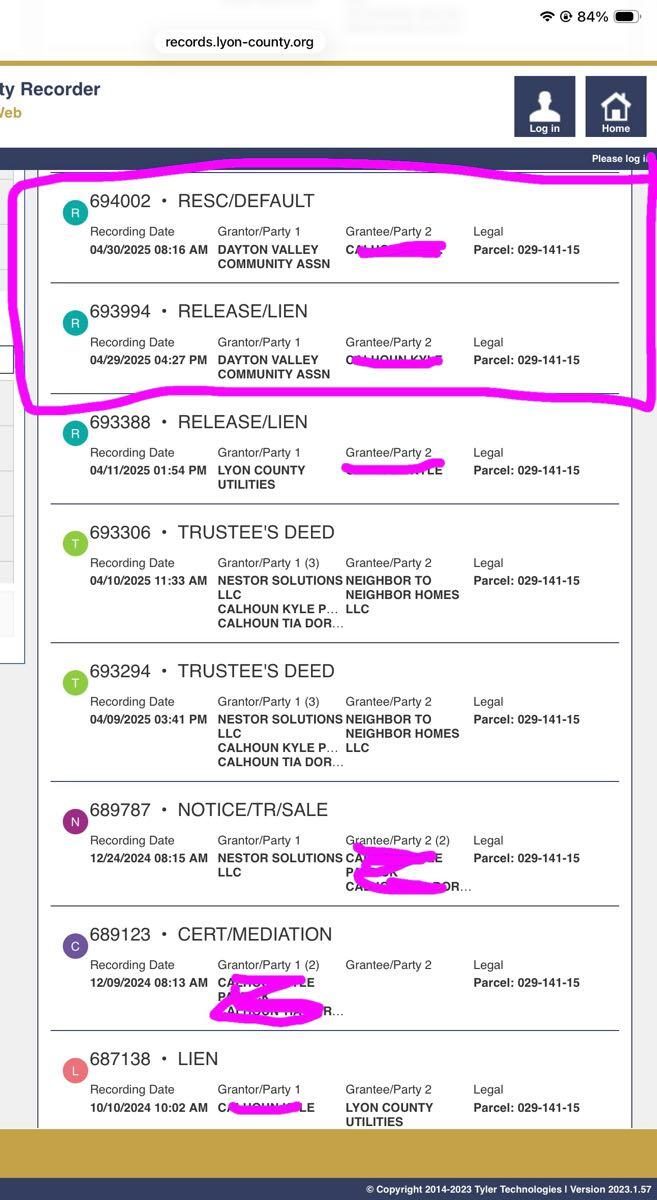
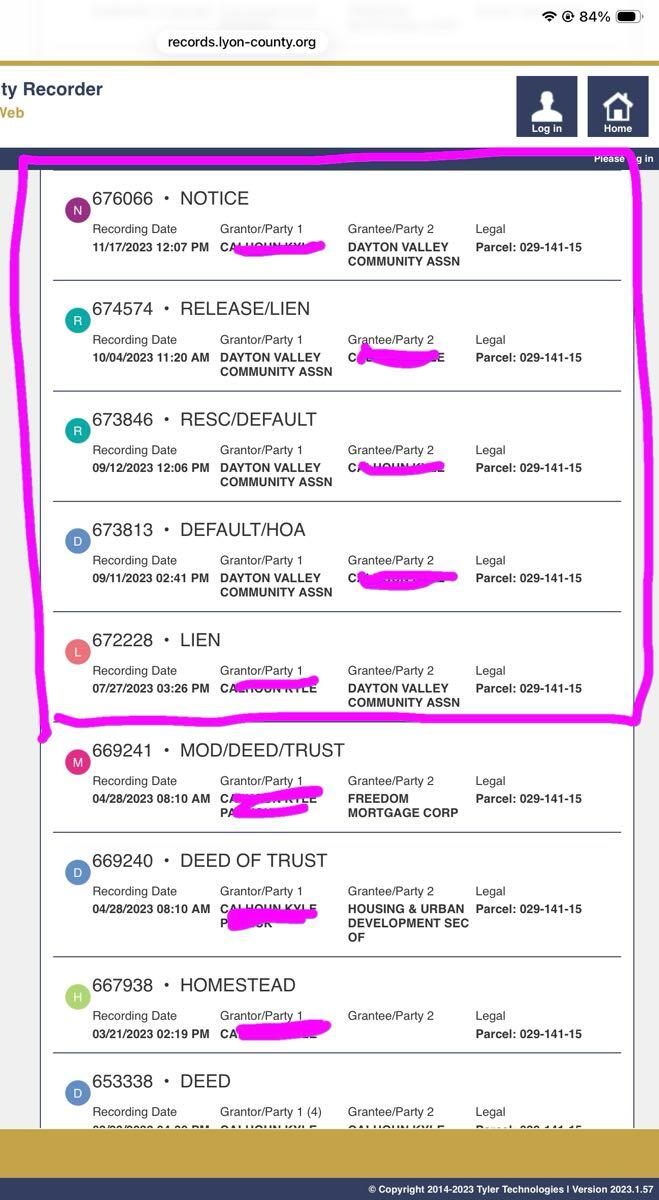
In July 2023, DVCA recorded a lien against the property.

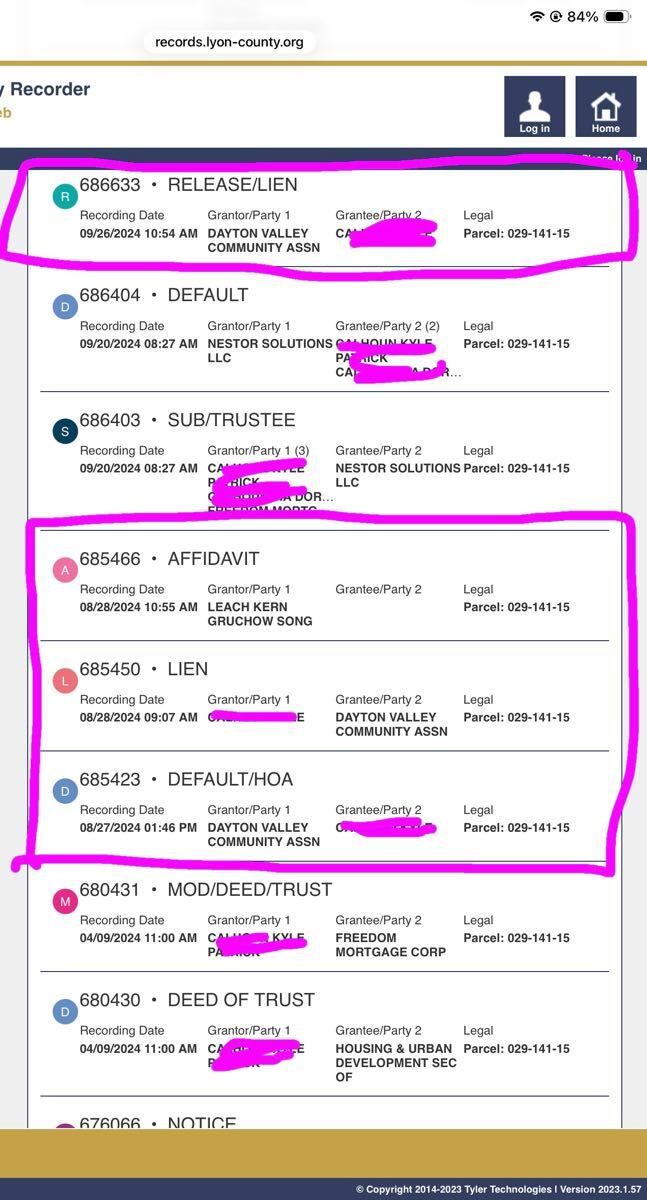
In September 2023, DVCA recorded a Default/HOA.

The very next day, DVCA recorded a rescission of that default.

In October 2023, DVCA recorded a release of its lien.

Then the cycle started again.

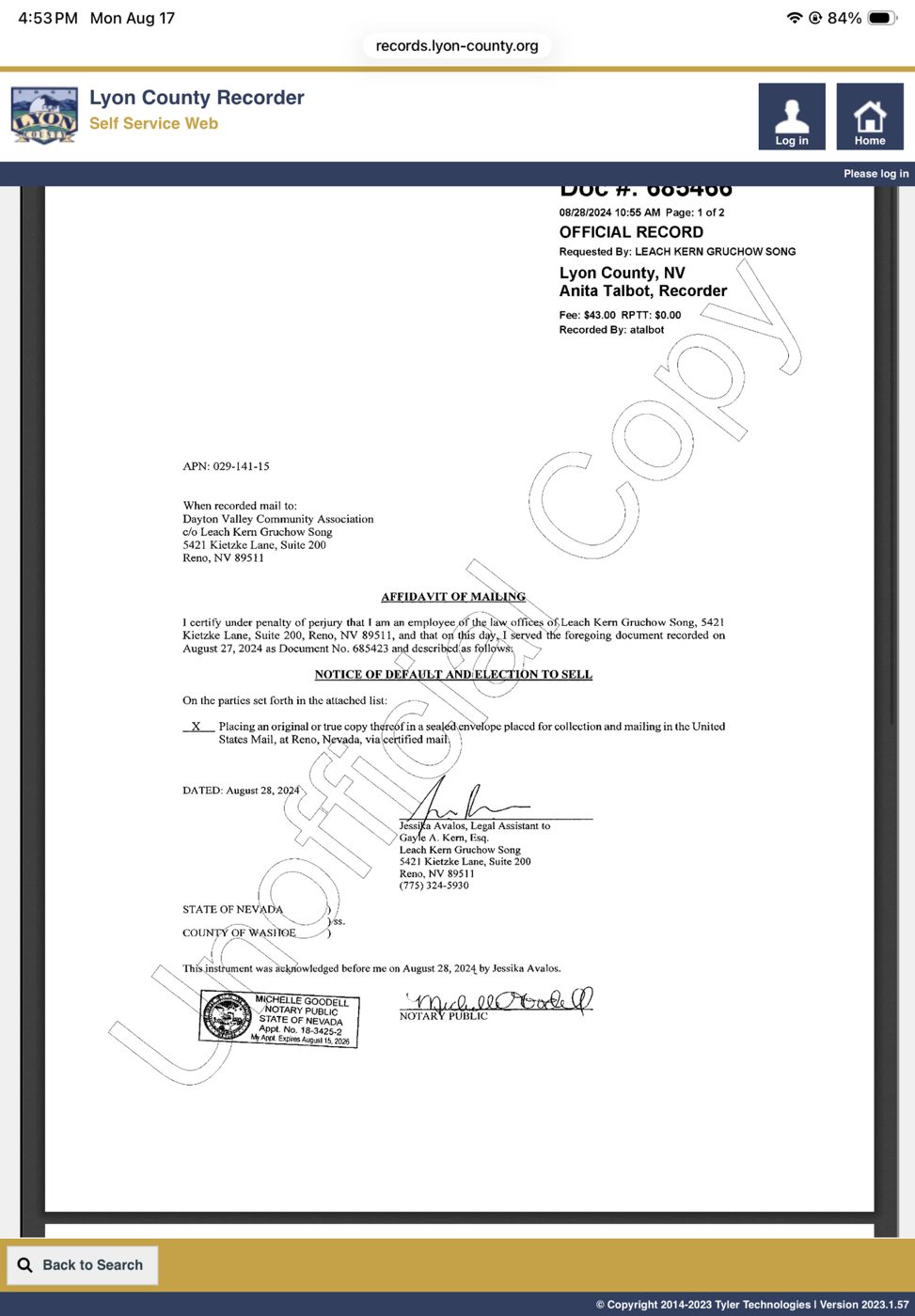
In August 2024, DVCA recorded another Default/HOA.

The next day, another DVCA lien was recorded.

By September 2024, the mortgage trustee was recording its own default.

Then, on September 26, 2024, DVCA released its lien again.

The mortgage foreclosure process continued.

A Notice of Trustee’s Sale was recorded in December 2024.

Trustee’s deeds were eventually recorded in April 2025 transferring the property to Neighbor to Neighbor Homes LLC.

And what happened to DVCA’s latest attempt?

On April 29, 2025, DVCA recorded another RELEASE OF LIEN.

On April 30, 2025, DVCA recorded a RESCISSION OF DEFAULT.

Game over.

Look at the screenshots from the Lyon County Recorder. This isn’t gossip. The recorded-document history is right there.

This is why I keep questioning the Board’s use of legal counsel.

The issue isn’t whether the abandoned property was a problem. It absolutely was.

The issue isn’t whether DVCA had the right to enforce its governing documents. It did.

The issue is whether anyone stopped to perform a basic cost-benefit analysis before repeatedly spending homeowners’ money pursuing an asset that was already buried under superior debt.

If a property is worth less than the debt ahead of the HOA, piling another $10,000, $20,000 or $30,000 in fines onto the ledger doesn’t create $30,000 of equity.

You cannot lien your way into equity that doesn’t exist.

And every letter from legal, every bankruptcy filing reviewed, every demand, every lien prepared, every default document, and every subsequent release costs the Association money.

That’s OUR money.

This is also why I have such a problem with the way LKG is used by this Board.

A threatening letter from an attorney may look impressive. A lien may look impressive. A $30,000 violation balance may look impressive.

But homeowners should be asking a much simpler question:

What did we spend pursuing this property, and what did DVCA actually recover?

Those two numbers should be incredibly easy for the Board to provide.

If DVCA spent thousands upon thousands of dollars in legal fees pursuing this property only to eventually release its liens as the property went through foreclosure, then homeowners deserve to know exactly what the return on that expenditure was.

Because legal enforcement isn’t supposed to be about generating paperwork.

It is supposed to accomplish something.

And sometimes the financially responsible decision is recognizing when, to quote our HOA President, “the juice isn’t worth the squeeze”.

Photo from the postPhoto from the postPhoto from the postPhoto from the post

August 14, 2026 at 6:24 AM · Shared with: your neighborhood · No longer on Nextdoor

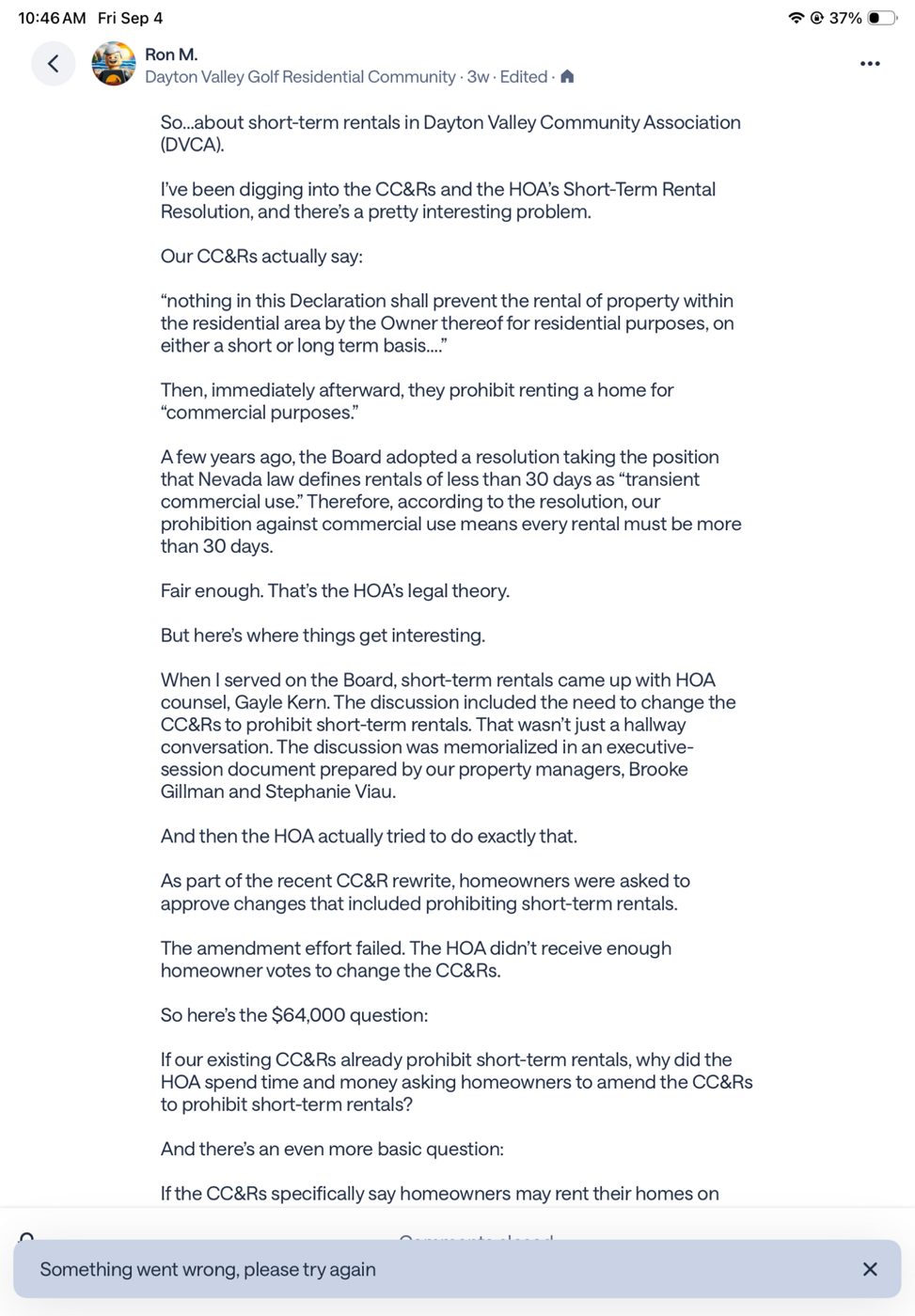
So…about short-term rentals in Dayton Valley Community Association (DVCA).

I’ve been digging into the CC&Rs and the HOA’s Short-Term Rental Resolution, and there’s a pretty interesting problem.

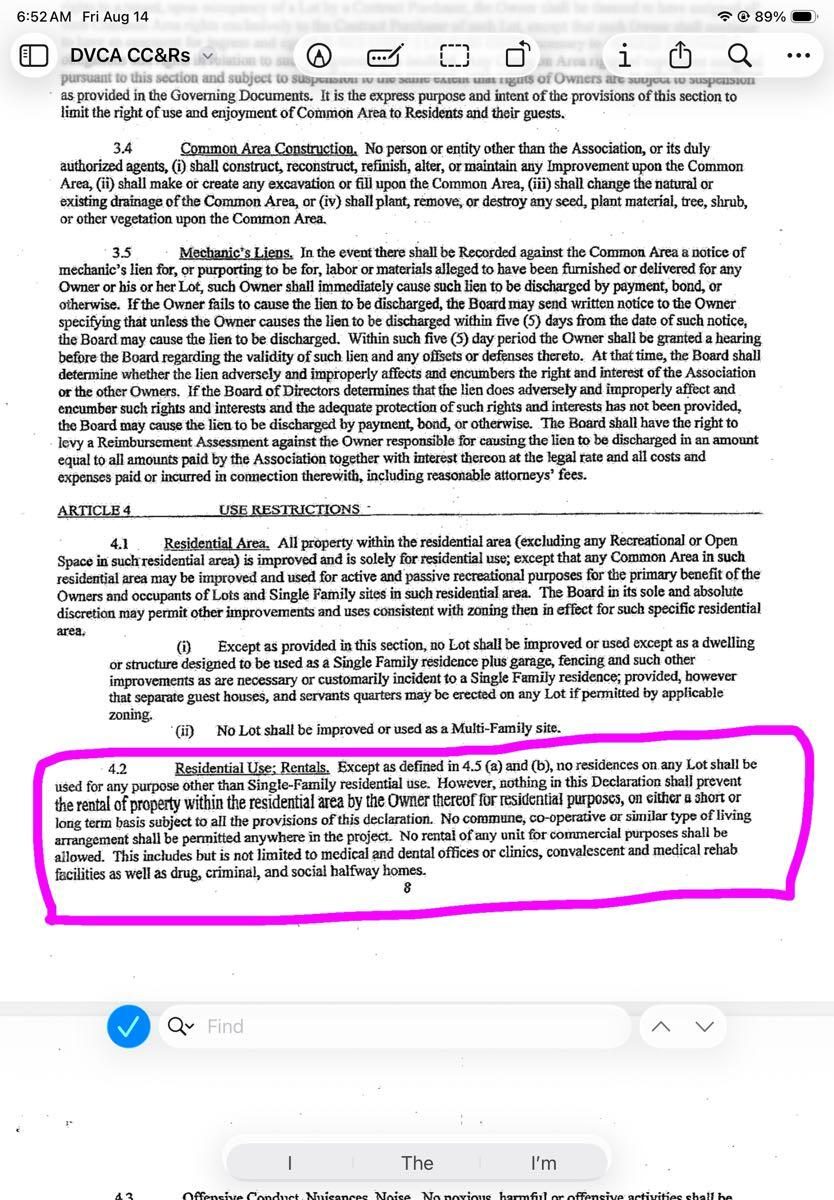
Our CC&Rs actually say:

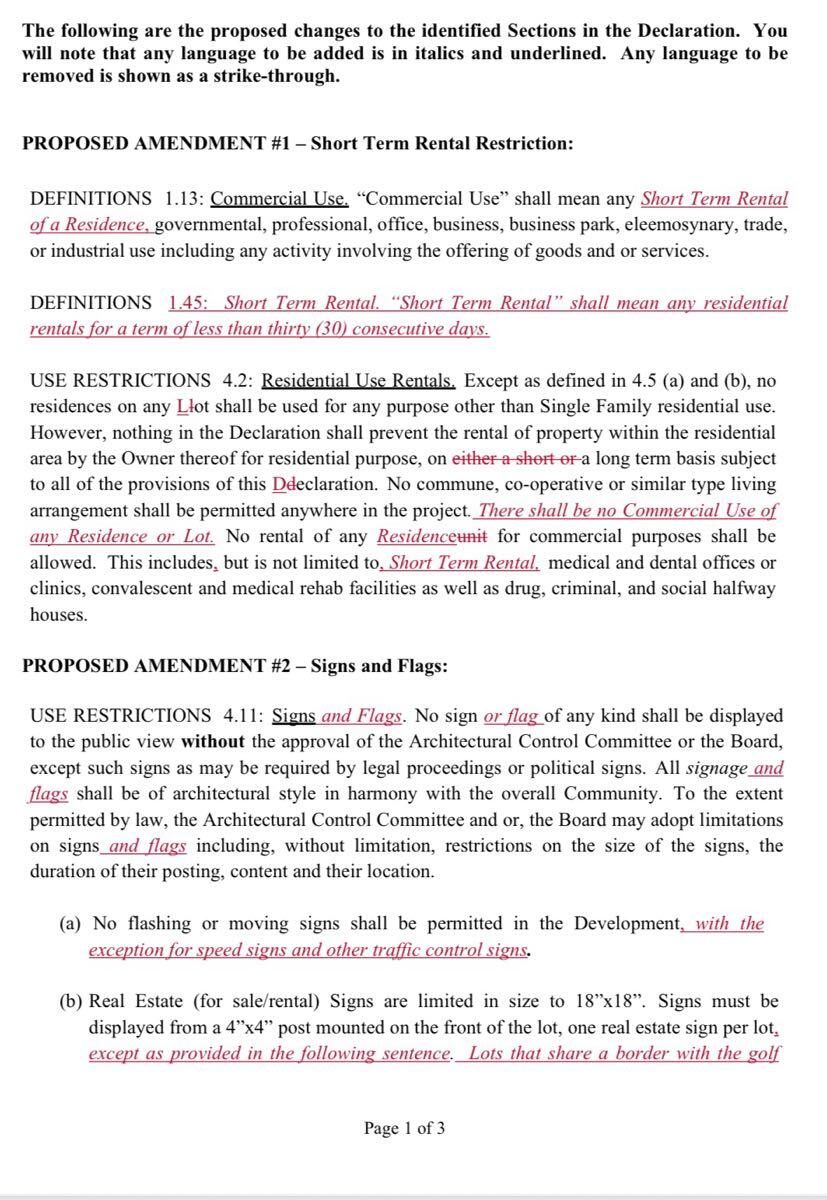
“nothing in this Declaration shall prevent the rental of property within the residential area by the Owner thereof for residential purposes, on either a short or long term basis….”

Then, immediately afterward, they prohibit renting a home for “commercial purposes.”

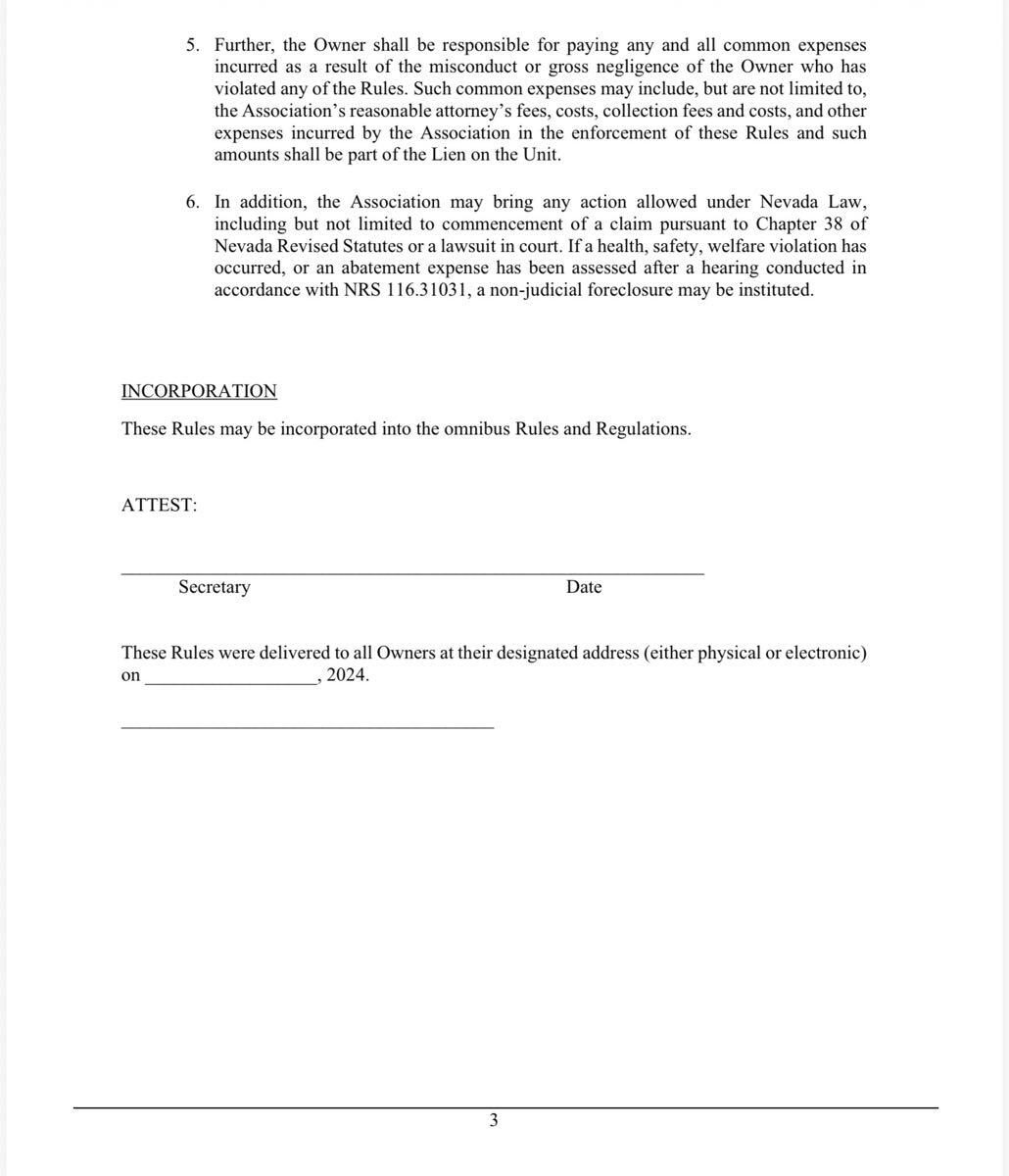
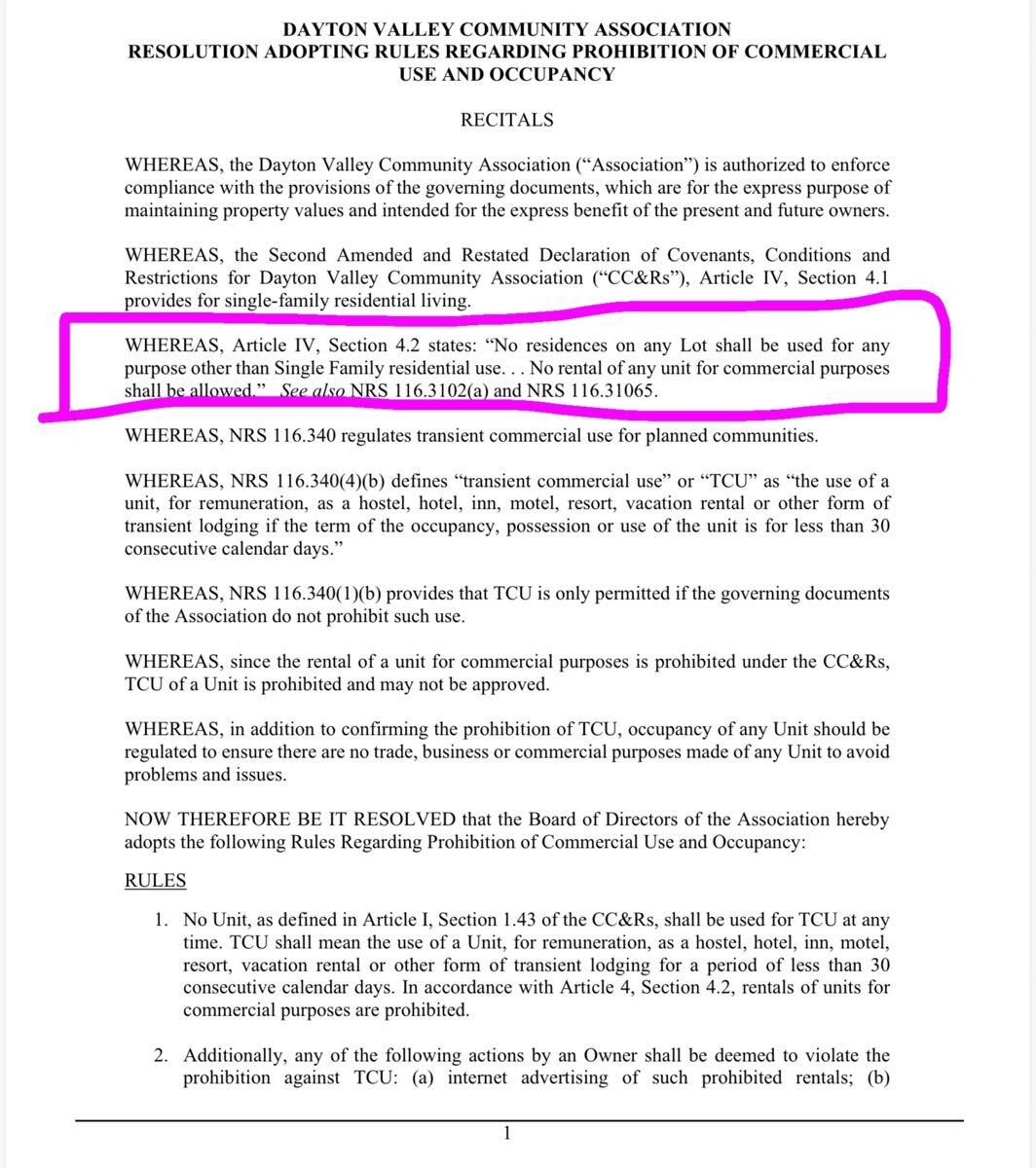
A few years ago, the Board adopted a resolution taking the position that Nevada law defines rentals of less than 30 days as “transient commercial use.” Therefore, according to the resolution, our prohibition against commercial use means every rental must be more than 30 days.

Fair enough. That’s the HOA’s legal theory.

But here’s where things get interesting.

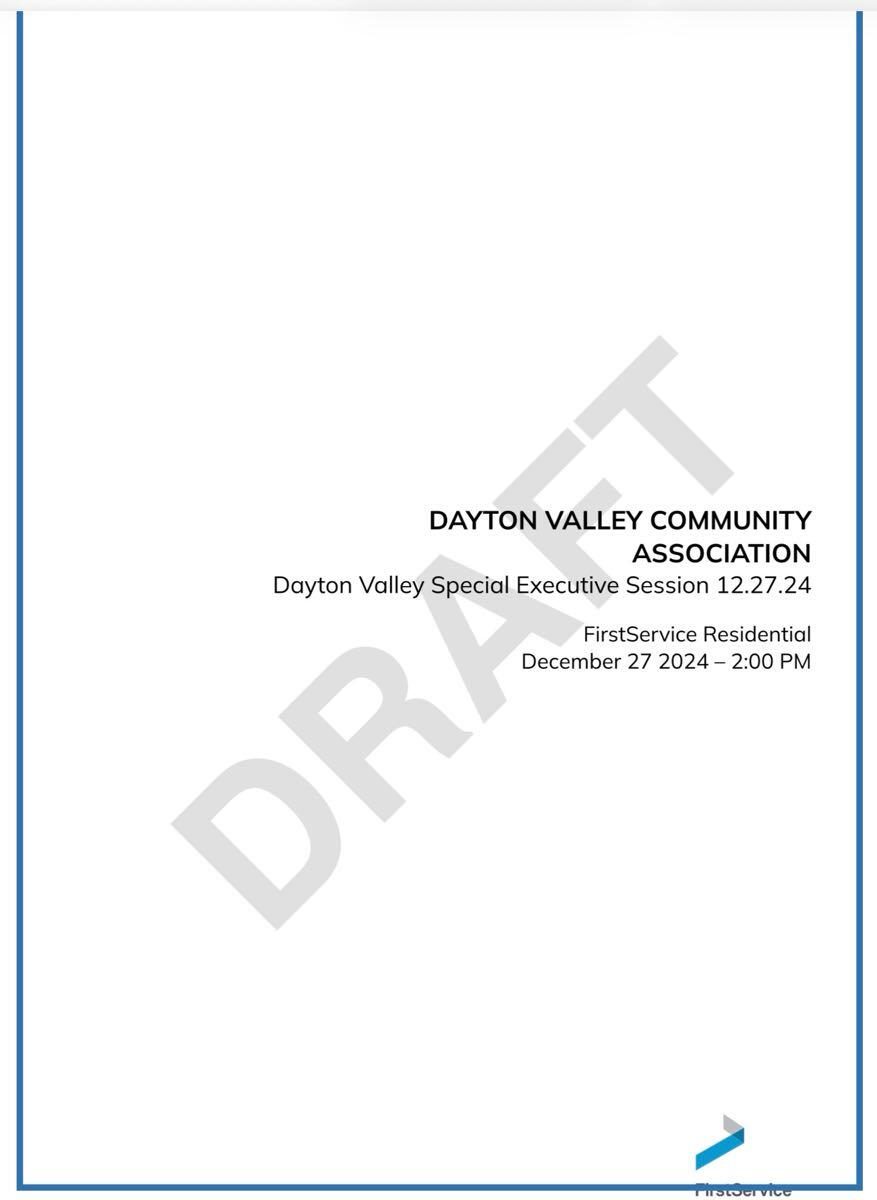
When I served on the Board, short-term rentals came up with HOA counsel, Gayle Kern. The discussion included the need to change the CC&Rs to prohibit short-term rentals. That wasn’t just a hallway conversation. The discussion was memorialized in an executive-session document prepared by our property managers, Brooke Gillman and Stephanie Viau.

And then the HOA actually tried to do exactly that.

As part of the recent CC&R rewrite, homeowners were asked to approve changes that included prohibiting short-term rentals.

The amendment effort failed. The HOA didn’t receive enough homeowner votes to change the CC&Rs.

So here’s the $64,000 question:

If our existing CC&Rs already prohibit short-term rentals, why did the HOA spend time and money asking homeowners to amend the CC&Rs to prohibit short-term rentals?

And there’s an even more basic question:

If the CC&Rs specifically say homeowners may rent their homes on either a “short or long term basis,” what exactly does the word “short” mean?

31 days?

60 days?

Six months?

Because apparently it doesn’t mean fewer than 30 days.

There’s another detail I find particularly interesting. The HOA’s STR resolution quotes the section saying homes are for residential use, inserts an ellipsis (…), and then quotes the prohibition against commercial rentals.

Guess what’s inside that ellipsis?

Yep.

The sentence saying “nothing in this Declaration shall prevent” residential rentals on either a “short or long term basis.”

That’s a pretty important sentence to leave out of a resolution explaining why short-term rentals are supposedly prohibited.

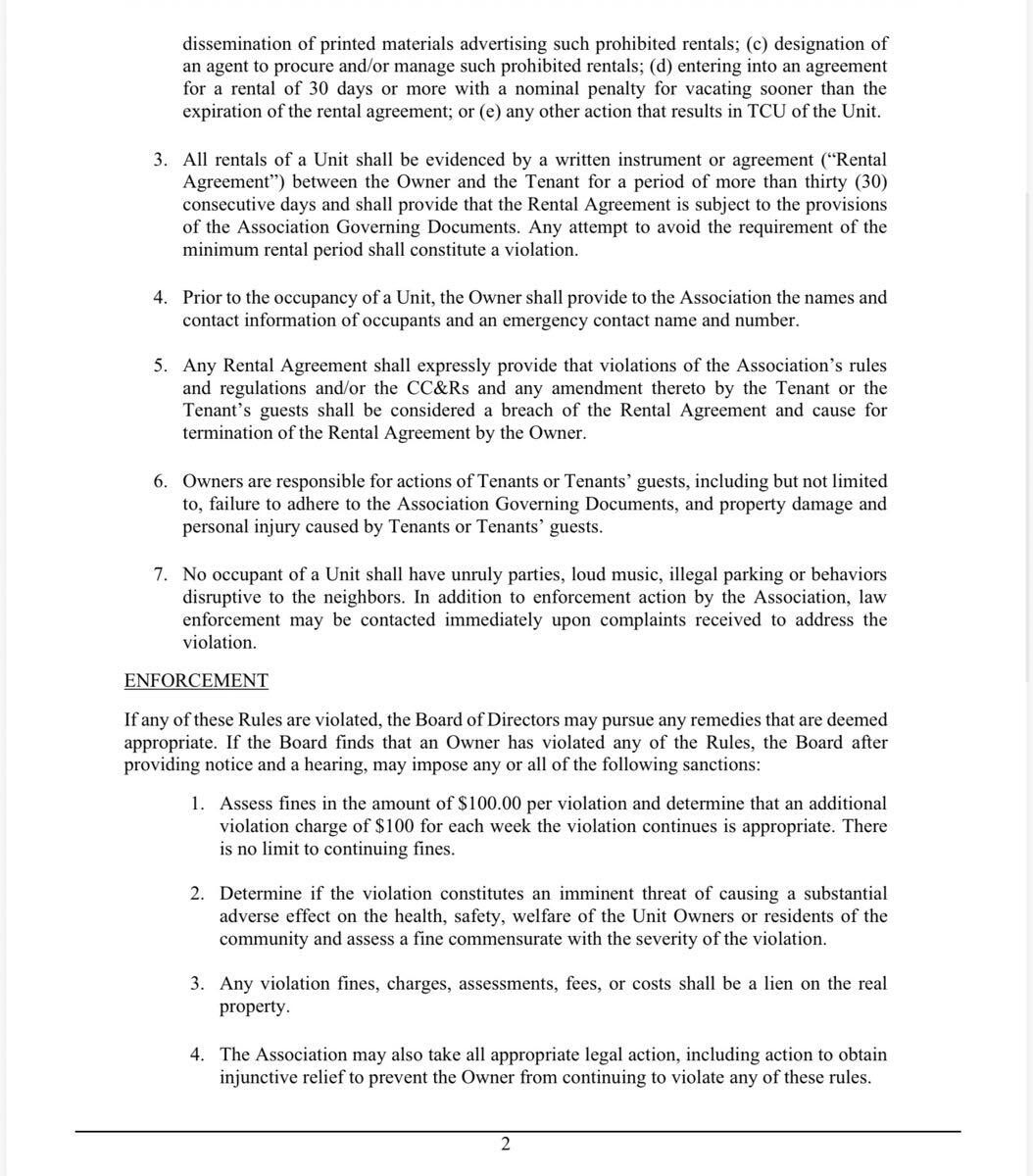
I’m not suggesting STR tenants get a free pass. They should follow the same noise, parking, nuisance and other HOA restrictions as everyone else, and the homeowner remains responsible for them.

But whether someone behaves badly and whether the HOA has the authority to prohibit the rental itself are two completely different questions.

I’m going to ask HOA counsel to explain the contradiction and to review the Association’s own executive-session records regarding the prior legal advice.

If the HOA’s position is that the existing resolution prohibits anyone from exercising the short-term residential rental rights described in §4.2, I intend to take that governing-document dispute through NRED’s alternative dispute resolution process and let the issue be decided through the proper process.

I’m not particularly interested in arguing about whether STRs are good or bad. That’s a policy question.

The interesting question is much simpler:

If homeownersi needed to amend the CC&Rs to prohibit short-term rentals, and that amendment failed, can the Board accomplish the same thing with a Board resolution?

And if the answer is that short-term rentals were already prohibited all along…why did we just ask 824 homeowners to vote to prohibit them?

Photo from the postPhoto from the postPhoto from the postPhoto from the postPhoto from the postPhoto from the post

August 3, 2026 at 10:38 AM · Shared with: your neighborhood

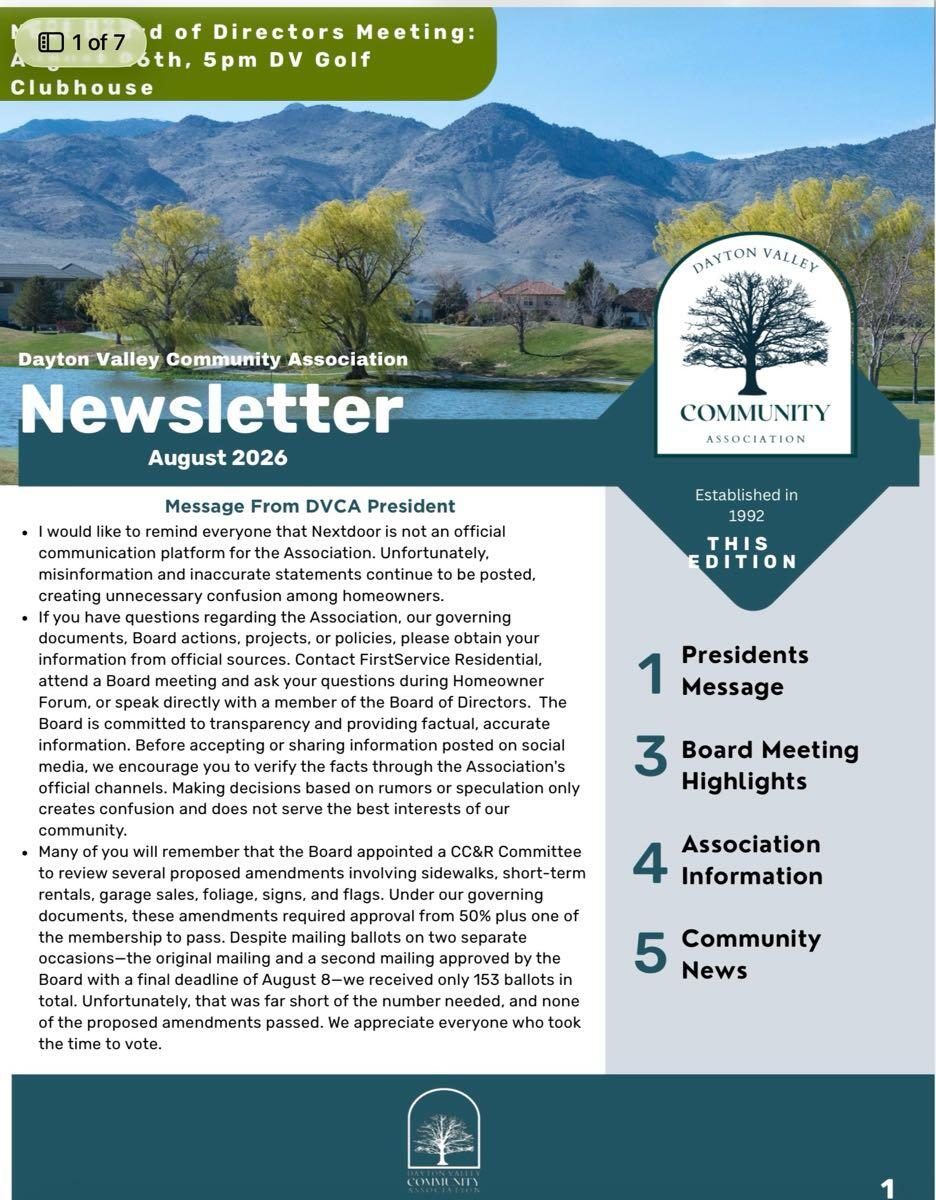
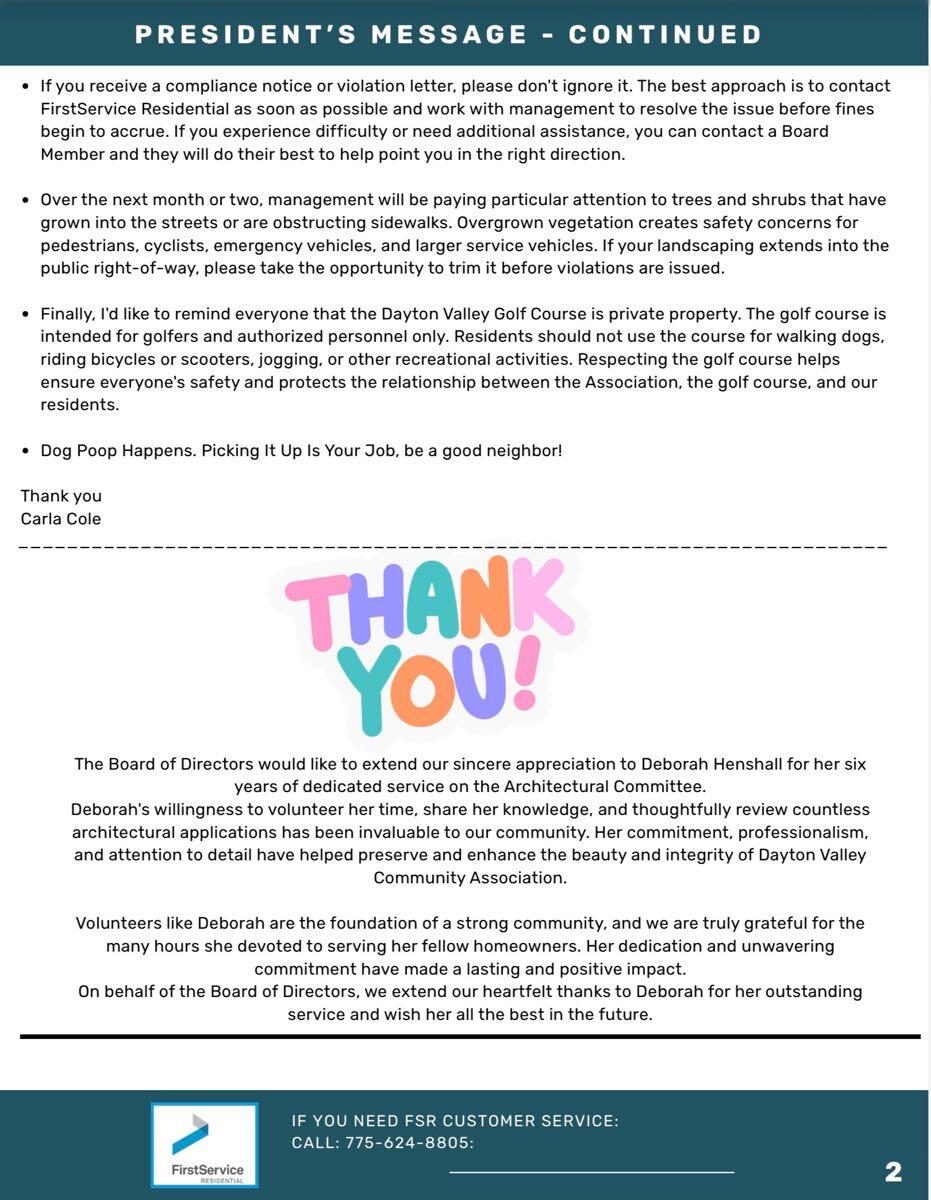
A few thoughts on the August DVCA newsletter…

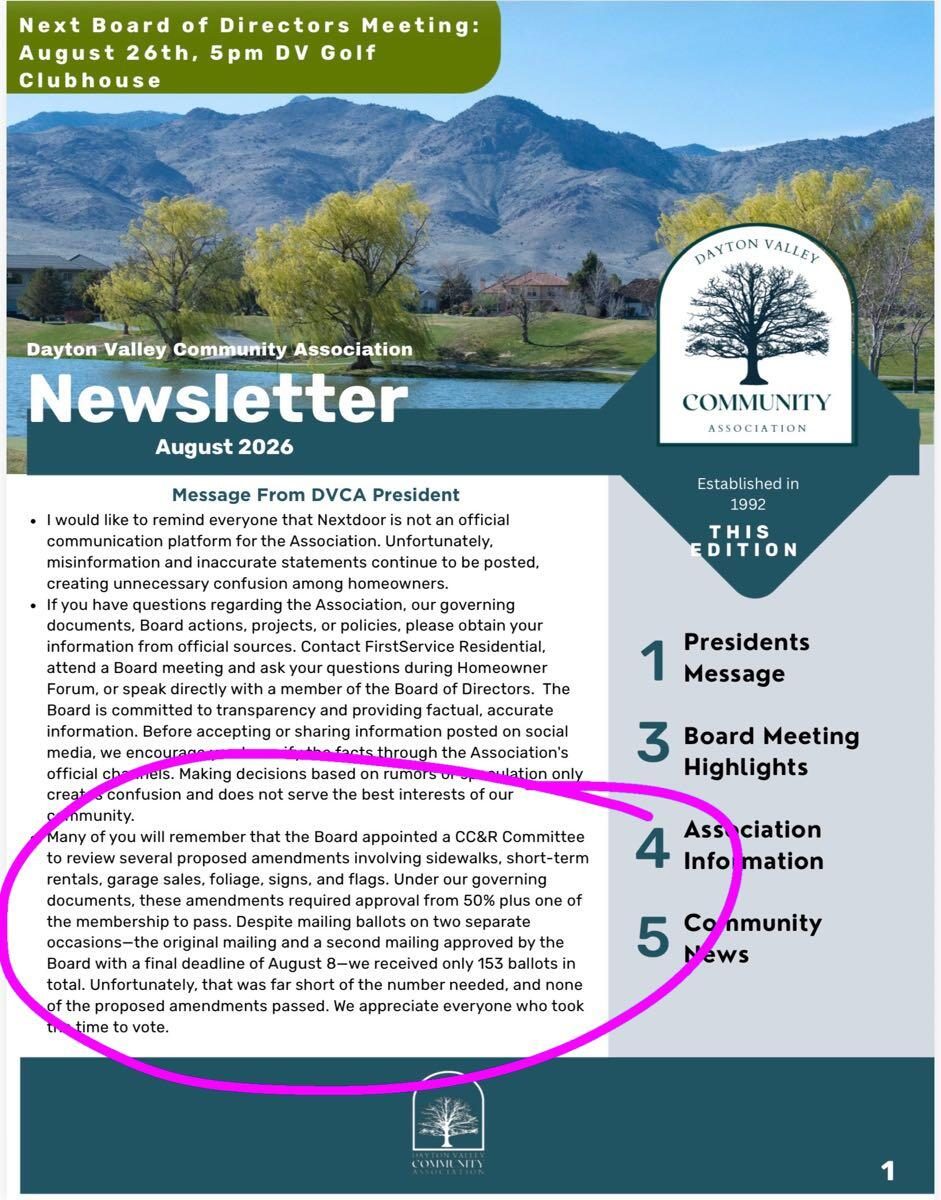
The Board spent months on CC&R revisions, countless volunteer hours, and what appears to be well over $10,000 in legal fees.

The result?

153 ballots out of 824 homes. Less than 19% participation. The amendments never had a realistic chance of passing.

Our community is divided, and large groups of homeowners simply do not support the current Board or the direction it is taking the Association.

I warned from the beginning that this initiative would fail, and fail spectacularly, because of the people chosen to lead it. The moment the committee chair and Board liaison were appointed in 2024, the effort was effectively doomed. I repeatedly urged them to bring together both the pro-HOA and anti-HOA factions. Instead, the process became divisive, multiple committee members resigned, and the results speak for themselves.

Here’s the part I don’t understand.

The Board already has the authority to grant waivers for many restrictions in Section 4 of the CC&Rs, including things like garage sales and even large train displays built in your garage. If the Board wanted to allow garage sales, it already had a mechanism to do so. An expensive CC&R rewrite wasn’t necessary.

The newsletter also warns homeowners about “misinformation” on Nextdoor.

I assume that’s directed at my posts about garage sales, the violation process, and the Board’s authority to grant waivers.

If anything I’ve posted is incorrect, identify it. Point to the governing document and explain why. Calling something “misinformation” without identifying a single false statement isn’t transparency. It’s the same tired playbook we’ve seen from this Board for years. It’s why only 153 people voted.

Finally, the newsletter encourages homeowners to attend Board meetings and ask questions. What it leaves out is that homeowner comments are limited to three minutes at the end of the meeting, after all Board business has been conducted, and the Board is under no obligation to answer any questions.

Questions and discussion are not the problem. Open dialogue and accountability make for a stronger community.

Photo from the postPhoto from the post

July 23, 2026 at 5:06 AM · Shared with: your neighborhood

Well…it finally happened.

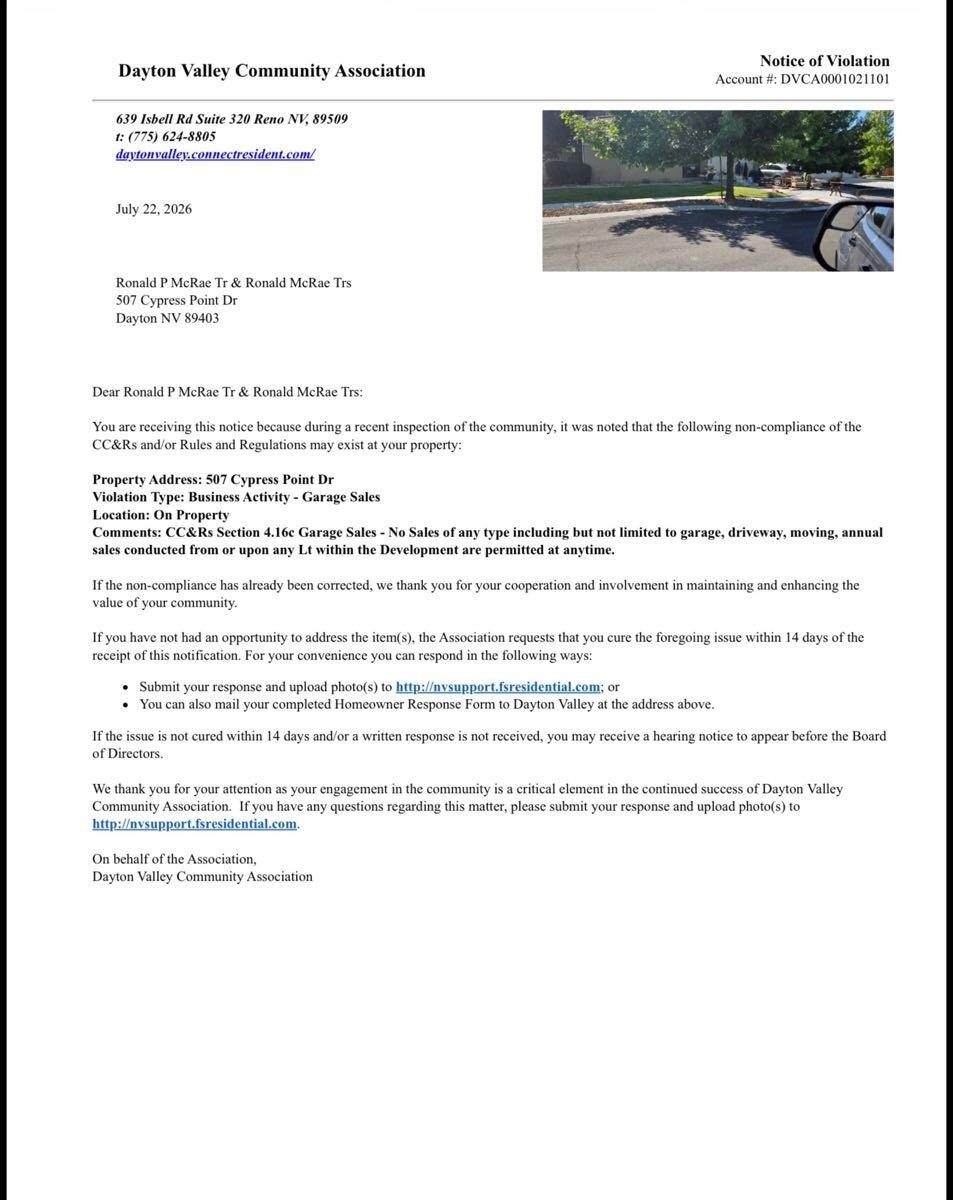
I received a violation letter from the HOA over a garage sale.

Ironically, the “fix” is incredibly simple.

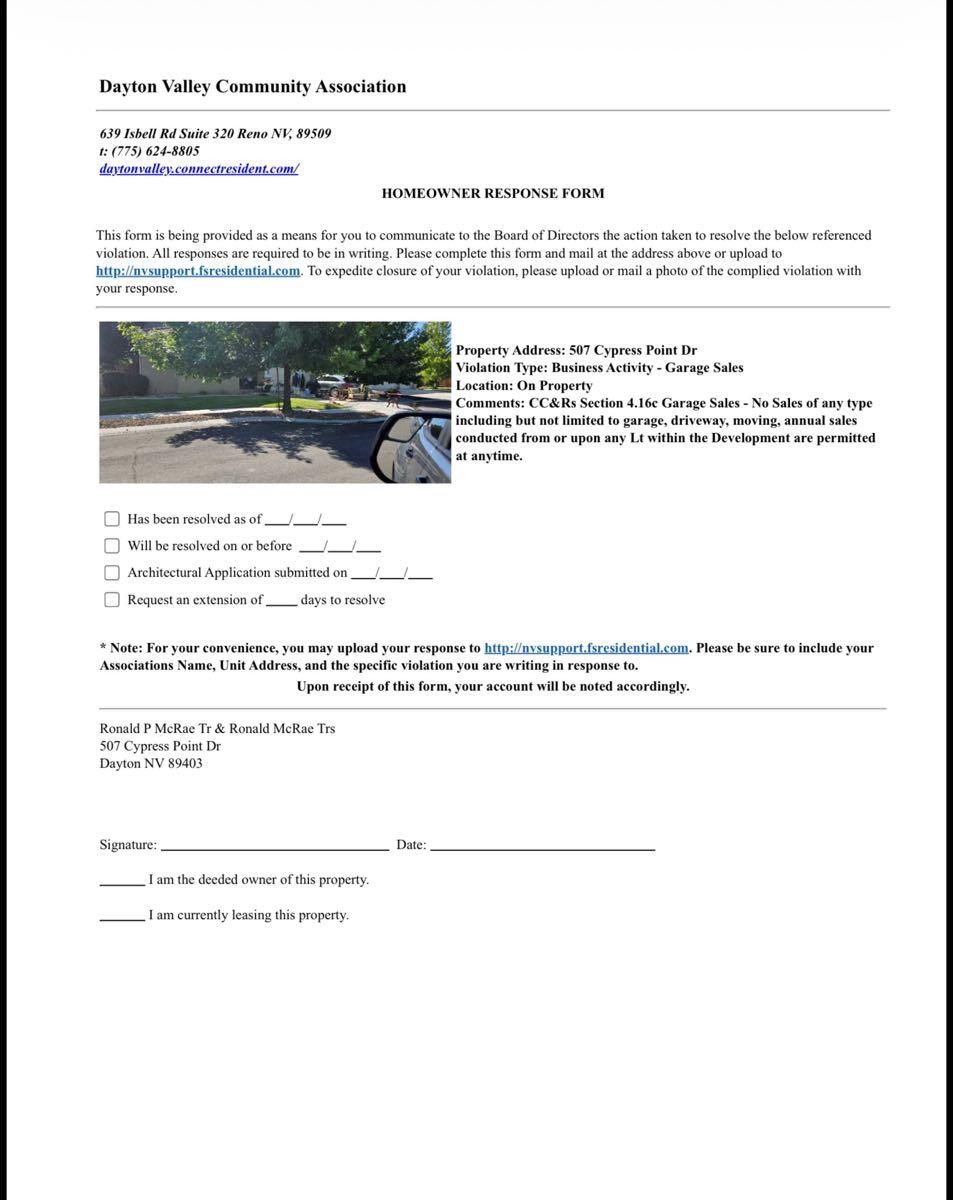
All I have to do is check the box that says “This has been resolved,” add the date it was corrected, and send it back. Assuming there are no additional garage sale violations within the next year, the matter is over because our governing documents reset habitual violations after one year.

What concerns me isn’t the violation itself. It’s how it was documented.

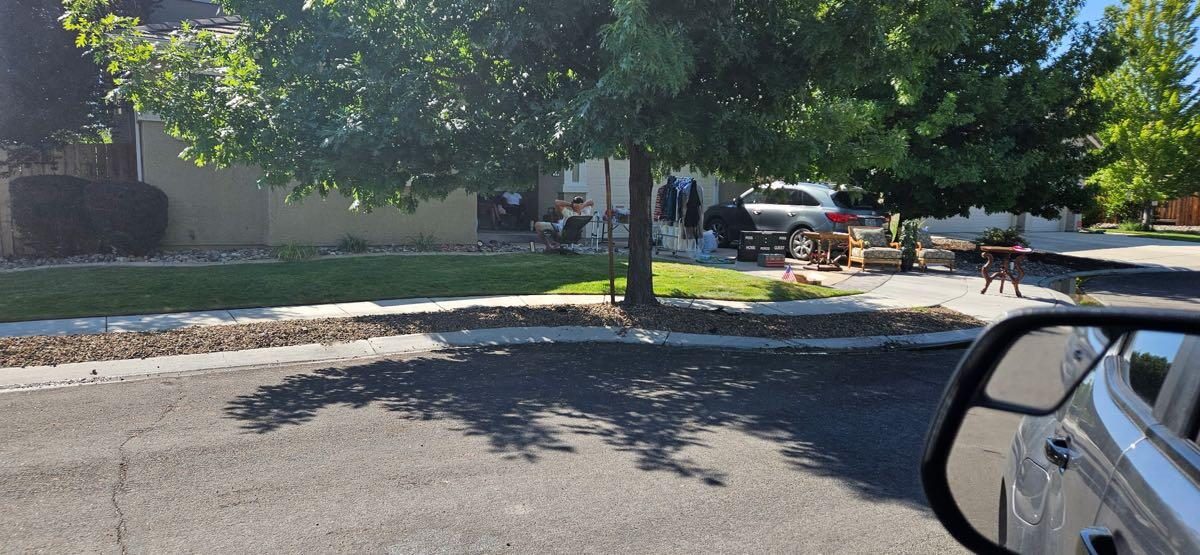
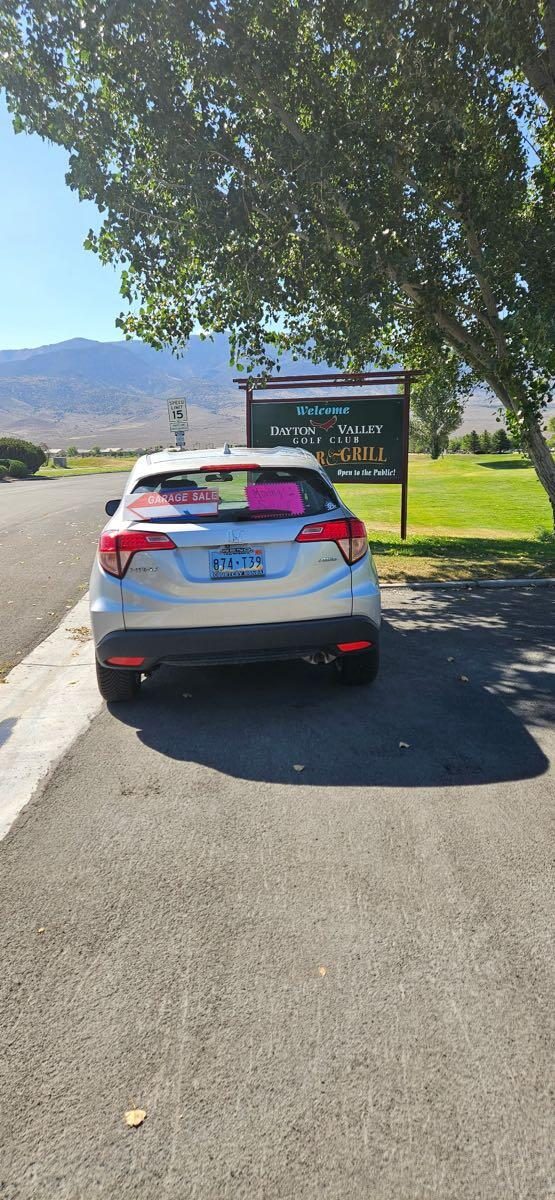
The notice letter shows the violation date as Wednesday, July 22nd. This is the same day I received the letter. (See picture #1 & #2)

The attached photographs do not include a date or time. (See picture #3 & #4)

The photographs do not show my house number or street address, even though historical violation notices have consistently included both the address and a timestamp so there is no question about when the alleged violation occurred or which property was involved.

One of the undated photographs is simply a vehicle displaying a garage sale sign. There is no address associated with the vehicle, and the photograph does not establish any connection between that vehicle and my home.

The photographs were also taken by a Board member rather than property management. During my time on the Board, legal counsel repeatedly warned us about the importance of consistent enforcement and the legal risks associated with selective enforcement. I was also present when legal counsel advised the Board regarding the use of vehicles as evidence and cautioned against attempting to associate license plates with residences for enforcement purposes.

So now what happens?

Instead of a straightforward violation notice, the Association’s attorney is going to have to review whether the notice complies with Nevada law, whether the evidence is sufficient, whether the procedures followed the Association’s own historical practices, and whether the enforcement was applied consistently. If the matter is not dismissed, there will likely be a hearing before the Board.

This is exactly the kind of situation that drives up legal expenses.

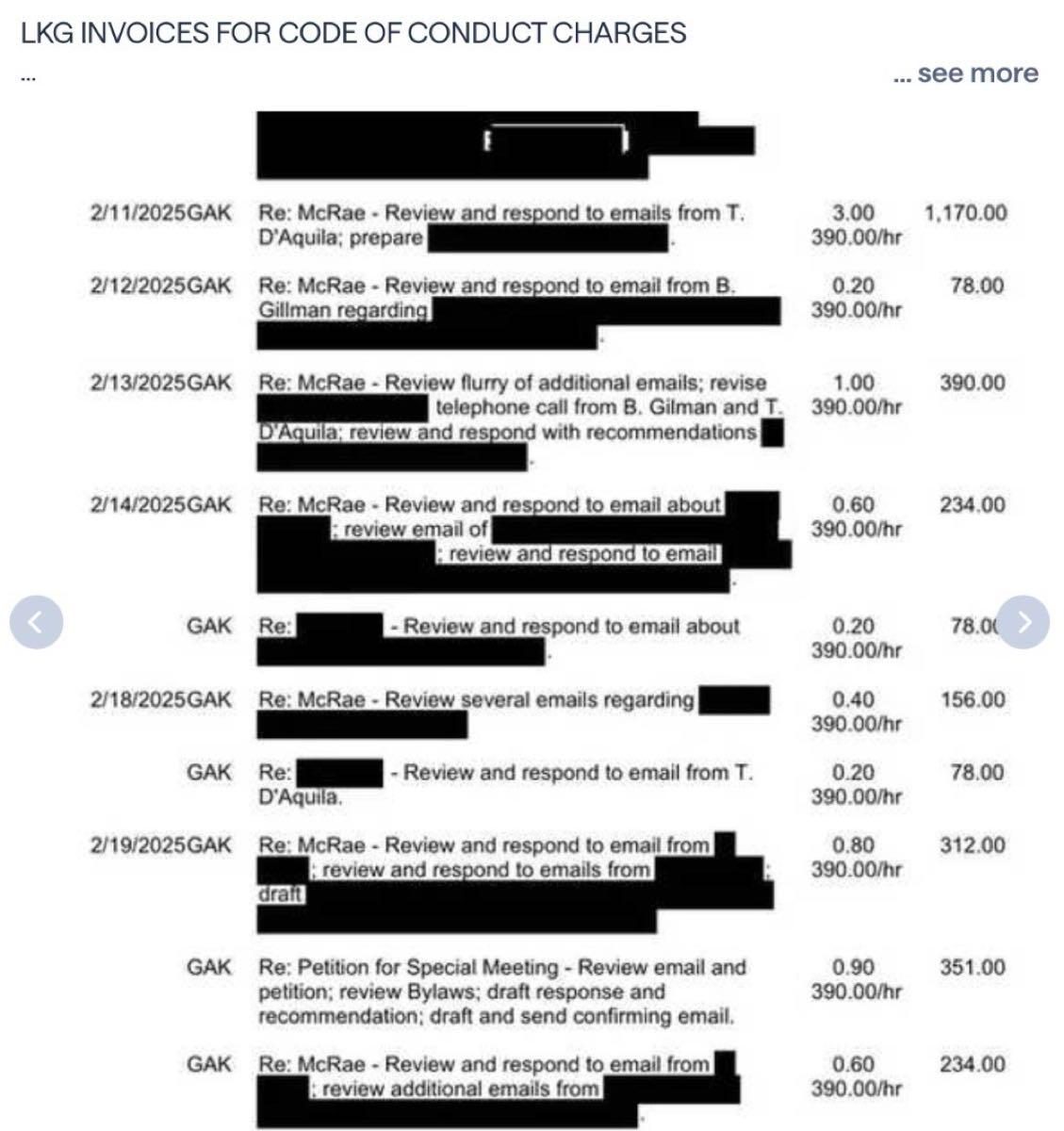
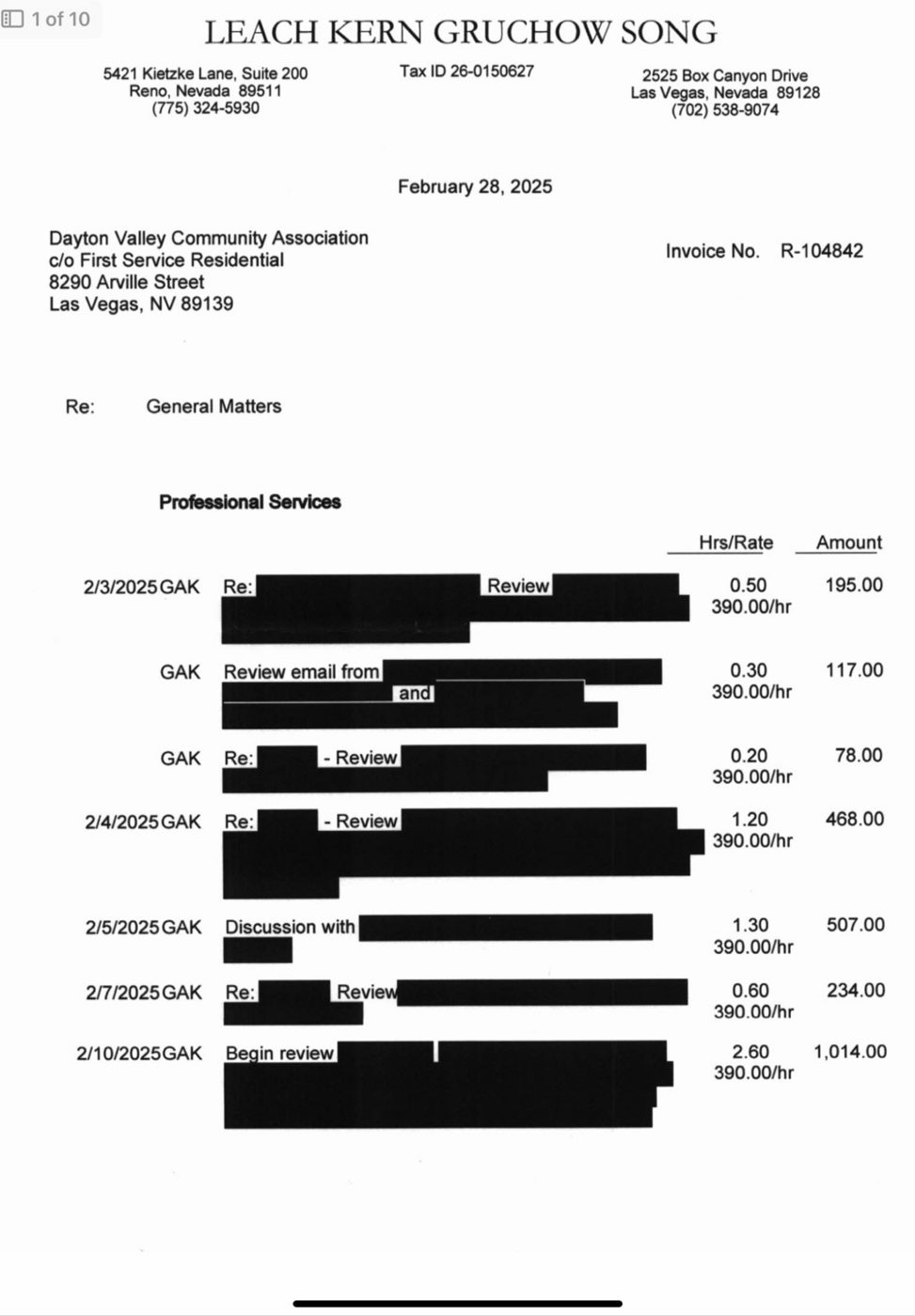
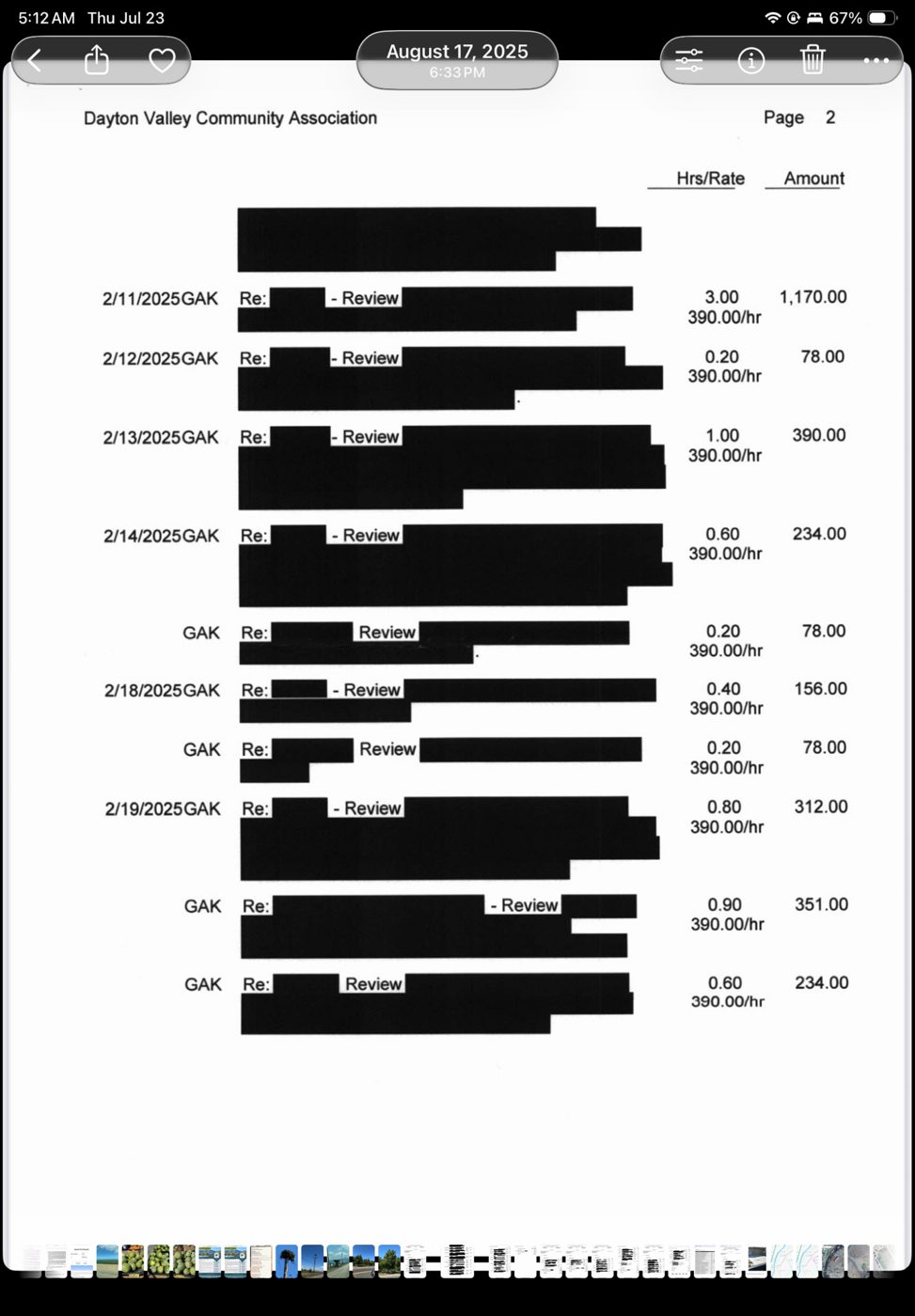
Every time a violation is prepared without basic identifying information, or in a manner that raises avoidable procedural questions, the Association will have to involve legal counsel to answer questions that could have been avoided from the beginning. Those attorney reviews, legal opinions, hearing preparation, and Board discussions are all paid for with homeowners’ assessments. Legal charges $390/hr. (See picture #5 & #6). Note that everything is redacted on the invoice. What is the board hiding?

This isn’t about one garage sale. It’s about good governance.

If the Board is going to enforce the rules, it should do so carefully, consistently, and in a way that minimizes unnecessary legal expense. A complete violation notice with clear evidence protects everyone…the homeowner, the Board, and the Association.

I’ll be asking HOA counsel to review the notice and, if the Board elects not to dismiss it, I’ll request a hearing. I’ll share what I learn so everyone understands how the process works and what our assessments are paying for.

For your edification, I included an older violation letter initiated by property management. Note the date/time stamp and address on the bottom of the photo (See last photo).

How did a deficient violation letter get sent with errant dates and lack of proof? First Service Residential Property Management. Our contract stipulates “no provisional managers” but the board, last year, allowed a junior property manager to oversee our community. It seems the violation was submitted without dates and our PM had to make something up. So… they used the date of submission as the date of violation. This, and the 1-year habitual clause, is why photos must be dated stamped.

Photo from the postPhoto from the postPhoto from the postPhoto from the postPhoto from the postPhoto from the postPhoto from the post

July 21, 2026 at 5:08 AM · Shared with: your neighborhood

Garage Sales - Variances.

For years, homeowners have been told that “garage sales are not allowed under any circumstances.”

That statement is simply not supported by the CC&Rs.

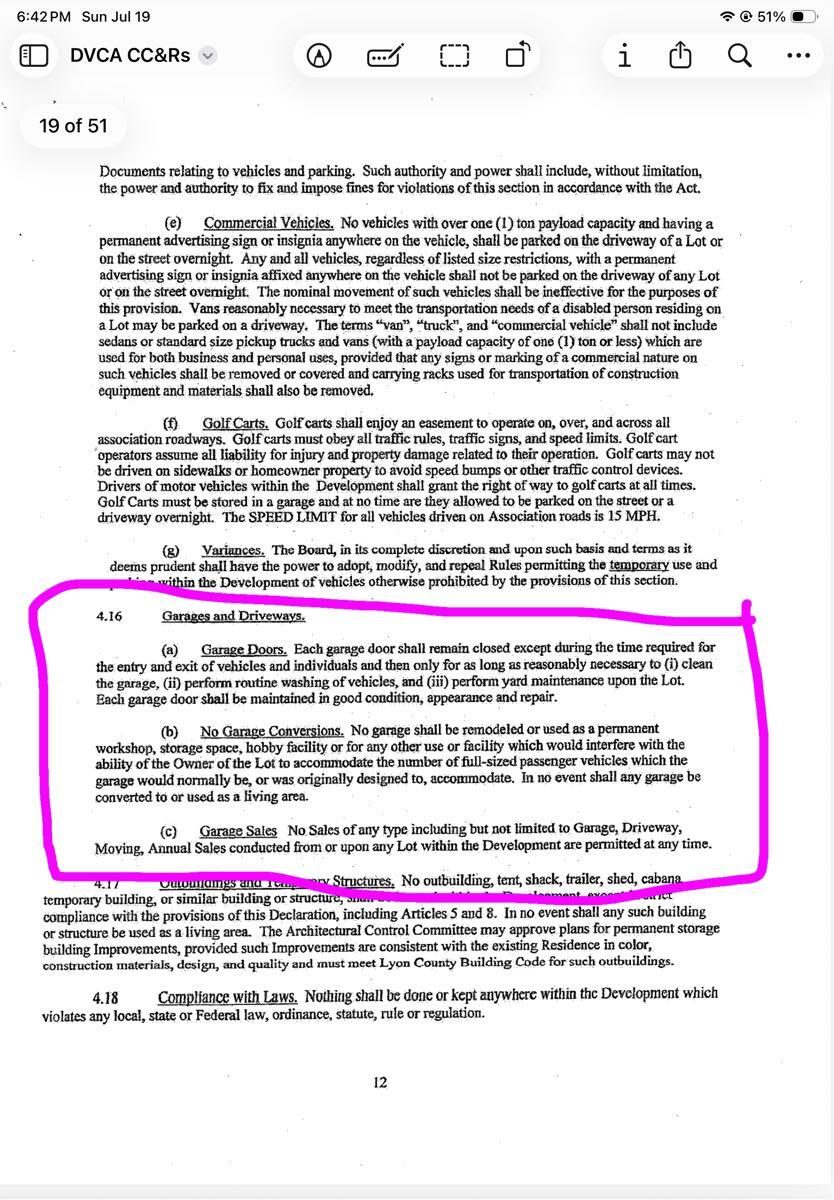
Yes, Article 4.16(c) prohibits garage sales. Nobody disputes that. (See attached picture)

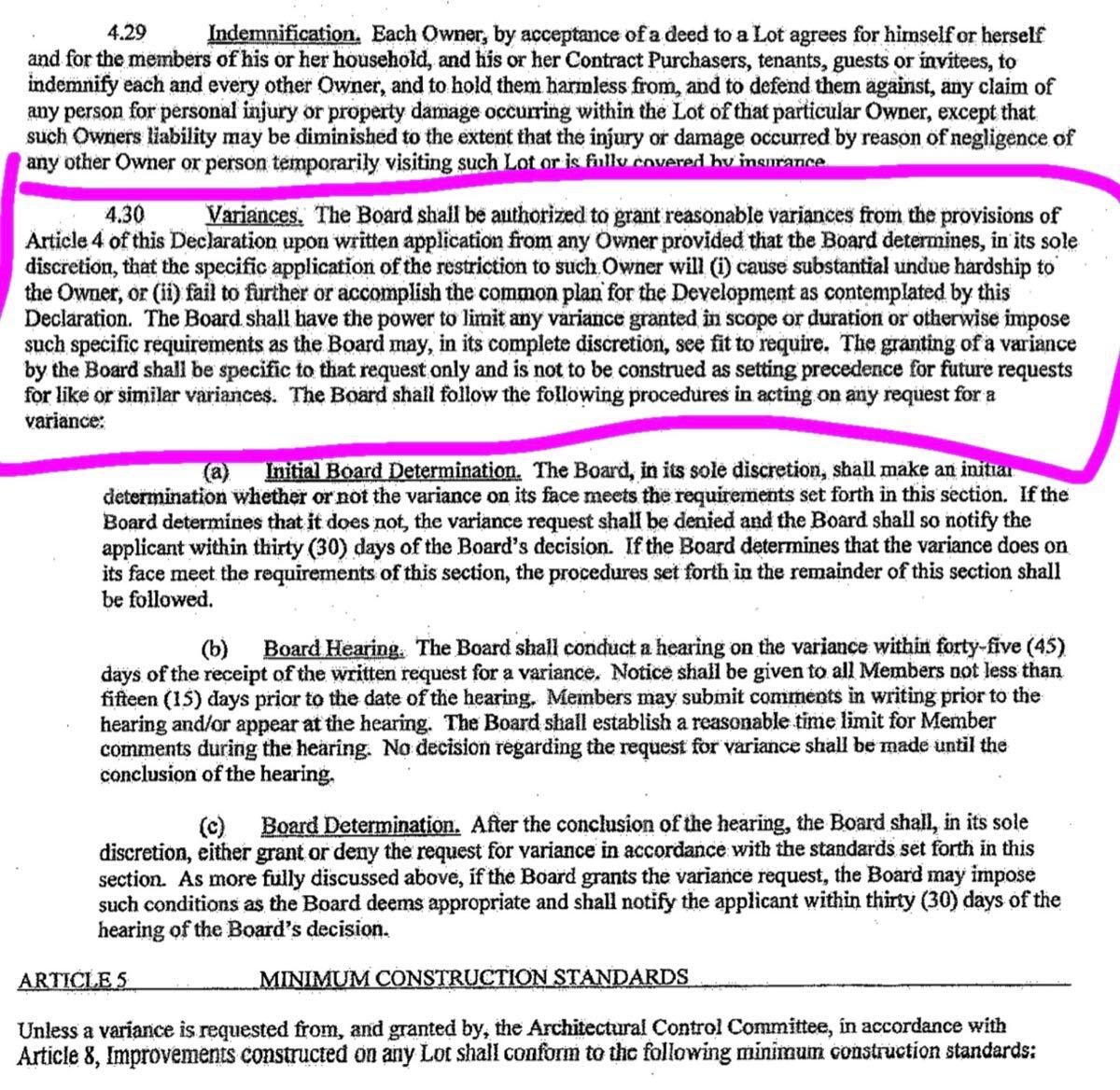
What the Board conveniently leaves out is Article 4.30. (See attached picture)

Article 4.30 expressly authorizes the Board to grant reasonable variances from the provisions of Article 4. Since the garage sale prohibition is found in Article 4.16, it is one of the restrictions the Board has the authority to waive.

The CC&Rs state:

“The Board shall be authorized to grant reasonable variances from the provisions of Article 4…”

The Board may grant those variances whenever it determines that strict enforcement either creates an undue hardship or fails to further the common plan of the development. It may also limit the variance in duration, scope, or impose any conditions it chooses.

In plain English, the Board already has the authority to approve a one-day garage sale, a community-wide garage sale weekend, or another limited exception. The Board doesn’t need to rewrite the CC&Rs to do that.

So why are homeowners repeatedly told that garage sales are prohibited “under any circumstances”?

That statement omits one very important fact: the Board itself has been given the power to make exceptions.

Homeowners deserved to know that before the Association spent well into five figures on attorneys attempting to amend the CC&Rs to permit garage sales.

The Board could have simply said:

“We have the authority to grant variances, but we have chosen not to.”

That would have been an honest policy decision.

Instead, homeowners were told there were no exceptions, even though the governing documents contain an entire section titled “Variances” authorizing exceptions to Article 4.

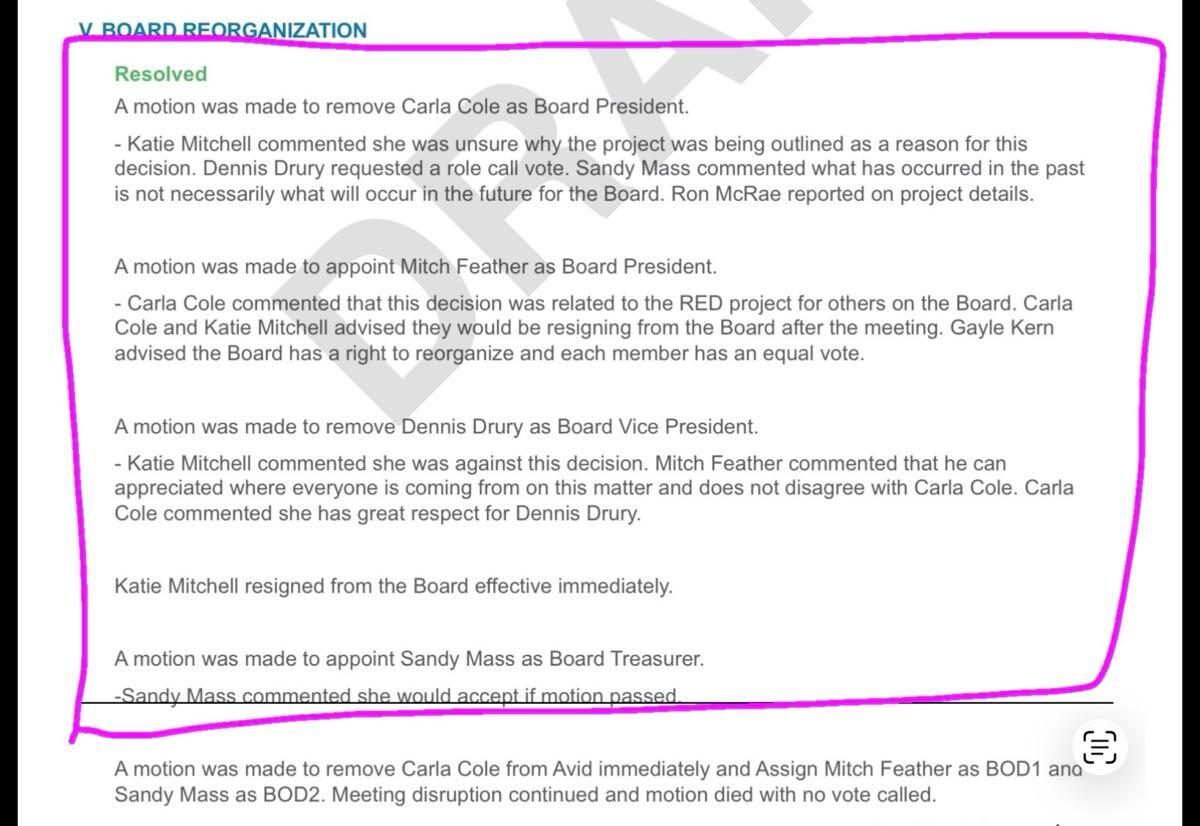
Whether that omission was intentional or simply the result of not reading the CC&Rs carefully, the effect is the same: homeowners were not given the complete story. This prohibition comes from one person: the president of the HOA. The same one we removed years ago due to lack of confidence (see attached picture).

The governing documents speak for themselves.

Article 4.16 prohibits garage sales.

Article 4.30 gives the Board the authority to grant variances from Article 4 (see attached picture)

Both statements are true. Telling homeowners only the first while ignoring the second is not full disclosure.

Our president likes to site “misinformation” on Nextdoor. I have ALWAYS provided original documents to prove my assertions. Ask the same from your elected representatives when they push back.

Photo from the postPhoto from the postPhoto from the postPhoto from the post