APPELLATE BRIEFS: ATTORNEY AS AGENT
By: Paul Georgeson, McDonald Carano Wilson LLP
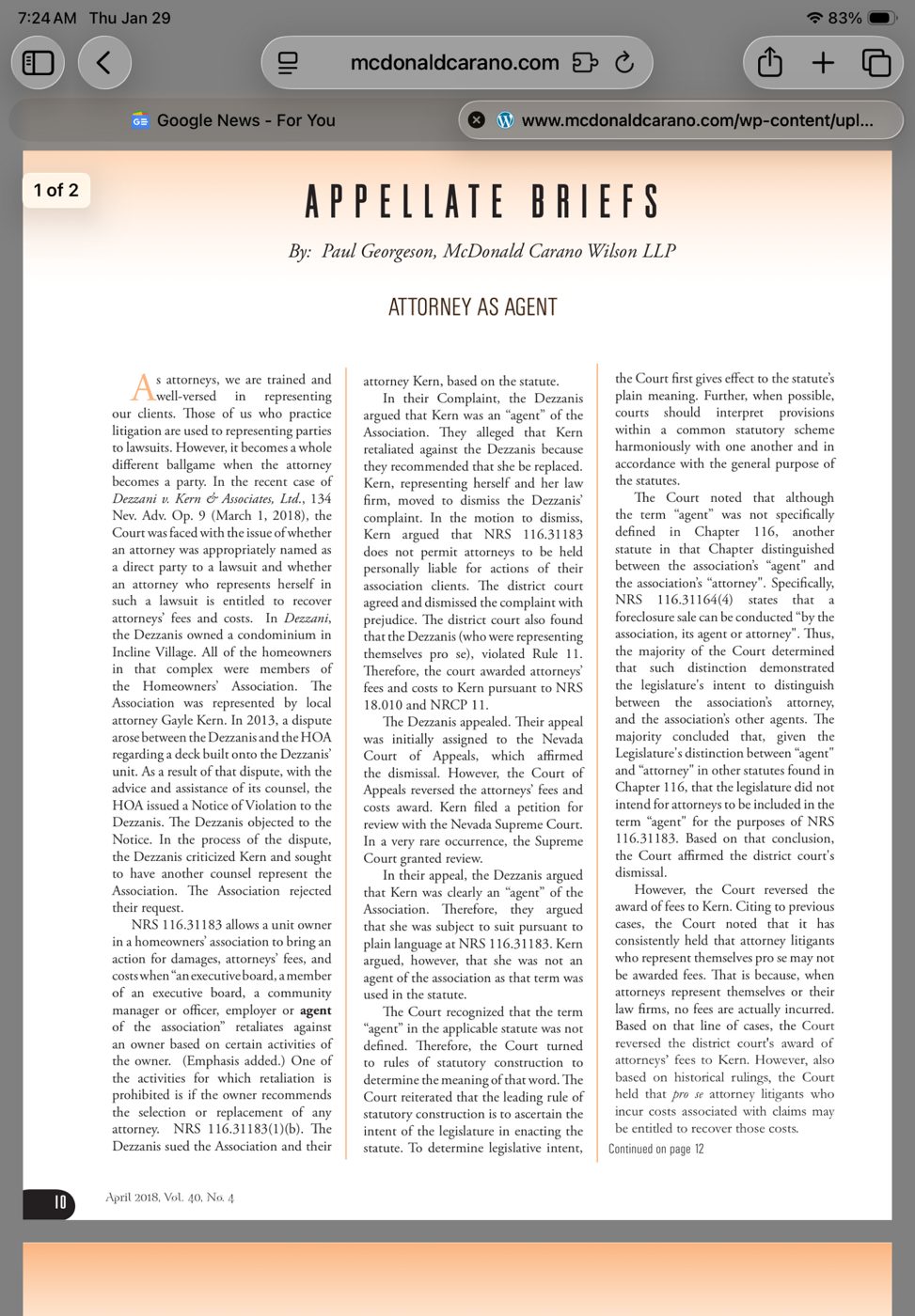
As attorneys, we are trained and well-versed in representing our clients. Those of us who practice litigation are used to representing parties to lawsuits. However, it becomes a whole different ballgame when the attorney becomes a party. In the recent case of Dezzani v. Kern & Associates, Ltd., 134 Nev. Adv. Op. 9 (March 1, 2018), the Court was faced with the issue of whether an attorney was appropriately named as a direct party to a lawsuit and whether an attorney who represents herself in such a lawsuit is entitled to recover attorneys' fees and costs. In Dezzani, the Dezzanis owned a condominium in Incline Village. All of the homeowners in that complex were members of the Homeowners' Association.
The Association was represented by local attorney Gayle Kern. In 2013, a dispute arose between the Dezzanis and the HOA regarding a deck built onto the Dezzanis' unit. As a result of that dispute, with the advice and assistance of its counsel, the HOA issued a Notice of Violation to the Dezzanis. The Dezzanis objected to the Notice. In the process of the dispute, the Dezzanis criticized Kern and sought to have another counsel represent the Association.
The Association rejected their request. NRS 116.31183 allows a unit owner in a homeowners' association to bring an action for damages, attorneys' fees, and costs when "an executive board, a member of an executive board, a community manager or officer, employer or agent of the association" retaliates against an owner based on certain activities of the owner. (Emphasis added.) One of the activities for which retaliation is prohibited is if the owner recommends the selection or replacement of any attorney. NRS 116.31183(1)(b). The Dezzanis sued the Association and their attorney Kern, based on the statute.
In their Complaint, the Dezzanis argued that Kern was an "agent" of the Association. They alleged that Kern retaliated against the Dezzanis because they recommended that she be replaced.
Kern, representing herself and her law firm, moved to dismiss the Dezzanis complaint. In the motion to dismiss, Kern argued that NRS does not permit attorneys to be held personally liable for actions of their association clients. The court agreed and dismissed the complaint with prejudice. The district court also found that the Dezzanis (who were representing themselves pro se), violated Rule 11.
However, the Court reversed the award of fees to Kern. Citing to previous cases, the Court noted that it has consistently held that attorney litigants who represent themselves pro se may not be awarded fees. That is because, when attorneys represent themselves or their law firms, no fees are actually incurred. Based on that line of cases, the Court reversed the district court's award of attorneys' fees to Kern. However, also based on historical rulings, the Court held that prose attorney litigants who incur costs associated with claims may be entitled to recover those costs.
…see pictures for entire story.