Apparently Asking Questions Is Now “Public Shaming”
I’ve noticed an interesting trend lately.
When I post something questioning the actions of the DVCA Board, the post frequently disappears because it has supposedly been reported as “public shaming.”
Apparently, discussing the actions of elected HOA directors in their official capacities is now considered shaming.
So let’s review some of the terrible things I have had the audacity to discuss publicly.
I questioned why the Association was contemplating spending six figures on streetlights on Bayhill and Augusta while two streetlights on Sawgrass have been broken, rotting at the base, and ignored for more than five years.
Public shaming.
I questioned why parking enforcement appears concentrated on certain streets while other streets seemingly receive little or no enforcement.
Public shaming.
I questioned why parking areas originally constructed by the developer are being painted red and removed from use, and I asked Lyon County whether those spaces were required as part of the original development approvals.
Public shaming.
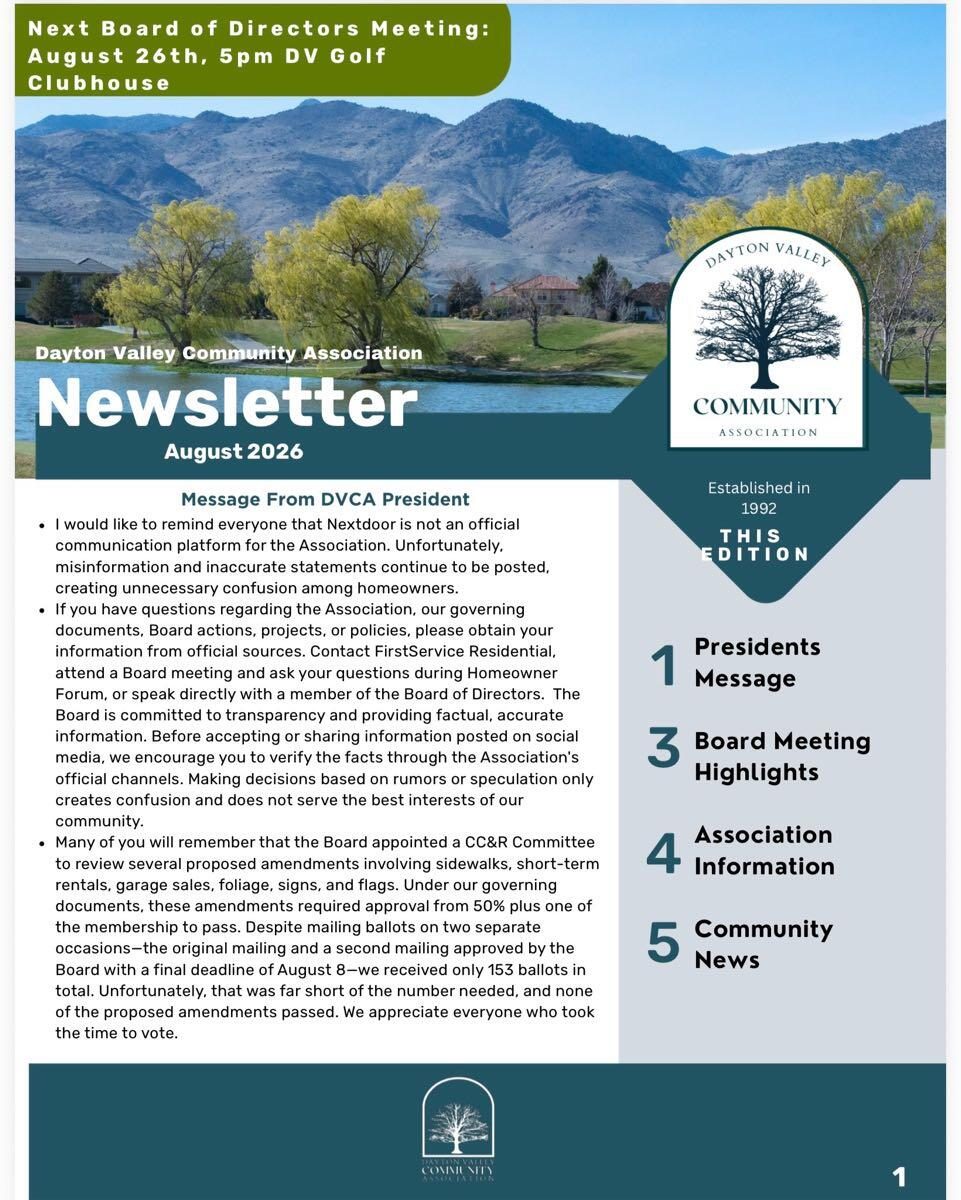
I questioned why the Association spent significant money with legal counsel attempting to rewrite the CC&Rs when everyone knew an amendment required approval from 51% of the entire membership. The effort ultimately produced nowhere near that participation.
Public shaming.
I questioned why we are paying a professional management company while our community has been assigned what FSR calls a “provisional manager,” resulting in basic governance questions repeatedly being sent to attorneys billing hundreds of dollars per hour.
Public shaming.
I questioned why Board member names and contact information disappeared from the newsletter while homeowners were simultaneously being told to get their information from “official sources.”
Public shaming.
I pointed out that homeowners are encouraged to attend Board meetings and ask questions, while Homeowner Forum gives them roughly three minutes and does not require the Board to actually answer those questions.
Public Shaming
I questioned why FSR is sending marketing emails to homeowners for insurance. Who authorized this? Who is getting paid for this? NRS states FSR is the custodian of records. It doesn’t give them access to homeowner emails for marketing services or products.
Public shaming.
And, of course, I have questioned legal spending, enforcement practices, violation procedures, selective enforcement, CC&R interpretations, parking rules, Board conduct, and whether decisions being made actually comply with our governing documents and Nevada law.
Apparently all of that is “public shaming.”
Here is the problem.
Criticism of an elected HOA Board is not inherently public shaming.
Questioning how homeowners’ money is spent is not public shaming.
Naming the directors who vote for, advocate for, or implement a policy is not automatically public shaming.
Asking why one street gets attention while another is ignored is not public shaming.
And pointing to the Association’s own records, meeting statements, newsletters, budgets, governing documents, and correspondence is certainly not public shaming simply because someone finds the resulting discussion uncomfortable.
There is a very simple way for a Board to avoid embarrassing public discussions:
Make defensible decisions.
Explain them.
Apply the rules consistently.
Answer reasonable questions.
Publish the information homeowners need to evaluate what their elected directors are doing.
Transparency is easy when everyone agrees with you. The real test of transparency is how an organization responds when somebody starts asking uncomfortable questions.
Deleting the uncomfortable questions doesn’t answer them.
It just makes the questions more interesting.
And perhaps we should reconsider the phrase “public shaming.”
Public officials should not be personally humiliated or harassed. I agree completely.
But when people voluntarily serve on a Board, exercise authority over 824 homes, spend homeowners’ money, hire attorneys, adopt rules, levy fines, restrict parking, and make decisions affecting everyone in the community, their official actions are legitimate subjects of public discussion.
Accountability occasionally causes embarrassment.
That doesn’t necessarily mean the person asking the question did something wrong.
Sometimes embarrassment is simply what happens when a decision becomes difficult to explain in daylight.
So perhaps the question isn’t:
“Why does Ron keep publicly shaming the Board?”
Perhaps the better question is:
“Why are ordinary questions about Board actions considered so shameful?”